South Carolina Democrats Reveal Millions Spent to Break GOP House Supermajority

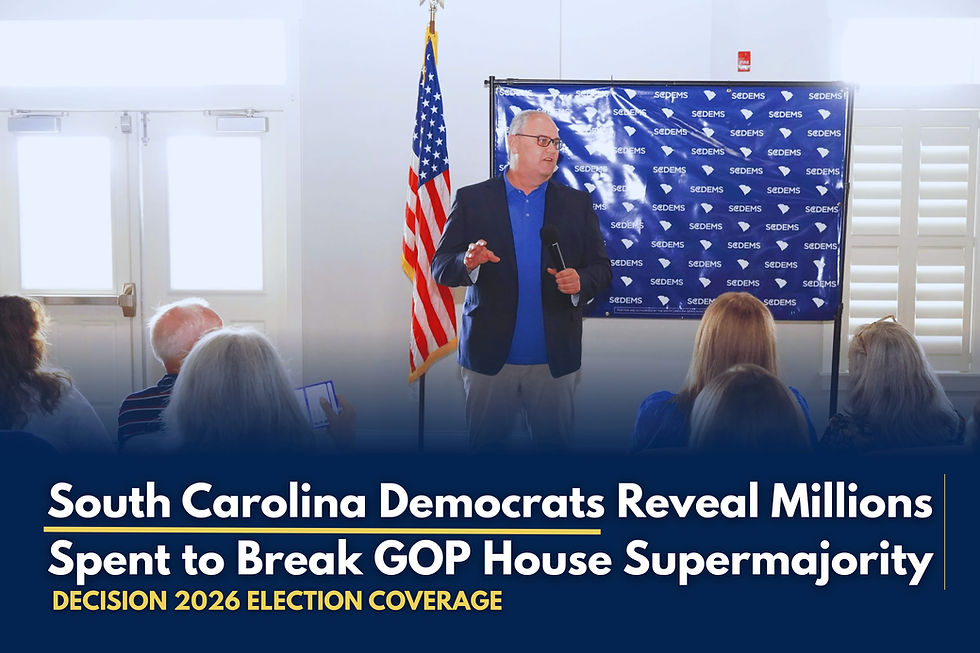
SCDP Chair Christale Spain and Executive Director Jay Parmley disclose nearly $1 million in Statehouse spending, millions more in campaign operations and the organizing behind 10 projected House pickups.
By Javar Juarez | Decision 2026 | November 4, 2026
COLUMBIA, S.C. — The South Carolina Democratic Party is putting numbers behind its historic 2026 election gains. Party leaders disclosed approximately $1 million in spending on Statehouse races, millions more in campaign operations and voter mobilization, and an organizing effort that made roughly 6 million voter-contact attempts.
During a Wednesday afternoon press conference, SCDP Chair Christale Spain and Executive Director Jay Parmley detailed the money, volunteers and campaign strategy behind the party's Flip the Future initiative.
The disclosure came just hours after CUBN published its post-election assessment of Democrat Annie Andrews' U.S. Senate victory, Dr. Jermaine Johnson's gubernatorial defeat and the questions surrounding campaign spending, organizing and the people responsible for delivering Democratic victories.
CUBN had followed the party's organizing work throughout the election. Wednesday's briefing provided the financial figures and operational details needed to examine that work more closely.
The Financial Cost of Breaking the Republican Supermajority
Parmley told reporters the party expects to have spent close to $1 million on Statehouse races alone, an investment Spain described as unprecedented for the organization.
He also reported approximately $1.4 million to $1.5 million in ground operations and coordinated campaign activity, along with another $1 million for get-out-the-vote efforts.
Combined, those estimates represent approximately $3.4 million to $3.5 million across the spending categories Parmley described. The party has not yet released a detailed accounting showing whether any of those categories overlap.
The spending helped support an election in which Democrats reported 10 projected House pickups, exceeding their original goal of seven seats needed to break the Republican two-thirds supermajority.
At least one close House contest remained subject to a recount. Republicans still control the South Carolina House and retain their supermajority in the Senate.
The investment also left the party facing a new financial challenge.
“We spent every dime we could find and couldn't find because we knew that we could win,” Spain told reporters.
She said the party would now need to rebuild its financial reserves while preserving the organizing operation established during the election.
Flip the Future: An Organizing Operation Built Over Time
The party's election strategy did not begin in the final weeks of the campaign.
Spain pointed to the SCDP's Democracy Builders program, which used a neighbor-to-neighbor approach to reach people who do not vote consistently.
The party also developed its On the Road series, bringing national Democratic leaders into rural communities and Republican-leaning areas where Democrats had struggled to compete.
The goal was to reach voters beyond the party's traditional base and bring infrequent Democratic voters into the election.
Parmley said the SCDP recruited Democratic candidates for all 124 South Carolina House districts while concentrating direct resources on approximately 30 competitive races.
He reported the following organizing activity:
More than 3,500 volunteer shifts since June.
Approximately 6 million voter-contact attempts through telephone calls and in-person outreach.
796,323 calls or door-knocking contacts during early voting.
Approximately 750 volunteers worked during the final two weeks.
Direct organizing and campaign assistance focused on approximately 30 House districts.
The early-voting contacts and final two weeks of volunteer activity were part of the larger operation, not separate totals to be added to the overall figures.
The party's numbers also do not include all the work conducted independently by individual candidate campaigns.
Parmley described an operation that combined paid digital advertising, direct mail, telephone outreach, door-to-door canvassing and voter mobilization.
Spain said the party deliberately targeted infrequent Democratic voters rather than concentrating all its resources on people already expected to vote.
The SCDP also worked with county Democratic organizations across South Carolina as part of its statewide strategy.
CUBN Documented the Organizing Before Election Day
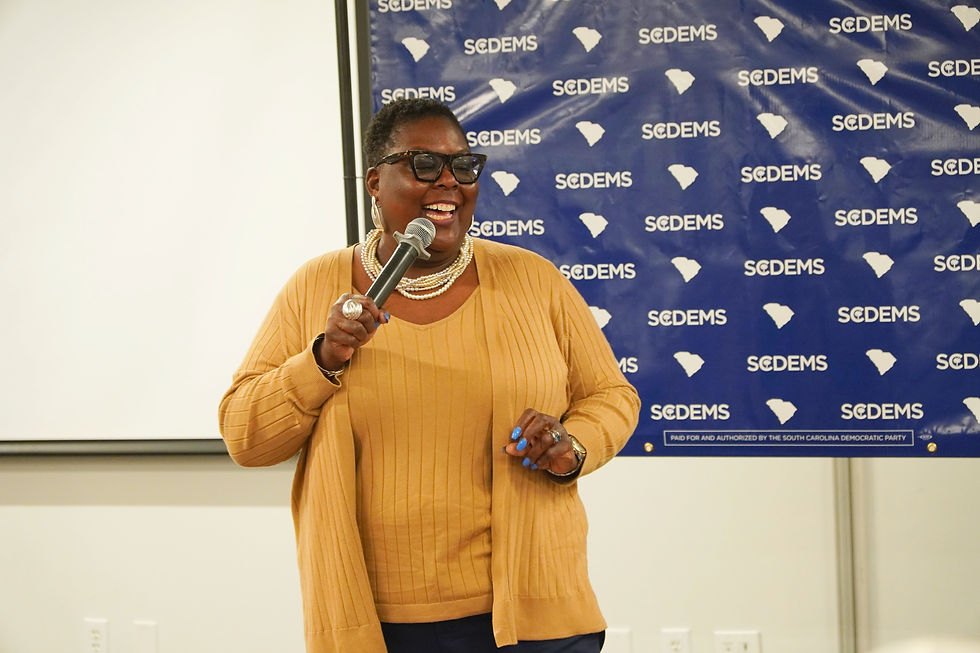
The Columbia Urban Broadcast Network followed the SCDP's organizing activity throughout the election cycle, reporting from political gatherings, leadership visits and community events connected to the party's effort to expand Democratic participation.
The party's On the Road effort brought national political figures into South Carolina, including Gov. Gavin Newsom, Gov. J.B. Pritzker, Sen. Cory Booker and Rep. Ro Khanna.

CUBN also reported on the political and educational discussions surrounding these visits, including the Claflin University forum in Orangeburg featuring former Chicago Mayor and White House Chief of Staff Rahm Emanuel.
Those events were visible parts of a much larger campaign operation.
Wednesday's disclosures supplied the numbers behind the public appearances: millions of voter-contact attempts, thousands of volunteer shifts and substantial spending on legislative races.
House Democrats Report More Votes Statewide Despite Republican Majority
Parmley reported that Democratic candidates across South Carolina's House districts collectively received approximately 989,000 votes, compared with roughly 973,000 for Republican candidates.
Those figures represent combined votes cast in individual House races, not a single statewide election. Republicans still won enough districts to retain control of the chamber.
Parmley also identified 19 additional House contests in which Democratic candidates received approximately 45% to 49.9% of the vote.
Another 18 races produced Democratic vote shares between 40% and 45%, according to the party's preliminary analysis.
The party described its 10 projected House pickups as its largest single net gain in modern South Carolina House election history.
Spain also credited Dr. Jermaine Johnson's gubernatorial campaign with helping build statewide voter participation.
Johnson lost to Republican Alan Wilson, but Parmley reported that his performance was approximately 4.64% better than the historical average for Democratic gubernatorial candidates, according to the party's analysis.
Spain defended Johnson's campaign and rejected suggestions that he had not received support from the state party.
The SCDP has not completed its review of ticket splitting, turnout and the differences between individual candidates' election results.
National Support Came, but Not at the Scale Seen in Neighboring States
The press conference also addressed how much financial support South Carolina Democrats received from national political organizations.
Parmley reported that the Democratic Senatorial Campaign Committee provided approximately $500,000 for advertising during the final week of the election.
He also identified approximately $22,000 per month in support from the Democratic National Committee.
Spain credited national figures, including Gavin Newsom, Cory Booker and Ro Khanna, with supporting the party's work.
But leadership said South Carolina had not received the same sustained national investment directed toward Democratic campaigns in neighboring Georgia and North Carolina.
Parmley drew a distinction between national organizations purchasing political advertising and money available to a state party for its own organizing operations.
Outside advertising can support candidates, but it does not necessarily pay for permanent organizers, voter-contact programs or the year-round infrastructure needed to compete in future elections.
The SCDP's position was not that national organizations provided no assistance. Its leaders said the state had delivered major election gains without the same long-term financial backing available elsewhere.
CUBN Questions Leadership About National Political Power
During Wednesday's press conference, CUBN questioned Spain about what South Carolina's election results should mean for the state's influence within the national Democratic Party.
South Carolina holds first-in-the-nation status in the Democratic presidential primary calendar. With Democrats now pointing to major election gains, CUBN asked how the state could secure greater influence over national political strategy, leadership appointments and investment decisions.
The question was whether South Carolina could become a place where national political decisions are made, rather than simply a state where presidential campaigns come to collect votes.
Spain acknowledged the opportunity but said the party was still assessing how to turn its election results into greater national influence.
CUBN also asked Parmley what the party would build if it had an additional $10 million and what opportunities had been missed because that level of funding was unavailable.
Parmley's answer focused on permanent organizing.
He said the party would invest in maintaining regular contact with voters through door-to-door conversations, telephone calls and community engagement throughout the year.
That approach would allow the SCDP to build relationships between elections rather than repeatedly starting new voter-contact operations when campaigns begin.
Black Voter Participation Remains Central to the Results
Spain credited Black voters as a major part of the Democratic turnout operation.
Parmley reported that Black voters accounted for approximately 29% of early ballots, according to the party's preliminary analysis.
He cautioned that complete Election Day demographic data was not yet available.
The party also acknowledged that individual campaigns made their own advertising and outreach decisions, even while participating in a coordinated statewide effort.
Parmley defended Johnson's use of radio and digital advertising, explaining that campaigns must decide how best to reach their voters.
Those explanations are relevant to CUBN's continuing examination of the differences between Andrews' Senate victory and Johnson's gubernatorial defeat.
CUBN's earlier assessment documented substantial differences in the two Democratic candidates' vote totals across all 46 counties.
The Financial Challenge Ahead
South Carolina Democrats now face the challenge of keeping their organizing operation in place after spending heavily to compete in 2026.
Parmley said the party was already examining approximately 25 to 26 House districts for possible investment in 2028.
South Carolina's first-in-the-nation Democratic presidential primary status could also bring new attention, fundraising opportunities and national political activity to the state.
Whether that attention produces long-term financial support remains unanswered.
The party's Wednesday disclosure provided a clearer picture of what its 2026 operation cost and how it worked.
CUBN's post-election assessment raised questions about the resources and organizing behind the results. Within hours, party leadership publicly provided spending estimates, voter-contact figures and explanations of its campaign strategy.
Those figures help clear up part of the election record.
Democratic victories were not the work of any one candidate, consultant or national political figure. They involved individual campaigns, local volunteers, county organizations, national partners and a state party that invested heavily in reaching voters across South Carolina.
The SCDP has now placed much of that work and its estimated cost on the public record.
The next step is to compare those figures with final campaign finance reports, certified election returns and complete voter-participation data.
For now, the party's disclosure establishes one important fact: South Carolina Democrats did not enter the 2026 election without a major organizing operation.
They built one, spent millions supporting it and are now facing the cost of keeping it alive.

Javar Juarez is Publisher and Editor-in-Chief of the Columbia Urban Broadcast Network (CUBN), an independent investigative news outlet based in Columbia, South Carolina, and a member of the South Carolina Press Association.


