Pritzker Warns of Election Interference, Calls for Hegseth’s Impeachment During South Carolina Visit


Illinois Gov. JB Pritzker brought his criticism of the Trump administration to Columbia, warning that federal immigration enforcement could threaten voter participation in November. Speaking directly with the New Progressive Journal, he also questioned American military readiness and called for Defense Secretary Pete Hegseth’s impeachment.
By Javar Juarez | New Progressive Journal | October 11, 2026
Columbia, S.C. - Illinois Gov. JB Pritzker arrived in South Carolina Saturday with a warning about the November 3 midterm elections and a message for Democrats: confronting President Donald Trump requires more than political rhetoric.
Pritzker's visit was part of a growing effort by prominent national Democrats to strengthen the party's presence in South Carolina.
Despite severe weather associated with a passing hurricane, supporters gathered at the Girl Scouts Leadership Center and later at Prince Hall Lodge for the South Carolina NAACP’s “We the People” conference dinner.
At the Democratic event, Pritzker addressed economic inequality, voting rights and the direction of his party. Before the NAACP, he spoke about his family's civil rights history and the responsibility of elected officials to defend constitutional protections.
But during an exchange with reporters, the governor delivered some of his strongest criticism of the Trump administration, calling for Defense Secretary Pete Hegseth's impeachment and warning that federal immigration enforcement could become a tool of voter intimidation.
Pritzker Calls for Hegseth's Impeachment

Speaking with the New Progressive Journal, Pritzker was questioned about military readiness, deteriorating relationships with international allies and concerns surrounding Hegseth's leadership.
His response was unequivocal.
"Secretary Hegseth ought to be impeached," Pritzker said.
The governor accused Hegseth of weakening America's military position through the expenditure of critical munitions during the conflict with Iran. He also questioned the administration's shifting explanations for its military operations.
"He's put the United States at risk," Pritzker said.
Pritzker, who spoke about his family's military background, emphasized the importance of maintaining a strong national defense while retaining experienced service members.
He recalled meeting a Navy veteran in Clarendon County whose daughter, according to the governor, planned to leave military service after 15 years rather than complete a 20-year career.
The exchange also raised concerns about Sen. Chris Murphy's reported difficulties accessing a military installation affected by the conflict with Iran. Pritzker concentrated his response on Hegseth's leadership, military personnel retention and the administration's conduct of the war.
His remarks placed national security alongside voting rights as a central concern in his criticism of the administration.
Could Trump's Chicago Crime Narrative Justify Election Interference?

The New Progressive Journal also questioned Pritzker about Trump's repeated characterization of Chicago as a city overwhelmed by violent crime, despite declining homicide figures.
The question addressed whether the administration could use public safety claims to justify expanded federal enforcement operations, including activity near polling locations during the November elections.
Pritzker rejected Trump's characterization of Chicago, citing what he described as a 61-year low in homicides and pointing to investments in public safety and law enforcement.
He then turned to federal immigration operations in Illinois.
Pritzker described heavily armed, masked federal immigration agents moving through Chicago neighborhoods, accusing ICE and Customs and Border Protection of employing intimidating and aggressive tactics that threatened the safety and constitutional rights of American citizens and immigrant communities alike.
Pritzker also challenged the suggestion that opposing those tactics amounted to opposing immigration enforcement.
"I think if you committed a violent crime and you're undocumented, you should be taken out of this country," he said.
He maintained that individuals accused of violent offenses should face prosecution and, when convicted, serve their sentences before deportation.
His distinction was clear: enforcing immigration law does not require abandoning due process or constitutional protections.
Pritzker expressed concern that federal immigration operations could expand into states with consequential elections, specifically naming South Carolina, North Carolina, Texas, Alaska and Ohio.
He said Democratic governors and attorneys general were preparing legal responses and discussing measures to protect voters from intimidation.
For South Carolina, the warning carried particular significance. The governor was not simply discussing immigration policy in Illinois. He was raising questions about the federal government's presence in communities where voters will soon decide the balance of power in Congress.
Voting Rights and Trump's Legislative Pressure Campaign
Pritzker repeatedly described the November midterms as a defining test for American democracy.
At the Girl Scouts Leadership Center, he urged Democrats to confront Republican policies more aggressively and criticized members of his own party for failing to respond forcefully enough.
"We're not fighting hard enough," he told supporters.
He divided Democratic leadership into two camps: "Team Fight" and "Team Cave."
His warning came amid an ongoing national dispute over the SAVE America Act, legislation that would impose additional citizenship-documentation requirements on voter registration and identification requirements for voting.
Trump also used bipartisan housing legislation as leverage in that dispute.
In June, the president refused to sign the 21st Century ROAD to Housing Act, explicitly linking his refusal to the Senate's failure to pass the SAVE America Act. The housing measure ultimately became law without his signature on July 11.
The administration's efforts to impose new restrictions on mail voting also encountered judicial resistance. On September 14, the Supreme Court declined to lift an injunction blocking challenged Postal Service restrictions ahead of the November elections.
Those developments formed the national backdrop to Pritzker's warning that states must be prepared to defend election administration and voters' access to the ballot.
The governor urged Democrats to focus not only on winning elections but also on protecting the institutions responsible for conducting them.
Black Women, Wages and Economic Justice

Economic inequality was another major theme of Pritzker's visit.
The governor criticized South Carolina's $7.25 minimum wage, arguing that working families cannot reasonably support themselves on earnings that have remained unchanged at the federal level since 2009.
He contrasted South Carolina's position with Illinois, where his administration increased the minimum wage to $15 an hour.
Pritzker said the increase delivered higher wages to approximately 1.4 million workers and helped lift 700,000 Illinois residents out of poverty.
He placed particular emphasis on Black women, who are disproportionately represented in low-wage occupations and often shoulder significant financial responsibilities within their households.
Recalling the signing of Illinois' minimum wage legislation, Pritzker described standing alongside working women, including Black women, whose families would benefit directly from higher earnings.
His remarks highlighted a persistent divide between the two states.
While Illinois has adopted a higher minimum wage and expanded several worker protections, South Carolina continues to rely on the federal minimum. Efforts to establish a higher state wage have repeatedly failed to advance through the Republican-controlled General Assembly.
Pritzker also discussed investments in childcare, early childhood education, paid leave and maternal health.
At the NAACP gathering, he highlighted Illinois' Birth Equity Initiative and efforts to reduce racial disparities in maternal mortality.
For the governor, wages, healthcare and civil rights were not separate political concerns. He presented them as interconnected responsibilities of government, particularly when policies disproportionately affect Black women and working families.
A Civil Rights Legacy Rooted in His Family

Pritzker's appearance before the South Carolina NAACP offered a more personal account of the experiences that shaped his political career.
The governor, a longtime NAACP member, spoke about his mother, whose civil rights activism during the 1960s and 1970s introduced him to political organizing.
He recalled accompanying her to demonstrations, attending meetings and helping prepare campaign materials.
His mother died when he was 17, but Pritzker credited her commitment to civil rights with influencing his understanding of public service.
He also reflected on his early political work with former North Carolina Gov. Terry Sanford and the lessons he drew from Sanford's approach to desegregation and racial equality.
Speaking to the South Carolina audience, Pritzker recognized the contributions of civil rights leaders Septima Clark and I. DeQuincey Newman, along with generations of organizers who challenged segregation and fought to expand political participation.
He urged Congress to pass the John R. Lewis Voting Rights Advancement Act and warned against efforts to diminish the nation's history of slavery and racial discrimination.
His remarks connected the civil rights struggles of previous generations to contemporary disputes over voting access, education and federal authority.
Despite his criticism of the country's political direction, Pritzker described himself as an optimist, arguing that American history demonstrates the power of ordinary people to challenge injustice and change government.
South Carolina Democrats Prepare for November
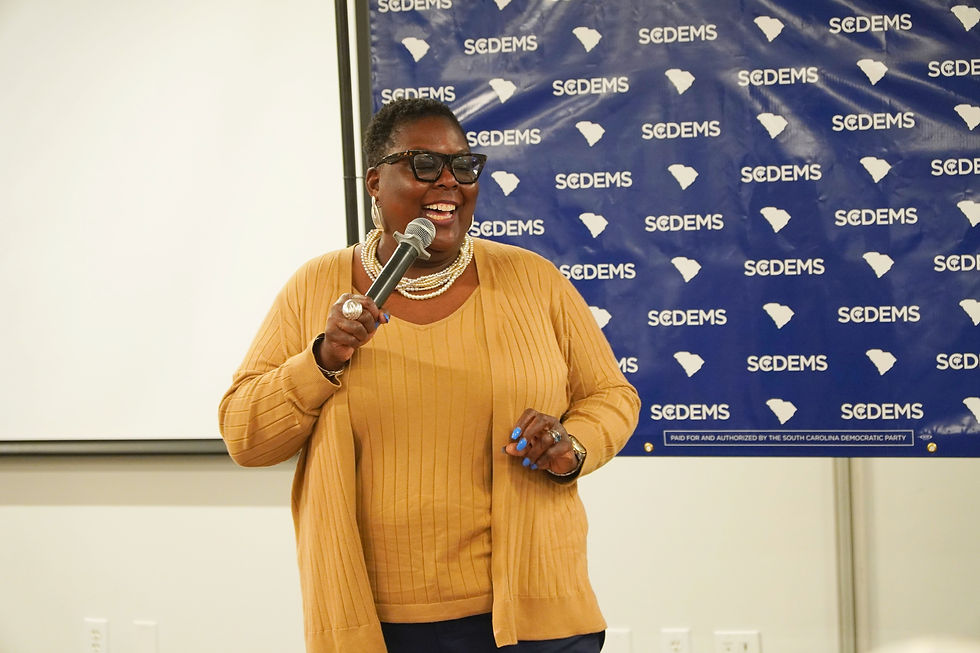
South Carolina Democratic Party Chair Christale Spain welcomed Pritzker to Columbia as the party continued its efforts to compete in legislative districts long controlled by Republicans.
Spain said Democrats had recruited 124 candidates for state House races, emphasizing the party's intention to expand its presence across South Carolina.
Democratic gubernatorial nominee Dr. Jermaine Johnson also addressed the gathering, encouraging supporters to participate in early voting beginning October 19.

Pritzker endorsed Johnson and argued that electing Democratic governors would strengthen the party's ability to challenge federal policies and advance its priorities at the state level.
The Illinois governor acknowledged the difficulties Democrats face in Republican-dominated states but maintained that voters across political affiliations share concerns about wages, housing, healthcare and economic opportunity.
He also challenged Democrats to communicate more effectively with working-class voters, including those who have supported Trump.
Rather than dismissing those voters, Pritzker encouraged his party to engage them on the economic pressures affecting their families.
His message reflected a broader argument throughout the evening: Democrats must demonstrate how their policies improve people's lives rather than relying exclusively on opposition to Trump.
What About 2028?
Pritzker's appearance also raised questions about his national political ambitions.
Asked whether he was considering a presidential campaign in 2028, the governor neither announced a candidacy nor ruled one out.
Instead, he redirected attention to his reelection campaign in Illinois, the November midterms and his efforts to support Democratic candidates nationwide.
His answer left the question of 2028 unresolved.
For now, Pritzker's political attention remains focused on the immediate contests that will determine control of Congress and shape the final two years of Trump's presidency.
A Warning Beyond the Campaign Trail

Pritzker's visit brought together several issues confronting voters ahead of November: economic security, military readiness, immigration enforcement and the protection of voting rights.
His criticism of Hegseth extended beyond partisan disagreement to questions about the nation's military resources and strategic position. His concerns about immigration enforcement raised the possibility that federal operations could affect Americans attempting to exercise their constitutional right to vote.
And his discussion of wages and civil rights challenged South Carolina lawmakers to consider how state policy shapes the economic opportunities available to working families.
The governor's remarks also placed South Carolina within a larger national struggle over the relationship between federal authority and the rights of individual states.
That struggle is particularly consequential in a state where generations of civil rights organizers fought to secure access to the ballot.
As the November 3 elections approach, Pritzker's message was unmistakable: political participation alone is not enough. Protecting the democratic process requires elected officials, state governments and voters to defend the institutions that make participation possible.
For South Carolina, those questions will extend well beyond Election Day.

Javar Juarez is Publisher and Editor-in-Chief of the Columbia Urban Broadcast Network (CUBN), an independent investigative news outlet based in Columbia, South Carolina, and a member of the South Carolina Press Association. He is also President of the Capital City Chapter of the A. Philip Randolph Institute.