“FREEDOM IS THE PRESENCE OF ECONOMIC POWER”


By Javar Juarez | New Progressive Journal | October 5, 2026
Winnsboro, S.C. — Congressman Ro Khanna represents a congressional district almost synonymous with American wealth.
Silicon Valley sits within it. Google, Apple, Nvidia and some of the most powerful technology companies on Earth operate there.
Khanna told a gathering at the Fairfield Career & Technology Center that roughly one-third of the nation’s wealth is concentrated within a 50-mile radius of his district.
But standing before residents in rural South Carolina, Khanna was not there to celebrate that extraordinary accumulation of wealth.
He was there to question it.
“You cannot have a country with that kind of wealth concentration in the hands of a few when it’s not working for so many others,” Khanna told the room.
“That just is not a way to build a nation.”
What followed was less a traditional political stump speech than a history lesson about America’s unfinished struggle for economic freedom.
Today, Americans are struggling to afford even the basic necessities as the cost of groceries, medicine, rent and other everyday expenses continues to climb, putting once-routine purchases increasingly out of reach for families across the country.
Khanna moved between Silicon Valley and the Black South, between abandoned industrial communities and modern technological wealth, and between the politics of the moment and an older economic vision articulated by A. Philip Randolph, Bayard Rustin and Dr. Martin Luther King Jr.
At the center of that argument was a remarkably simple proposition:
Freedom from oppression is not enough.
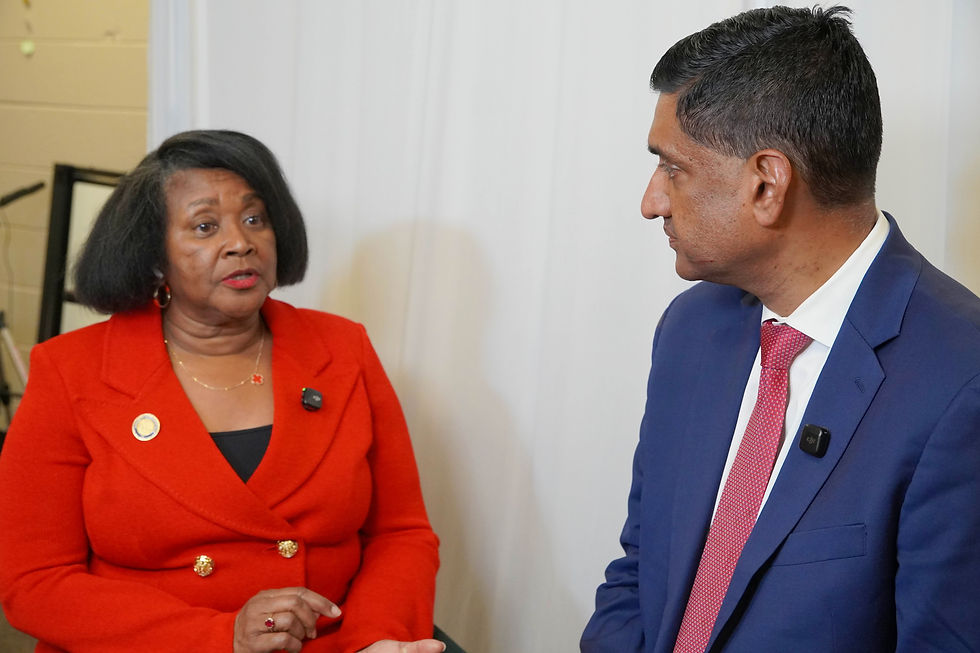
“Freedom is not just the absence of oppression,” Khanna later told New Progressive Journal during a conversation with South Carolina Rep. Annie E. McDaniel.
“Freedom is the presence of economic power, economic independence.”
For those familiar with the legacy of Asa Philip Randolph, the argument was strikingly familiar.
THE UNFINISHED ECONOMIC MOVEMENT

More than six decades after the March on Washington, Americans largely remember the gathering through the soaring words of King’s “I Have a Dream” speech.
But that is not the march’s full name.
It was the March on Washington for Jobs and Freedom.
Randolph and Rustin understood that civil rights without access to jobs, capital and economic security could leave Black Americans legally free while remaining economically marginalized.
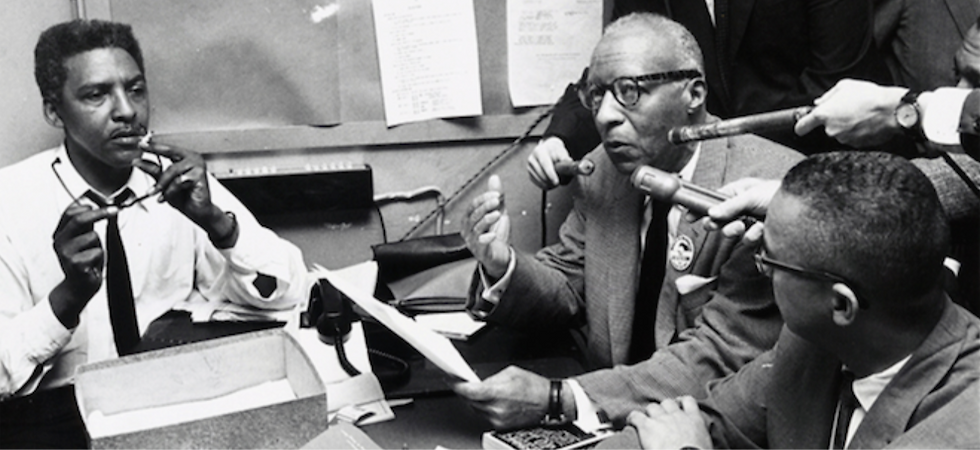
Rustin was central to translating that vision into political strategy. As the principal organizer of the 1963 March on Washington, he helped build a movement whose demands extended beyond desegregation to jobs and economic opportunity.
That work did not end with the march.
Randolph and Rustin later advanced the Freedom Budget, an ambitious national economic program aimed at eliminating poverty and extending economic security across racial lines.

For them, winning civil rights under the law was inseparable from building the economic conditions necessary to exercise those rights in everyday life.
“A community is democratic only when the humblest and weakest person can enjoy the highest civil, economic and social rights that the biggest and most powerful possess.” - A. Philip Randolph
Khanna reached directly into that history in Fairfield County.
He invoked Franklin D. Roosevelt’s Four Freedoms, including “freedom from want,” and connected that principle to Randolph, Rustin and King and their subsequent push for an economic program capable of extending the gains of the Civil Rights Movement into American households.
“A. Philip Randolph and Bayard Rustin and Dr. King were inspired by FDR,” Khanna said. “They came up with the Freedom Budget, and they said that for freedom we need economic empowerment.”
Then came his indictment of his own party.
“The Democratic Party has not delivered for a lot of people when it comes to actual economic dignity and economic empowerment that Randolph and King were talking about.”
That acknowledgment matters in places like Fairfield County.
Across rural South Carolina, political promises can collide with a much harsher economic reality: young people leave home looking for opportunity elsewhere, communities struggle to retain workers and institutions, and economic development does not always translate into locally held wealth.
McDaniel brought that reality directly into her conversation with Khanna.
She described rural communities where young people graduate and leave, where communities struggle to find firefighters and nurses and where hospitals are closing.
The question, she suggested, is not simply how to attract development but how communities can retain wealth after it arrives.
Khanna offered a phrase for it.
“Hometown wealth.”
It may have been one of the simplest descriptions of the challenge discussed all evening.
WHO GETS TO PARTICIPATE IN AMERICA’S WEALTH?

Khanna’s economic argument was not that everyone needs to become extraordinarily rich.
It was that ordinary Americans should possess enough economic independence to control the direction of their own lives.
“All the money is being made, but it’s in the hands of a few,” he said.
What Americans want, Khanna continued, is “a decent life.”
They want economic independence and economic power.
His prescriptions were expansive.
Khanna called for a 5 percent tax on billionaires, Medicare for All, free childcare, fully funded public schools, a federal jobs program for young adults and a housing initiative that could provide zero-down-payment, low-interest loans to workers who meet eligibility requirements.
But in Fairfield County, the larger question was not simply what Washington could give rural America.
It was what rural America could build if it finally had access to capital.

Khanna pointed to the young people he had encountered in South Carolina with technological talent and ambition but without the family networks or financial relationships that routinely open doors in Silicon Valley.
At Claflin University, he recalled meeting two young people with what he considered an impressive technology idea.
His immediate reaction was sobering.
They had little chance, he said, because they did not have the connections that could get a venture capitalist to return their email.
Khanna turned the familiar national debate over diversity, equity and inclusion on its head.
“What about all those kids who go to Stanford because their parents went to Stanford who get a check written to them before they have an idea?” he asked.
“You want to talk about merit?”
For Khanna, finding talent outside established networks is not the abandonment of merit.
It is finding merit where wealth and privilege have historically failed to look.
That argument led him to call for what he described as a “Marshall Plan for America,” an economic revitalization project centered on families and communities left outside the modern economy.
But communities like Fairfield were not simply “left out.” Generations of racial discrimination, exclusion from capital and property, greed and the concentration of political and economic power helped determine who could build wealth and who could not.
The real test is what happens when the investment comes. Do local people own businesses, property and other assets because of it? Do they build wealth? And do they have enough economic power to shape what happens in their own community?
“The Democratic Party needs a clear economic vision,” Khanna said.
FROM RANDOLPH TO THE AGE OF ARTIFICIAL INTELLIGENCE

There is, however, an unavoidable contradiction facing any modern campaign for economic development.
The industries promising tomorrow’s jobs can also consume enormous resources and wield extraordinary political and economic power.
Artificial intelligence has made that conflict impossible to ignore.
For South Carolina, the rapid expansion of data centers has raised questions about who controls development, who benefits from it and what happens when the enormous infrastructure demands of the digital economy collide with the needs of the communities surrounding it.
NPJ asked Khanna directly about that tension.
His answer was unequivocal.
“I’m for technology, but not at the expense of communities.”
Khanna said data centers should not be built in residential communities or on farmland.
If developers seek industrial sites, he argued, affected communities should have a voice.
He also said data centers should not consume local water at the expense of residents or cause their electricity bills to rise.
That last point has become the subject of an increasingly consequential fight in Congress.
Just days before Khanna’s visit to Fairfield County, Senate Democrats blocked the Republican-backed Ratepayer Protection Act after it overwhelmingly passed the House 417-3. Republicans argued the measure would help prevent families and small businesses from absorbing infrastructure costs created by massive new electricity users such as data centers.
Democrats argued that the legislation did not go far enough.
The legislation directed state utility regulators to consider standards for assigning those costs to large-load customers.
Sen. Martin Heinrich of New Mexico, the ranking Democrat on the Senate Energy and Natural Resources Committee, argued that Congress should instead require data centers to pay for the grid infrastructure their enormous energy demands make necessary.
He called for legislation with “real teeth.”
That debate exposes the larger question surrounding America’s rush into artificial intelligence: when the government says communities and ratepayers should be protected, is that protection a principle or an enforceable right?
Khanna himself is trying to answer that question.
His Data Center Bill of Rights calls for communities to have the ability to reject proposed data centers, preserve local regulatory authority, protect households and small businesses from higher electricity costs, require disclosure of water consumption and establish enforceable community-benefit agreements.
In Fairfield County, Khanna went further in describing what those benefits should look like.
He called for technology companies to make substantial direct investments in communities hosting massive facilities, proposing at least $10 million for every 100 megawatts of data-center capacity.
When McDaniel asked what communities could do, Khanna became even more direct.
“You can’t shove these down the throats of communities,” he said.
If a data center is placed at an industrial site, Khanna argued, developers should obtain community consent and make a significant financial investment in the place carrying the burden of that development.
McDaniel pointed to Fairfield County’s own response, telling Khanna that county officials had enacted a moratorium intended to give council members time to learn more before developers arrived at the negotiating table.
Her description contained an important principle of its own: the terms of development should not simply be dictated by the data-center companies.
But this is also where Khanna’s economic vision deserves further examination.
His Data Center Bill of Rights is currently a House resolution. It declares that communities should possess these protections and calls on Congress to enact them. The resolution itself does not yet give Fairfield County, or any other community, the federal legal power to enforce them.
It is one thing to declare that communities deserve consent.
It is another to guarantee it.
It is one thing to say local water should be protected.
It is another to create an enforceable mechanism capable of stopping an industrial project when that resource is threatened.
And it is one thing to say that the extraordinary wealth generated by artificial intelligence should be shared with communities.
It is another to require it by law.
“WE NEED RECEIPTS”

Perhaps Khanna supplied the appropriate standard himself.
Earlier that evening, he recalled a minister telling him that politicians need more than good ideas.
They need “receipts.”
Khanna pointed to his work with South Carolina’s HBCUs as evidence of what investment can produce. But the same standard must follow the promises now being made about artificial intelligence and economic development.
When the data centers are built, the power lines erected and the investments announced, communities should be able to point to what they gained.
Jobs. Contracts. Businesses. Property. Infrastructure. Wealth.
Something that belongs to the people who were there before the development arrived and remains after the profits leave.
Otherwise, economic power remains exactly what Randolph spent his life fighting against: concentrated somewhere else.
A NEW ECONOMIC PATRIOTISM

Khanna ultimately described his vision as a kind of “new economic patriotism.”
He argued that America needs a new social contract and perhaps its greatest economic undertaking since the New Deal, one capable of mobilizing both government and private capital around economic opportunity.
And once again, he returned to Randolph, Rustin and King.
Americans remember the voting-rights marches and the great confrontations of the Civil Rights Movement, Khanna argued, but too often forget that King’s final years also confronted war, poverty and economic inequality.
Economic power, Khanna said, was necessary for true freedom.
That may be the most consequential question raised by his visit to Fairfield County.
Not whether America can produce more wealth.
It already does.
Not whether artificial intelligence can produce another generation of extraordinarily wealthy corporations.
It already is.
The question is whether this period of extraordinary technological advancement can produce something America has repeatedly failed to deliver:
economic power distributed broadly enough that ordinary people can determine the future of their own families and communities.
For Randolph, the struggle for civil rights could never be separated from the struggle of the worker.
For Rustin, political organization had to ultimately confront economic structure.
For King, the movement did not end when segregation became illegal.
And standing in rural South Carolina more than six decades after the March on Washington for Jobs and Freedom, Ro Khanna was arguing that America still has unfinished business.
“We need to not just defeat Donald Trump,” Khanna told the Fairfield gathering. “We need to defeat the forces and conditions that produce Donald Trump in America.”
His proposed answer is an economic mission expansive enough to reconnect Americans who have watched wealth accumulate somewhere else.
Near the conclusion of his remarks, Khanna imagined a multiracial democracy joined not simply by political opposition but by a shared economic purpose.
“If we provide for the economic dignity of everyone,” he said, “if we unify this country around an economic mission of renewal, then we can become that multiracial democracy that Douglass prophesied.”
A. Philip Randolph would have recognized the argument.
The unfinished question is whether America is finally prepared to deliver the receipts.

Javar Juarez is Publisher and Editor-in-Chief of the Columbia Urban Broadcast Network (CUBN), an independent investigative news outlet based in Columbia, South Carolina, and a member of the South Carolina Press Association. He is also President of the Capital City Chapter of the A. Philip Randolph Institute.