The Power of the Vote: Dr. Jermaine Johnson’s family, faith and the mission behind a New South Carolina


After a year on the campaign trail, Johnson talks about the children he worries about, the wife who knows him best and the communities asking their government to show up.
By Javar Juarez | New Progressive Journal | October 30, 2026
COLUMBIA, S.C. — When I asked Jermaine Johnson what this campaign had cost his family, he told me about his daughter’s school lunch.
She is four. She has asked him twice to come sit with her at school. He calls her his best friend, and having to keep putting off that visit has made him sad.
He has promised her he will come.
He also told me about getting into a gym with his seven-year-old son. His oldest son helped arrange it, calling ahead so they could shoot basketball before anyone else arrived. Johnson wanted some time alone with his child, and they found it.

The conversation moved through the rest of his family: a daughter talking about what was happening at school, an older son trying to figure out his future, and his wife, Dr. Evan Johnson, helping him hold everything together while joining him on the campaign trail.

“She’s a powerhouse in her own right,” he said.

For much of the past year, I have followed Johnson across South Carolina. Our reporting has taken us through his announcement for governor, his filing, candidate forums, the Democratic primary and gatherings in communities far from the places that usually command statewide attention.
In our October 19 interview, I wanted to ask about the life he was carrying through all those appearances.
How was the father doing? The husband? The deacon? What did it feel like to keep speaking about other people’s children while his own daughter waited for him to come to lunch?
“It’s been tough, man,” he said.
He answered with the familiarity that has helped people connect with him throughout this race. He talks about his children, his wife and his worries in the same direct language he uses when someone stops him to talk about a problem in their community.
That closeness is part of what this year of reporting has revealed. It also helps explain why the campaign is so personal to him.
At his announcement last October, Evan told a story about her husband repairing her car after an accident. He stayed up late researching how to replace the door, did the work himself, then left just hours later for a speaking engagement in Marion County.
“A problem hates to see him coming,” she said.
She described a man who wants to understand what is wrong and get to work fixing it. That was the husband she knew before he asked South Carolina to consider him for governor. CUBNSC’s campaign-announcement coverage
A year later, I asked whether there was still room for romance.
Johnson described holding hands with Evan, hugging her and finding a few seconds between campaign events to look into her eyes, kiss her or tell her he loves her.
“We never want to lose ourselves in this stuff,” he said, “because after all is over with, it’s still just gonna be me and her.”
Then he put it his own way.
“That’s my girlfriend.”
The answer belongs in this story because Johnson has been asking people to see his family throughout the campaign. When he filed in March, he made that wish clear.
“I want them to see me. I want them to see my wife. I want them to see my children.” CUBNSC’s filing-day coverage

In October, he explained why he felt that picture was still incomplete.
He said some coverage had made him feel like a spectacle. People wanted to hear the painful story, marvel at what he had survived and move on without learning much else about him.
“They’ve been using me as some damn spectacle,” he said.
He connected that feeling to the long history of treating Black people as entertainment. He was frustrated by attention that lingered on his appearance, athleticism or suffering while leaving his work and family in the background.
Johnson’s life includes poverty, homelessness and the loss of his brother to gun violence. Those experiences matter. So do the relationships, decisions and years of work that followed them.
He wants people to understand what he is trying to change.
“This is about changing this thing,” he said.
When our conversation turned to young people dying from violence, he explained what he meant.
“There are so many kids falling through the cracks,” he said.
He talked about children without mentors, programs or someone to guide them. Then he returned to his own childhood and the basketball coach who helped get him out of his environment.
“It breaks my heart because I was one of those kids.”
Johnson believes that without that coach, he would have ended up dead or in prison. Someone saw enough in him to help. Someone gave him access to a life he could not yet reach on his own.
Now, he said, he sees children being dismissed who remind him of himself.
“There are so many more Jermaine Johnsons out there,” he said. “But nobody is talking to those Jermaine Johnsons. Nobody’s giving those Jermaine Johnsons opportunities.”
He kept returning to that word: Opportunities.

He knows how far one can carry a child because he measures his own life from the moment somebody helped him.
“I don’t want those Jermaine Johnsons to be forgotten about,” he said. “I want to give them opportunities so that they can thrive and be successful in their own right.”
That answer reaches into a difficult conversation our network has been having with this community.
After altercations ended Columbia’s Juneteenth festival early in June, our reporting examined the response to the young people involved. I called ministers, organizers and people whose judgment I trusted. Those conversations revealed concern, exhaustion and fear about how to bring young people together safely—and how to hear them before another gathering ended in conflict.
Adults were asking what had happened. The harder work was asking what support had been missing and who was prepared to provide it consistently. CUBNSC’s examination of youth engagement
Johnson’s answer begins with staying involved.

When I asked him about parenting, he called his approach “tough love.” He corrects his children, he said, then hugs and kisses them. He wants them to understand that he loves them and does not want them to face the obstacles he faced.
He said he speaks to young people in the community the same way.
“Listen, I don’t want to lose you,” he tells them. “I don’t want to come to your funeral. I love you. I care about you, and I want to see the best for you.”
A man who lost his brother knows that a family has to keep living after the funeral. His words carry that knowledge. He is talking about children he wants to see grow up.
He has also taken that concern into the legislature.

Johnson was the lead sponsor of the proposed Community Violence Intervention and Prevention Act. It called for grants to community organizations, support for people at greatest risk of violence, and evaluations to determine whether the programs were working. It also called for public reporting on how the money was spent and what the programs accomplished. Legislative record
South Carolina operates a Community Violence Intervention and Prevention program that funds local organizations and requires monitoring and evaluation. South Carolina Department of Public Health
In the gubernatorial debate, Johnson emphasized mentoring, mental-health care, community organizations and measuring results. Republican nominee Alan Wilson highlighted sports programs connecting children with law enforcement, along with additional policing, juvenile-justice and mental-health resources.
Johnson’s answer drew on prevention work he had already pursued. His interview explained why that work mattered so much to him. NPJ’s debate analysis
Long before that debate, Johnson had learned what it felt like to organize something and wonder whether anyone would come.
In 2015, after retiring from basketball, he held a community event about second opportunities at the St. John Holistic Wellness Center in Hopkins. It rained. Three people attended.
The next year, he returned to the facility to advocate for a young man who had been stopped by police three times in three days. There, he met State Representative Joe Neal, an encounter Johnson later credited with helping him understand service.
On June 9, 2026, Johnson returned again.
This time, he had won the Democratic nomination for governor outright, defeating Billy Webster and Mullins McLeod without a runoff. His wife, children, relatives, pastor and campaign workers were there.
“I am honored to be your Democratic nominee,” he told them. CUBNSC’s election-night reporting

He had chosen a place where people could understand how much had happened between the first gathering and the victory celebration. The three people who came in 2015 had been worth showing up for. Eleven years later, he was still working in the community where he had started.
The primary victory also came after months of being told, in different ways, that he could not win.
In our interview, Johnson spoke about racist insults, being called unqualified and seeing his race used to dismiss him. He said some of the doubt came from people who looked like him.
“It’s been disheartening, man,” he said.
He did not pretend that the attacks had no effect. He said he had experienced worse, and he kept working.
“I’ve been doubted my entire life,” he said. “All I do is just continue to show up.”
When I asked about support within his own caucus, he said most members had supported him. Some had come around later. He recalled a colleague apologizing after the primary for failing to stand with him from the beginning.
He also spoke about Representative John King, whom he described as a supporter from day one. Johnson said King had called to thank him for running and for reaching people who were excited about participating.
Before announcing, Johnson had talked with Evan about what he hoped the race could accomplish. He knew winning would be difficult. He wanted the campaign to get people involved and help other candidates win seats, even if he did not win his own.
“I may not win, but we are gonna get some power back,” he recalled telling her.
He described that as the beginning of what he hoped would become healing for the state: people taking part, gaining representation and having a greater say in decisions affecting their lives.
That idea becomes easier to understand when he describes his conversations outside the campaign’s biggest rooms.
“They feel forgotten,” he said of the rural communities he has visited. “They feel overlooked. They feel like nobody’s thinking about them.”

People sometimes get angry with him over things he does not control, he said, because he is the person who has arrived and is willing to listen.
He lets them talk. Then he tries to help them find the person or office responsible.
“This is what I signed up for,” he said. “I signed up to be a leader.”
He gave me an example from Atlantic Beach.
Residents had told him about a lack of funds and support. Johnson said he took those concerns to their Republican state representative, Tim McGinnis. A meeting followed, and, according to Johnson, conversations about helping the community were underway.
He explained that he could have stayed with the residents and criticized their representative. He wanted to get their concerns to someone who could act.
“I’m literally trying to get people the resources that they need, man.”
He also gives people homework: find out who represents you in the House, the Senate and local government. Learn whom to call. Know where to take the problem.
That work was visible before his campaign for governor. At a 2024 discussion at Lavish Grooming Lounge in Columbia, Johnson joined local leaders talking with residents about government responsibilities and public participation.
“Elected officials must be a resource,” City Councilman Tyler Bailey said that evening. CUBNSC’s barbershop reporting
The setting mattered. People could ask questions in a place they knew, among people they could speak to directly. Understanding government became a conversation they could enter.
Johnson has taken a similar approach to education: asking lawmakers to spend time with the people affected by their decisions.
He introduced legislation that would require members of the General Assembly to substitute teach or volunteer in a public school five times each year. He also introduced a proposal for a $52,000 minimum annual salary for certified, full-time special education teachers. School-service proposal | Special education salary proposal
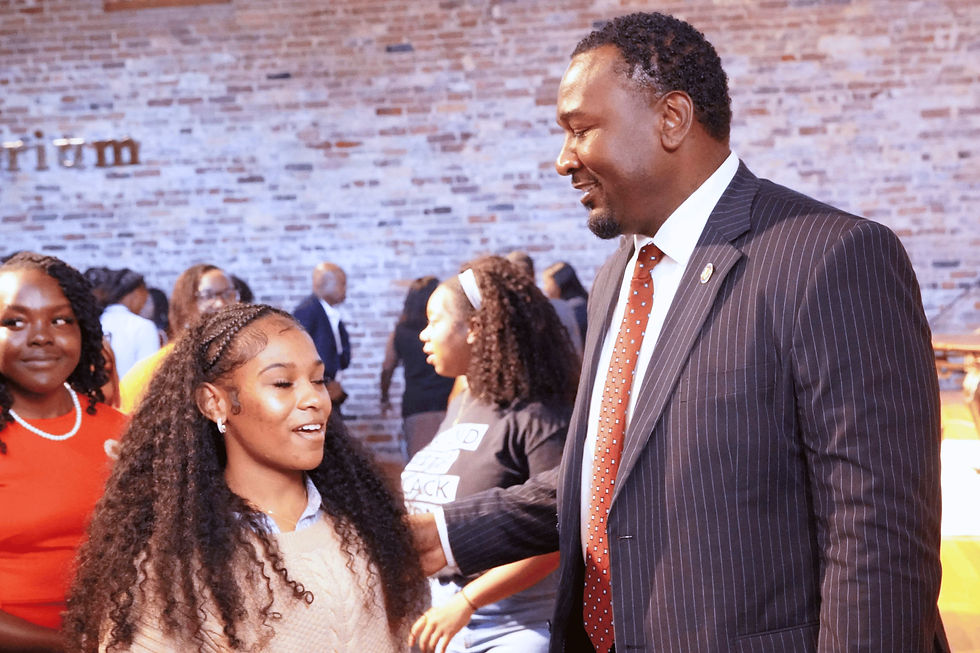
At Claflin University this month, alongside Sylvia Wright and Rahm Emanuel, he spoke about attending seven high schools while growing up homeless and living in motels. He credited teachers with helping him continue.
“I would not be here without a teacher,” he said.
He also raised the problem of rural students lacking reliable internet access, describing children doing homework in a McDonald’s parking lot.
For a student trying to finish an assignment, that means finding transportation, a connection and somewhere to work before the homework can even begin. Johnson was asking why those students still had to overcome barriers other children did not. CUBNSC’s Claflin University reporting
Health care brought him back to another question of access.
In our interview, Johnson spoke about expanding Medicaid and his willingness to accept political criticism to pursue it. He said he believed some Republican lawmakers wanted expansion but feared the backlash.
That was his assessment of his colleagues. His own position was clear: he would be willing to take the criticism if it helped people get care.
“I’ll take the hits,” he said. “I’ll take the punches.”
The willingness to endure criticism also runs through how he talks about faith.
Johnson, a deacon, describes the campaign as a responsibility he believes God gave him. Asked about the hostility he had encountered, he returned to that belief.
“God did not show everybody else this vision,” he said. “He showed me this vision.”
He speaks about faith as a reason to keep working when other people cannot see what he sees. The disappointments remain. So do the miles, the criticism and the family obligations. He believes he has to continue.
By October, the campaign had brought him onto stages with national figures. At the Columbia rally with Senator Raphael Warnock and Dr. Annie Andrews, Johnson urged supporters to think about the whole ticket and the responsibilities of the different offices on their ballots.

Warnock closed with a story about writing to his daughter after Ketanji Brown Jackson’s confirmation to the Supreme Court. He connected the letter to the decisions voters make about the world children inherit.
“Every time you vote, you’re writing a letter to your children,” he said. CUBNSC’s rally coverage
I thought about that while returning to Johnson’s interview.
There was his daughter asking him to come to school. His son shooting basketball with him in an empty gym. The coach who had once helped him. The children he now tells he does not want to bury.
These are the relationships through which Johnson explains his politics. They help connect the man repairing a car door, the legislator proposing community grants and the candidate listening while someone tells him how badly their community needs help.
After a year of coverage, those connections deserve space in the record.
Johnson has been clear about wanting people to see his family. He has also asked them to see the children who remind him of himself, and the residents who feel they have been left out of the state’s future.
“I’m a nominee for governor of South Carolina,” he said, “because somebody gave me an opportunity.”
He knows what that opportunity made possible. He is asking what South Carolina could make possible for the people still waiting for theirs.
Voting information: Early voting ends Saturday, October 31, 2026. Centers are open 8:30 a.m.–6 p.m. Registered voters may use any early-voting center in their county.
Election Day is Tuesday, November 3, with polls open 7 a.m.–7 p.m. Confirm your assigned polling place, review your sample ballot and check photo-identification guidance through the South Carolina Election Commission.

Javar Juarez is Publisher and Editor-in-Chief of the Columbia Urban Broadcast Network (CUBN), an independent investigative news outlet based in Columbia, South Carolina, and a member of the South Carolina Press Association.

