Mullins’ Black Mayor and the Tobacco coup d'état

Updated: Mar 15

How bloodlines, banking power, civic memory, and Black labor built a South Carolina town — and why its present crisis is bigger than one mayor
By Javar Juarez | CUBNSC
MULLINS, S.C. — There is a cemetery down a dirt road outside this Pee Dee town where the founding families of Mullins lie together beneath brush, hardwoods, and silence.
You do not arrive there by accident. You pass a cow pasture. You drive down a long dirt road. You look out over flat open land that can fool you into thinking there is nothing there. Then you step closer and realize the history of the town is not gone at all. It is simply overgrown.
The grave of Colonel William Sidney Mullins is there, still standing prominently behind the brush. So are the McIntyres, the Betheas, the Sales, and other family names that recur across Marion County’s old landholding network. The stones are not random. They are relational. They tell the story of bloodlines, marriage, property, and continuity.
One of the graves belongs to a woman named Athalia McIntyre Sale.

If you know your Bible, you already feel the charge in that name. Athaliah was the daughter of Ahab and Jezebel, the queen who seized power through bloodshed and dynastic violence. In a Bible-literate Southern world, names were rarely meaningless.
In this cemetery, they read less like isolated inscriptions and more like an archive of family intention. Athalia was the daughter of Mary Mullins McIntyre, a Mullins by birth, and her grave ties the Mullins and McIntyre lines together in stone. The Bethea connection appears there too, through marriage, linking one of Marion County’s oldest white family dynasties into the same burial ground.
That is where this story begins: not with a council meeting, but with a dynasty.
Because the public fight now unfolding in Mullins over Mayor Miko Pickett did not rise from nowhere. It sits atop a much older structure. To understand why the first Black female mayor of Mullins has been targeted so aggressively, the public has to understand what Mullins is, how it was built, who benefited, and who did not.
This is not just a story about one mayor.
It is a story about a town built on Black labor, controlled through white institutions, and still struggling over who gets to decide its future.
The Land Before the Town
Before there was a Mullins, there was Pee Dee land.
The ground that became Mullins and Marion County belonged to the Pee Dee people, a Siouan-speaking Native nation whose culture in the Pee Dee basin goes back at least to around 980 CE. They built earthen mounds, practiced maize agriculture, fished the rivers, hunted, and sustained regional trade networks long before Europeans attempted to rename and reorganize the land around them. The Pee Dee were not a footnote. They were the original people of this place.
European intrusion shattered that world. By the time English land grants pushed settlers inland after 1735, the Pee Dee had already been devastated by disease, colonial violence, and displacement. South Carolina’s legal system helped erase them further by reclassifying Native people into other racial categories, stripping them of recognition and land protection. In 1738, the Pee Dee were moved from their old town in Marion County to a colonial reservation elsewhere in the state. The town that would one day bear the name Mullins rose only after the original inhabitants had been removed.
That matters because the origin of Mullins is not simply a railroad story. It is first a story of dispossession.
Colonial Settlement and the Economy of Bondage
European settlers moved up the Pee Dee in the 1730s and 1740s, establishing places like Britton’s Neck, one of the earliest settlements in the region. The territory that would later become Marion County passed through colonial designations such as Queensboro Township and Prince Frederick’s Parish before becoming Marion District in 1800, named for Revolutionary War general Francis Marion.
But administrative names do not tell you how a region really worked. Labor does.
From the earliest colonial period, the economy here was built on enslaved African labor. By 1860, 45.8 percent of white families in South Carolina owned enslaved people, one of the highest slaveholding rates in the country. Marion County fits squarely inside that system. Cotton wealth in the region depended on enslaved Black labor, and the names of those enslaved people were largely excluded from the official story, even when their value was counted on paper.
The families that dominate the Mullins cemetery were not standing outside that economy. They were embedded in it.
The Betheas, one of the oldest white dynasties in Marion County, arrived with colonial roots, political power, and land. The historical record describes John Crawford Bethea plainly: he accumulated “lands and Negroes” and died very wealthy. The first gin house in Marion County was built by “Buck Swamp John” Bethea. This was not simply a family of farmers. It was a family of infrastructure builders in the antebellum economy.
The McIntyres intermarried with the Mullins family. The Betheas' intermarried with the McIntyres. Read genealogically, the cemetery is not a collection of separate clans. It is one interconnected power network of land, blood, and economic control.
So when the public asks who built Mullins, the answer is not just “a founder.” It is a system.
The Man Behind the Name

The town of Mullins was named for William Sidney Mullins, a North Carolina transplant who came to Marion County after studying law at the University of North Carolina. He rose to become one of the county’s most influential men, serving in the South Carolina House beginning in 1852 and helping determine that the route of the Wilmington and Manchester Railroad would pass through Marion County.
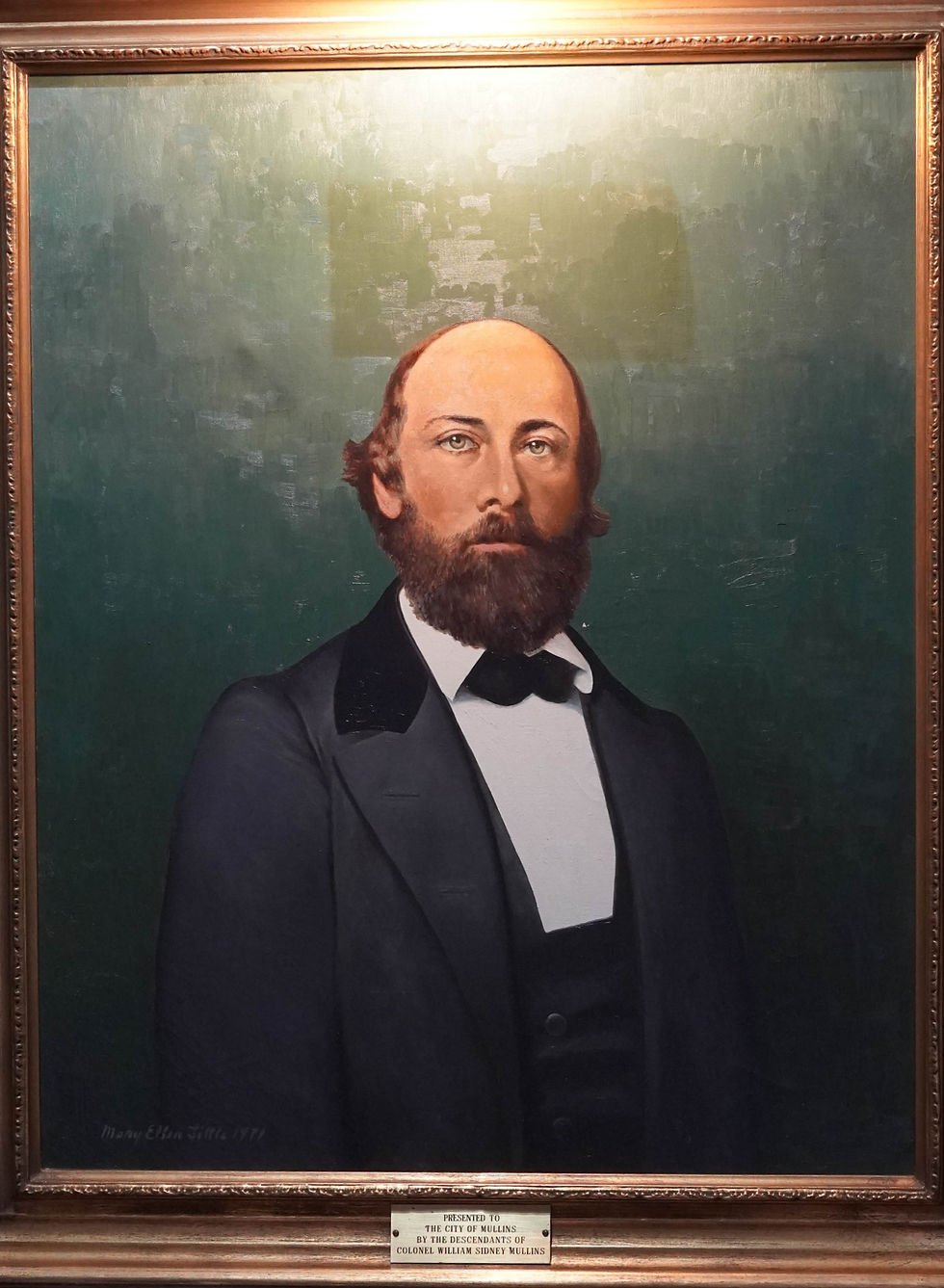
The depot was named Mullins Depot in his honor. The town later took the same name when it was incorporated on March 4, 1872.
That date matters.
Mullins was incorporated in the middle of Reconstruction, at the very moment Black political power in South Carolina had reached heights the state had never seen before and would not see again for generations.
What the local origin story usually leaves out is that the founding of Mullins took place while Black South Carolinians were briefly exercising democratic power in numbers that terrified the state’s white elite.
That omission is not accidental. It is part of how public memory works in the South.
Reconstruction, Then Counterrevolution
During Reconstruction, South Carolina became the only state in the nation where Black legislators held a majority in the state legislature. More than 200 African Americans served in the House and nearly 30 in the Senate during the era. Marion County itself produced Black leadership, including Henry E. Hayne, who represented the county in the state senate and later became South Carolina’s Secretary of State.
Then came the backlash!

White paramilitary terror, including Red Shirt violence and Ku Klux Klan activity, helped dismantle Reconstruction across South Carolina. Federal authorities declared martial law in Marion County as early as 1870 because of Klan violence there. By the end of the century, Black political participation had been systematically crushed.
The 1895 constitution helped lock that counterrevolution into place through disfranchisement. By 1940, Black voter participation statewide had been nearly extinguished.
Mullins was incorporated at the beginning of that arc. Then came tobacco.
So the sequence matters:
Native land was taken.
Plantation wealth was built through slavery.
Reconstruction opened a brief democratic window.
White power reasserted itself through violence and law.
Then the town’s major wealth engine arrived.
The story does not jump from “founder” to “small-town charm.” It moves through conquest, bondage, counterrevolution, and accumulation.
The Tobacco City Was Built by Black Hands

In 1891, Dr. C.T. Ford planted an experimental tobacco plot to see whether the crop would thrive in local soil. It did. Planter’s Warehouse was built in 1894, and the first auction sale followed. Mullins’ population and prosperity exploded with the tobacco economy. By mid-century, the town operated nine tobacco warehouses and claimed a place among the largest tobacco markets in the state.
Again, the question is not whether tobacco made Mullins prosperous. It did.
The question is: who made tobacco possible?
The archival record answers clearly. Many landowners leased their farms to tenants and sharecroppers, and the majority of that labor force was African American.

The same Black labor that had worked under slavery and then under Reconstruction-era agricultural dependency was redirected into the tobacco fields. The wealth from that crop built Mullins’ homes, schools, library, hospital, and civic institutions.
Black families grew the crop.
White institutions accumulated the wealth.
That is the core economic truth of Mullins.
The town was built by Black labor on land Black people did not own.
And the institutions that still dominate Mullins today grew out of that arrangement.
The Bank in the Warehouse

In 1933, during the Great Depression, Ernest and Bishop Bonar Anderson opened Anderson Brothers Bank in the back of the Anderson Warehouse in Mullins.
That detail is not colorful trivia. It is the central structural fact of the story.
The bank did not arise outside the tobacco economy. It arose inside it.
The Anderson brothers were already warehousemen. They were already positioned at the point where Black labor entered the white-controlled market. They loaned money to warehouse owners so those warehousemen could issue immediate checks after crop sales. Then the major tobacco corporations — Reynolds, American, Imperial — paid the warehouses, and the loans were retired. The warehouse and the bank were not separate institutions. They were consecutive stages of the same extraction system.
Over time that structure became a dynasty.
Generation One: Ernest L. Anderson, who served on the Mullins Town Council and as a South Carolina Highway Commissioner, and his brother Bishop Bonar Anderson.
Generation Two: Bert Neal Anderson, who not only led the bank but was also a principal owner of Big Three Warehouse in Mullins, confirming that the warehouse and bank remained one family enterprise across generations.
Generation Three: David E. Anderson as President and CEO, Neal Anderson as Chairman, and the late Tommy Anderson as Vice President.
This is not a bank that merely happened to be local. It is a family institution grown directly from the tobacco supply chain.
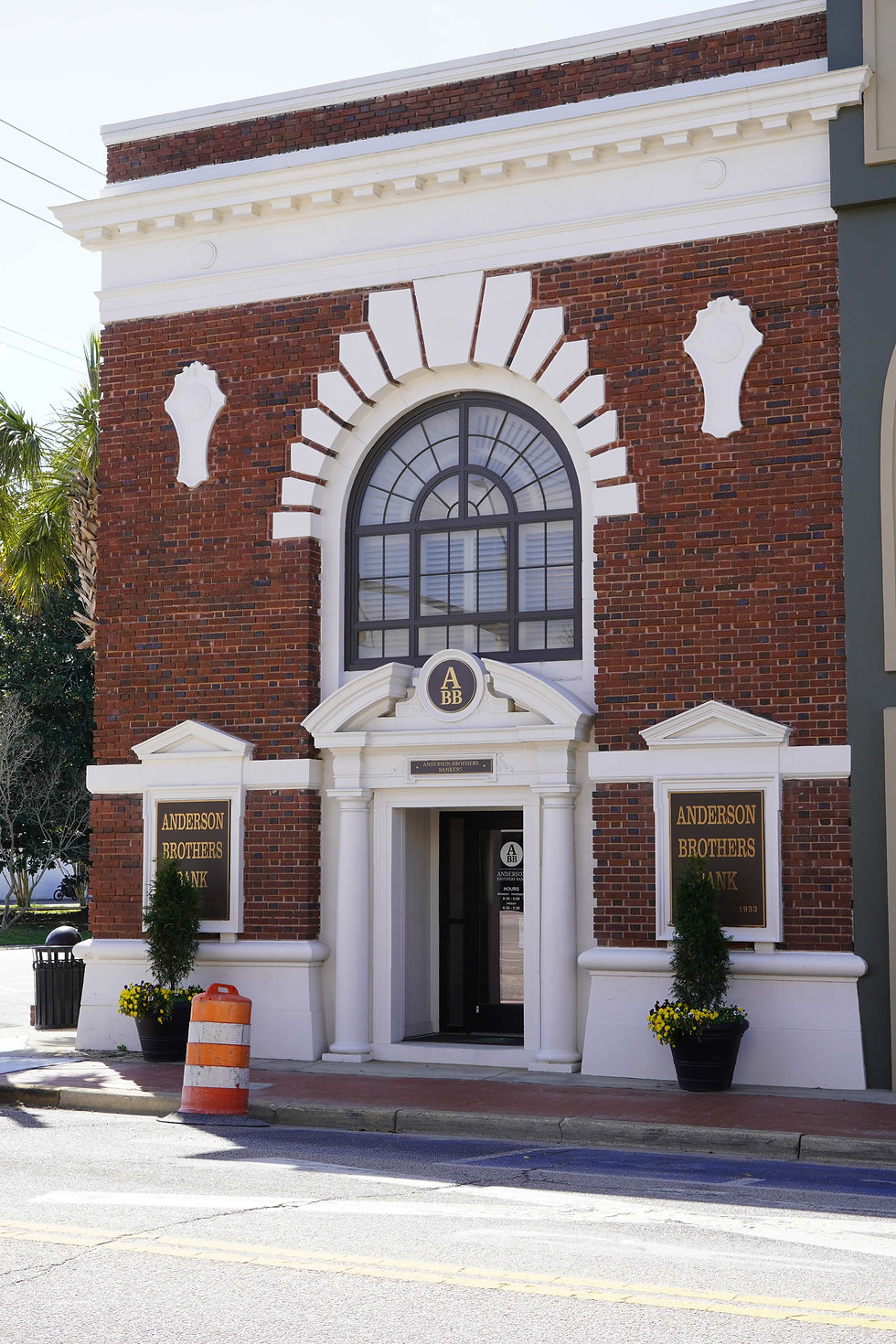
As of March 2025, Anderson Brothers Bank had approximately $2.07 billion in assets. David Anderson himself said it took the bank 87 years to reach $1 billion, then only four more years to cross $2 billion.
Now compare that with the county it came from.
Marion County median household income rose from about $26,526 in 2000 to $34,501 in 2023, a weak increase in nominal terms and effectively flat or worse once inflation is considered. Meanwhile the bank’s assets multiplied roughly tenfold over that same period. The bank compounded upward. The county largely stood still.
That divergence is not a footnote. It is the modern economic architecture of Mullins.
What $2 Billion Looks Like in a Poor Black Town

Mullins today is roughly 77 to 80 percent Black. Poverty exceeds 34 percent. White household income is nearly double Black household income. The city is majority renter. Homeownership remains low. Housing values are low. Vacancy is high.
This is exactly the kind of place where the public should ask what the hometown bank has actually done for the hometown.
And the answer gets sharper when you look at mortgage lending data.
The HMDA (Home Mortgage Disclosure Act) data reviewed in this reporting shows that in Marion County, Black applicants were denied mortgage loans by Anderson Brothers Bank at more than twice the rate of white applicants: 21.2 percent for Black applicants versus 9.8 percent for white applicants. In the under-$50,000 income band — the income range where many Mullins residents actually live — Black applicants were approved at a rate 10.8 percentage points lower than white applicants in the same range.
That does not mean every denial was unlawful. It does mean the public has a right to ask hard questions about what a “hometown bank” looks like when the majority-Black community surrounding it remains poor, renter-heavy, and under financed while the bank itself reaches $2 billion in assets.

The bank’s CRA (Community Reinvestment Act) rating is Satisfactory, not Outstanding.
In plain language, it meets the minimum acceptable standard.
That is not the profile of a transformative hometown institution.
That is the profile of a successful bank in a struggling Black town.
Civic Memory, Curated

Walk into the South Carolina Tobacco Museum and you enter another layer of Mullins’ story.
The museum is owned and operated by the City of Mullins and housed inside the town’s historic railroad depot, a building that also contains the Mullins Chamber of Commerce. In 2004, the South Carolina General Assembly designated it the Official Tobacco Museum of South Carolina, though the title came without any state funding.
The museum operates through a combination of city support, donations, and community partnerships.
But what matters most about the museum is not simply who owns it. It is what story it tells—and what story it does not.
Inside, visitors encounter the romantic memory of the tobacco era: cured barns, farm tools, warehouse photographs, and artifacts celebrating a time when tobacco markets filled the streets of Mullins. Memorabilia from cigarette advertising campaigns sits alongside a documentary titled When Tobacco Was King, built around the recollections of warehousemen and farmers who remember the town’s booming tobacco auctions.

Yet the foundation of that economy receives far less attention. The museum does not meaningfully center the Black sharecroppers and tenant farmers who formed the backbone of the tobacco labor force in Marion County.
The men and women who planted the crop, primed the leaves, cured the barns, and hauled the tobacco that filled those warehouses remain largely peripheral to the official narrative.
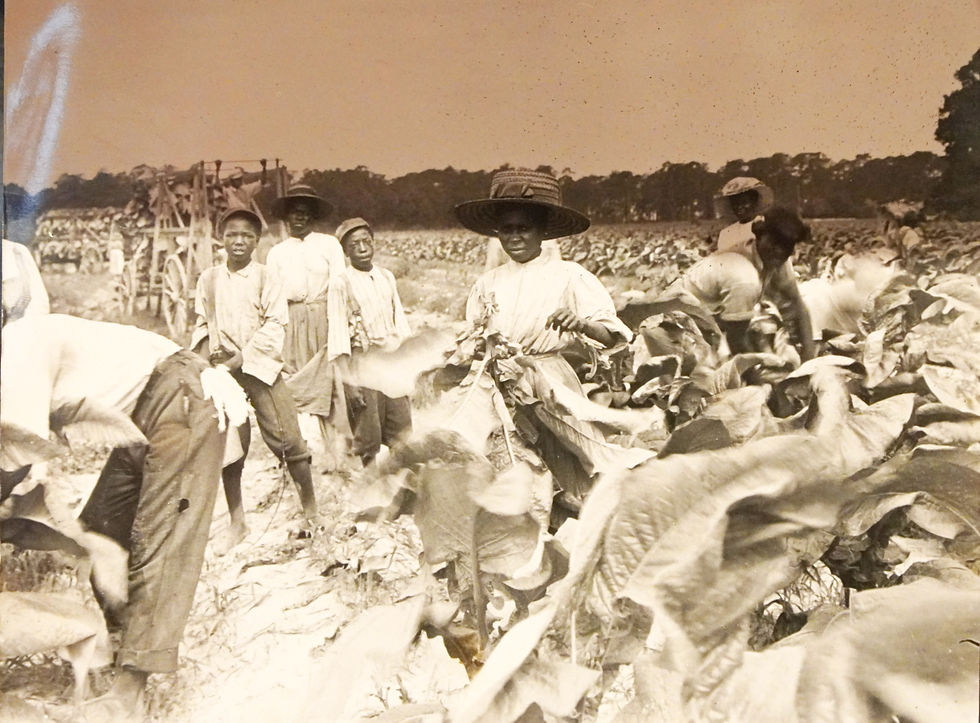
The economic engine of Mullins is remembered through its markets and merchants far more than through the labor that sustained it.
The institutions that grew from that tobacco economy still appear across the town’s civic landscape today. Public records do not show Anderson Brothers Bank directly funding the museum itself. But the bank’s presence is woven into many of the spaces where Mullins commemorates its tobacco past.
The most visible example is the Anderson Brothers Bank Tobacco Bowl, the long-running football rivalry tied to the town’s tobacco heritage. Press events for the game are hosted at the bank’s conference center.
The Mullins Chamber of Commerce—operating from the same depot building as the museum—lists the bank among its members, represented locally by bank officer and city council member Luke Gasque, as well as Johnny Floyd, Senior Vice President and Regional Executive for the Marion and Dillon region of Anderson Brothers Bank.
The overlap extends further. In February 2026, the bank announced that Michael Martin, a loan officer and assistant branch manager at its McIntyre Branch in Mullins, also serves as president of the Greater Mullins Chamber of Commerce.
None of these connections are unusual in isolation. In small towns, civic leadership often overlaps. But taken together they illustrate something larger about how Mullins remembers itself.
This is how civic memory works.
The labor that built the tobacco economy is largely absent from the narrative.
The nostalgia of the market era is carefully preserved.
And the institutions that grew from that economy remain present in the spaces where the town celebrates its past.
The Two Firsts

For 148 years after Mullins was incorporated, no Black person held the mayor’s office.
Then Robert L. Woodbury was sworn in on November 10, 2020 as the first Black mayor in the city’s history.
He was followed in November 2024 by Miko Pickett, the first Black woman elected mayor of Mullins. Pickett won by 31 votes, 795 to 764.
That timeline is not incidental. It is the break in the pattern.
For nearly a century and a half, the city founded by the families in that cemetery had never chosen Black executive leadership.
Then it did.
Twice in five years.
That is the crack in the old order through which all of this present conflict has emerged.
What Miko Pickett Was Trying to Do

The public record is clear that housing was central to Mayor Pickett’s agenda. At her swearing-in, she said her platform was economic development, housing, and city beautification.
And this was not empty rhetoric.
Before she was even sworn in, Mullins held a formal CDBG Needs Assessment Public Hearing, the required first step in applying for Community Development Block Grant funds.
By January 14, 2025, the city publicly acknowledged a $567,000 CDBG check presentation and also a $1.5 million Rural Infrastructure Authority grant for flooding remediation at the Mullins Housing Authority.
In one council meeting, the city publicly recognized more than $2 million in housing and infrastructure-related funding.
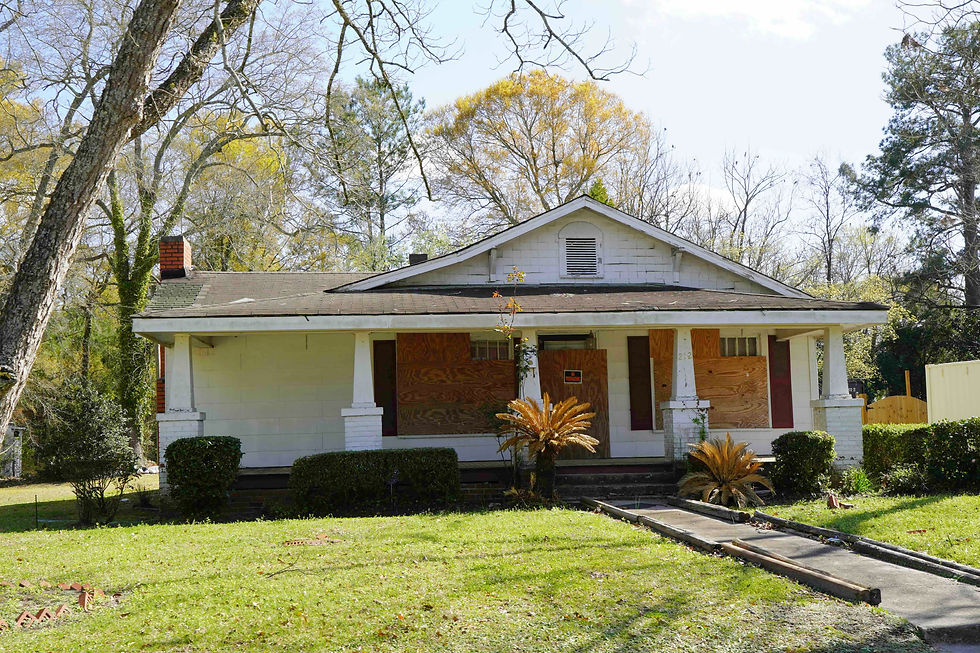
In her mayor’s report, Pickett referenced façade grants, workforce housing development, coordination with the ministerial alliance, and transit expansion to Little Pee Dee Manor.
By October 2025, the public record referenced Project Phoenix, CDBG Status, Condemnation Working Sessions Scheduled, and Grant Update – Grant Review. The attached Project Phoenix materials described a blight removal effort tied to CDBG funding and demolition of unsafe structures.
Notices of intent to demolish were posted on multiple properties across the city.

This matters because it shows that Pickett’s administration was not merely talking about housing. It had brought actual money into a majority-Black, majority-renter, majority-poor city and had begun moving those redevelopment tools into visible effect.
Then the backlash intensified.
The Nativity Scene and the Manufactured Flashpoint

The conflict did not begin only with the February 2026 suspension. It had been building.
One public flashpoint came in December 2025, when Pickett ordered the removal of a Nativity scene from public property near the city marketplace, citing the constitutional principle of separation of church and state.
A conservative legal organization mocked the decision. Local opponents seized on the moment.
On its face, the fight was about Christmas symbolism. In practice, it became a way to cast a Black woman mayor pursuing housing and redevelopment as someone culturally out of step with the town.
That matters in the Bible Belt, and it matters even more in a town whose historical bloodlines, cemetery symbolism, and public memory are steeped in Christian language.
The Nativity controversy was not the whole story.
It was an attack vector.
And residents understood it that way.
The Suspension
On February 27, 2026, five of six council members voted to suspend some of Mayor Pickett’s ceremonial privileges and open an investigation into her conduct. The stated grounds included misinformation, unauthorized public correspondence, and disobedience of ordinances.
No independent investigator was appointed. The investigation was assigned to the city attorney and city administrator.
Councilwoman Terry Davis, the only council member consistently supportive of Pickett, later demanded a third-party investigation.

Pickett was not present at the meeting. Her family said she had a prior business commitment, had offered to meet later in the day, and that there had been no genuine effort to ensure her presence. Her husband Dominic Pickett described the pattern at the meeting bluntly:
“Like anything she does, they look to vote against it. Anytime she tries to do anything on Black History Month or for Black people, that council is normally against it.”
The public record also shows that the suspension specifically barred Pickett from signing proclamations or contracts on behalf of the council. In practical terms, that matters enormously in a city where CDBG-driven redevelopment and housing-related projects were underway.
The effect — regardless of the council’s framing — was to constrain the mayor’s ability to execute the agreements attached to the very projects her administration had advanced.
Pickett publicly said she was being politically lynched. That is a heavy phrase. But it did not arise in a vacuum.
She is the first Black female mayor.
She had brought housing and redevelopment money into the city.
She was now being investigated by the same municipal power structure that opposed her.
The public is entitled to ask what exactly this council believed it was protecting.
The Election Date Fight
At the same time the conflict with Mayor Pickett was escalating, the city moved toward changing municipal elections from November of even-numbered years to April of odd-numbered years.
City officials argued the shift was not a new policy but a correction. According to the city attorney, the municipal code already contemplated April elections, even though Mullins had conducted elections in November for years.
The attorney’s position was that the discrepancy had to be resolved by bringing the city’s practices into alignment with the written ordinance.
But whatever the legal origin of the provision, the political effect is clear.
November elections produce the highest voter participation in the United States. April municipal elections — held off-cycle and without statewide races on the ballot — historically produce far lower turnout.
In Mullins, a city that is roughly 77 to 80 percent Black, that difference carries real political consequences.
Mayor Pickett warned during the March 10 council meeting that the change could disenfranchise residents by shifting elections into a low-visibility cycle. She proposed allowing the 2026 election to remain in November and addressing the ordinance question afterward.
The motion failed by a vote of five to two.
This is where the local dispute begins to intersect with a larger civil-rights question.
In a majority-Black city, election timing is not a technical detail.
It is power.
Why the Change Matters Nationally
Under Section 2 of the Voting Rights Act of 1965, election practices that result in the denial or abridgement of voting rights on account of race are prohibited. Courts have repeatedly examined structural changes — including election timing, district boundaries, and voting procedures — when those changes are shown to dilute the political influence of minority communities.
A shift from high-turnout November elections to low-turnout off-cycle elections can, in some circumstances, produce exactly that effect.
Whether the Mullins change ultimately meets the legal threshold for a voting-rights challenge would require further investigation. But the structure of the situation is clear: a majority-Black electorate, a change to a lower-participation election cycle, and a political conflict centered on the city’s first Black female mayor.
That context makes the fight over election timing more than a procedural correction.
It raises questions about representation and power in a town where both have long been contested.
Pam Anderson and the Meaning of 31 Votes

Pickett’s 2024 opponent was Pam Anderson.
That fact matters on its own. It matters more because Pam Anderson is the wife of David E. Anderson, President and CEO of Anderson Brothers Bank.
Pickett did not defeat a random challenger.
She defeated the wife of the man leading the $2 billion financial institution that grew from the tobacco-financing system that helped shape Mullins’ economic structure for generations.
The margin of that victory was 31 votes.
Then, on February 27, 2026, Pam Anderson attended the council meeting at which Pickett was suspended and publicly endorsed the council’s action. Her campaign account also remained open in ethics filings after the election.
None of those facts alone prove a coordinated effort.
But together they frame the political reality surrounding the conflict.
The first Black female mayor of Mullins won by 31 votes.
The candidate she defeated was the wife of the local bank’s chief executive.
And that same defeated candidate later publicly supported the council’s move to curtail the mayor’s authority.
The public can decide what that means.
But the public cannot say it does not matter.
Luke Gasque and the Bank–Council Overlap

The Anderson banking structure in Mullins is not simply historical.
It is still embedded in the town’s civic and political life.
One of the clearest examples sits directly inside the city government.
Luke Gasque.
Gasque serves as a Mullins City Council member while also working as an Assistant Vice President and City Executive at Anderson Brothers Bank. His Statement of Economic Interests filed with the South Carolina Ethics Commission reports salary income from Anderson Brothers Bank while he simultaneously holds elected office on the Mullins City Council.
Gasque was sworn into office on the same night Mayor Miko Pickett took office.
The overlap between the bank and city government becomes visible in the public meeting record.
On January 21, 2026, Gasque chaired a Mullins Finance Committee meeting in which a screenshot of the City of Mullins Capital Fund account held at Anderson Brothers Bank was entered into the public record. The image showed a municipal checking account at the bank with an available balance of $21,231.77.
Weeks later, on February 27, Gasque joined the council majority in voting to suspend Mayor Pickett and strip her of key executive authorities, including the power to sign certain contracts on behalf of the city.
Taken together, the public record shows:
• a city council member employed by Anderson Brothers Bank
• a municipal account held at that same bank
• the council member chairing the meeting where the account appeared in the city’s financial discussion
• and that same council member voted to suspend the mayor.
Those facts do not require interpretation. They are visible in the public record.
They also explain why South Carolina ethics law becomes relevant to the discussion. State ethics rules require public officials to disclose financial relationships and to consider recusal when official actions could affect entities with which they have a financial association.
Whether those disclosures or recusals were made in connection with the bank relationships surrounding city finances is a question that citizens — and, if necessary, regulators — are entitled to examine.
The Captive Economy
The central question residents are really asking is not only “Why is the mayor under attack?”
It is “Why has Mullins stayed like this?”
Why does a majority-Black city remain poor?
Why do so many young people want to leave?
Why is the public asked to celebrate tobacco history without being taught who really built that economy?
Why does the bank grow while the town stagnates?
Why are jobs broad but ownership narrow?
Why does so much of the visible civic structure feel connected to the same institutions and families?
The answer is structural.
A place like Mullins can function as a captive economy.
Cheap labor benefits employers. Low homeownership benefits landlords.
Weak wealth-building keeps residents dependent.
A strong local bank can meet regulatory minimums while still failing to transform the community around it.
Political control helps protect all of the above.
That does not require cartoon villainy. It requires continuity.
And Mullins has continuity in abundance.
The Pee Dee were removed.
Plantation families accumulated land and enslaved labor.
The tobacco economy was built on Black tenants and sharecroppers.
The bank rose from the warehouse.
The museum curates nostalgia while omitting the labor.
The city remained white-led for 148 years.
Then the first Black female mayor won by 31 votes.
Then the old structure pushed back in public.
That is the tobacco coup.
Not a single event.
A system.
A continuity.
A century-spanning transfer of labor into institutional power.
What the Public Should Ask Now
This report does not need to tell citizens what to think. It gives them enough to ask the right questions.
They should ask city leaders:
Why does the city maintain accounts at Anderson Brothers Bank, and which accounts are there?
What disclosures or recusals were made by officials employed by that bank?
What exactly were the written charges against Mayor Pickett before her suspension?
Why was she investigated by internal officials rather than an independent party?
Why was election timing pushed in a way that could predictably reduce participation in a majority-Black city?
Who owns the cleared or targeted parcels affected by Project Phoenix?
Who benefits if Black neighborhoods are demolished, cleared, and redeveloped?
Why does the official story of tobacco still not center Black labor?
Why do the young people of Mullins see escape, not opportunity, as the path to a livable life?
And above all:
Who has really been served by the way Mullins has worked for the last hundred years?
Because the answer is not hidden anymore.
It is in the cemetery.
It is in the bank.
It is in the museum.
It is in the meeting minutes.
It is in the mortgage data.
It is in the election fight.
It is in the fear residents feel when they lower their voices and tell you something heavy hangs over the town.
The people of Mullins are not crazy for feeling it.
They are living inside history that was never properly named.
Now it is.