Johnson Wins the Room — Now He Has to Win the State

By Javar Juarez | CUBNSC | Democratic Primary Coverage
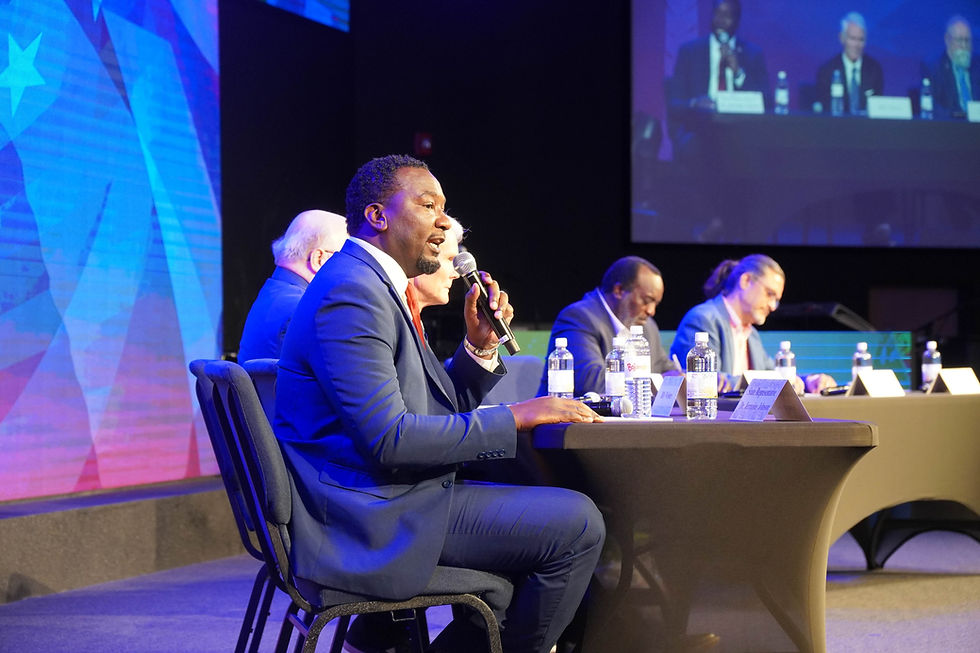
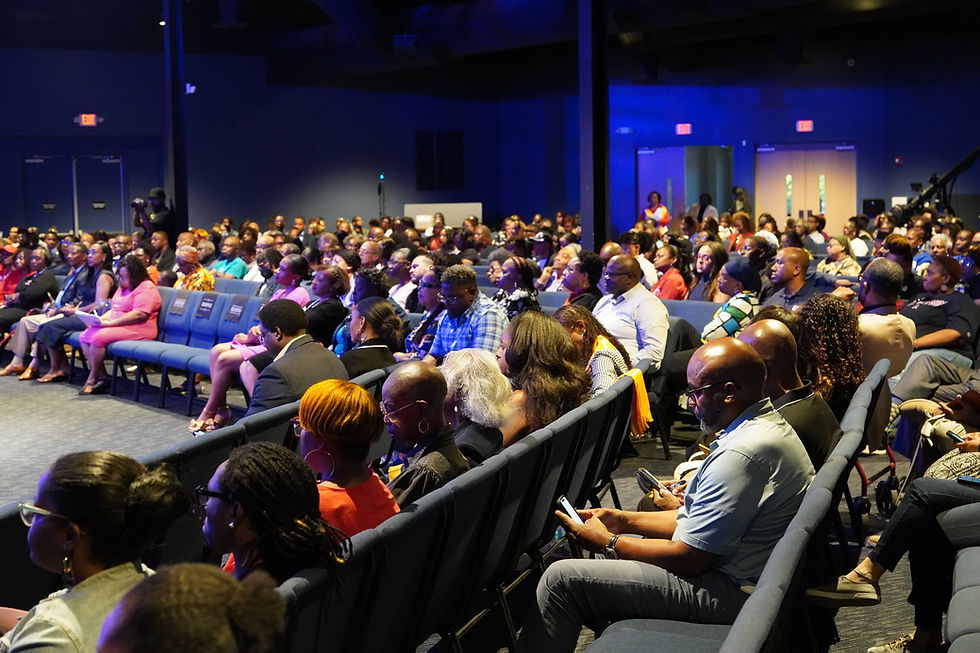
At The Brook Church in Columbia, South Carolina, a diverse slate of gubernatorial candidates took the stage in what became more than a routine forum. It was a revealing snapshot of a state grappling with deep structural challenges while searching for leadership capable of meeting the moment.
The forum featured Democratic candidates alongside third-party challengers from the Workers Party, the Green Party and the United Citizens Party. While ideological differences were present, what stood out most was a striking consensus on the issues facing South Carolina.

Healthcare, infrastructure, education, and economic inequality dominated the discussion. These are not new concerns, but the urgency in the room reflected a growing awareness that the status quo is no longer sustainable.
South Carolina, a state of just over five million residents, remains under firm Republican control, with a supermajority in both chambers of the General Assembly.
This political reality framed much of the conversation, as candidates wrestled with how to govern effectively in a system where legislative resistance is not hypothetical but guaranteed.
A Clear Policy Consensus

Across the stage, candidates repeatedly returned to the same core issues.
Healthcare, particularly Medicaid expansion, emerged as the most unified priority.
Candidates pointed to the staggering number of uninsured residents, estimated at around 500,000, and emphasized the economic and human costs of inaction. The through-line was clear: a state that cannot keep its people healthy cannot keep them employed, educated, or safe.
Infrastructure followed closely behind. South Carolina's roads and bridges, often ranked among the worst in the nation, were cited as both a safety hazard and an economic barrier. Education and workforce development also featured prominently.
Candidates spoke about the need to invest early in children while ensuring stronger pathways to employment through technical training and higher education.
Economic justice, including wages, taxation, and access to opportunity, rounded out the central themes.
In short, there was little disagreement about what South Carolina needs. The real question is who can deliver it.
Jermaine Johnson: Prepared, Present, and Picked by His Peers

Among all candidates, State Representative Jermaine Johnson distinguished himself as the most prepared, the most grounded, and — by the end of the evening — the most unanimously endorsed person on the stage.
As the only sitting member of the General Assembly present, Johnson brought a level of experience that was immediately apparent. His responses were clear, rooted in policy, and reflective of someone who understands not just the problems but the mechanics of government required to address them.
Johnson did not wait long to draw the sharpest contrast of the evening. When Walid Hakim acknowledged openly that as a Green Party candidate he would enter the governor's office without a single ally in the State House, Johnson answered him directly:
"He who knows the rules has the power. It's time out for individuals who want to have on-the-job training. It's time for somebody who can hit the ground running on day one."
That was not a campaign slogan. That was a counterpunch — and it landed.
Johnson backed it with three terms of legislative relationships and a record of introducing legislation on mental health providers in schools and sheriff's departments that no other candidate on that stage could match.
Johnson described a statewide listening tour he conducted two years ago alongside former gang members affiliated with Gangs and Peace, visiting approximately 30 counties across South Carolina to hear directly from residents about their most pressing concerns. Every single county gave the same answer: mental health resources.
That is not a campaign talking point.
His policy priorities aligned directly with what the room was asking for.
On healthcare, he was unequivocal: expanding Medicaid on day one, whatever it takes.
On mental health, he went further than most, pushing back against a stigma that runs deep in Black Southern communities:
"It is okay to have Jesus and a therapist."
He said that in a church.
That took clarity and courage.
On infrastructure, he connected the crisis directly to everyday economic harm — roads so degraded they drive up car insurance premiums, crack windshields, and cost families money they do not have.
On transparency and civic accountability, he pledged to create advisory councils made up of everyday residents for every critical state department, a structural commitment to bringing people inside the process rather than governing over them.
And then came the moment that sealed it.
When candidates were asked who they would vote for if they could not cast a ballot for themselves, every candidate on that stage pointed to Jermaine Johnson.
Gary Votour, a third party candidate who drew the loudest applause of the night for his movement framing, did not hesitate: Johnson, he said, is
"probably the most effective person in the Democratic Party that can make change."
He added that the first time he met Johnson was at an abortion rights rally — Johnson walked up to him on the frontline, introduced himself, checked on him. Votour said that moment told him everything he needed to know.
Michael Addison, the United Citizens Party candidate, said he would want Johnson as his lieutenant governor — and pledged to support him not just with words but financially.
Walid Hakim, the Green Party candidate navigating visible health challenges throughout the forum, called Johnson a man of integrity whose ideas he trusted.
Billy Webster, the seasoned businessman who spent the evening projecting executive pragmatism, acknowledged Johnson's courage and credibility in a way that resonated beyond party lines.
That level of cross-candidate consensus is rare in any political forum. It does not happen by accident. It speaks to a reputation built over three terms in the State House — a reputation that, as Johnson himself put it, you can verify by calling anyone in the General Assembly.
"Ask them about my character. Ask them about my integrity. They will say Jermaine wears his heart on his sleeve. He works for the people."
The Unfinished Task: Movement

For all of Johnson's strengths, there is a challenge he has not yet fully answered — and it was named loudly from the other side of the stage.
What Johnson has demonstrated is readiness to govern. What remains less fully formed in his public campaign is the architecture of a sustained movement capable of delivering the turnout that his own analysis demands. He has the fieldwork. He has the relationships. He has the legislative knowledge. The question is whether those assets are being organized into something larger than a candidacy.
Gary Votour, the Workers Party Socialist candidate who acknowledged openly that he has no realistic path to the governor's mansion, was explicit about what he was building instead:
"I'm not asking you to support me. I'm asking you to help build a movement."
That distinction — between running for office and building organized power — landed with the room in a way that no policy platform alone can manufacture.
Walid Hakim reinforced it from a different angle, reframing the entire political divide:
"It's not left versus right. It's the top versus the bottom, the haves versus the have nots."

Together, Votour and Hakim tapped into something Johnson's campaign needs to absorb rather than compete against. The energy they generated was not a rebuke of Johnson. It was a map of the terrain he has to organize. In a state where political disengagement is not incidental but structural, movement energy is not a bonus — it is a prerequisite for governing.
Johnson positioned himself as proof of what is possible: a Black man from adversity, homeless at one point, sleeping in a locker room at the College of Charleston, who earned his doctorate, became a deacon, and was elected the first Black and youngest representative in his district.
That story is real and it is powerful.
The next step is tying that individual proof to a collective architecture — making clear not just what Johnson has survived, but what he intends to build, and with whom.
A Field of Contrasts

Other candidates offered a mix of ideas and perspectives, though not all landed with equal force.
Michael Addison brought energy and bold proposals, particularly around marijuana reform — pardoning every nonviolent marijuana conviction on day one, then decriminalizing and building an economic framework around the industry.
His argument that criminalization has disproportionately harmed Black communities found real support in the room. But his delivery often felt rehearsed, and the pathway from idea to implementation remained unclear.
Compounding those concerns was his self-described dual affiliation with both the South Carolina Republican Party and the South Carolina Democratic Party — a revelation that landed with visible confusion.
As a United Citizens Party candidate, that dual membership raised genuine questions about consistency and political grounding that his energy alone could not resolve.

Billy Webster, the seasoned businessman, leaned into experience and pragmatism.
His mother's refrigerator sticker — "don't talk, just do" — became a kind of personal manifesto. His economic analysis was sharp where it landed. He pushed back forcefully against calls to eliminate the state income tax by Republicans, warning that the $6 billion it generates represents nearly 40 percent of a $15.7 billion state budget:
"You can't cut your way to prosperity. You have to invest in your competitive advantages."
That is sound economics. But his ties to the payday lending industry cast a shadow over his message, particularly in front of an audience that knows exactly how those practices have moved through Black communities for generations.
Walid Hakim remained present and engaged throughout the forum, though he openly acknowledged the health challenges he is navigating — including multiple strokes and short-term memory difficulties. His commitment to remaining in the race under those conditions spoke to his dedication to public service.
His 100-year plan framing — multi-generational, transparent, built to outlast any single administration — introduced a structural imagination that the rest of the field did not match, even if his electoral viability remains limited.
Gary Votour emerged as one of the most morally clarifying voices of the evening. His socialist framing was unapologetic and precise:
"Housing before landlord greed. Health care before insurance company profits. Schools before tax breaks. Workers before billionaires."
And his closing argument reframed the entire purpose of his candidacy:
"Change has to come from organized people. It comes from churches, unions, neighborhood groups, civil rights organizations, students, elders, parents, workers, standing together and refusing to be ignored."
That message will outlast this election cycle. Whether Johnson's campaign learns from it or watches it dissipate into another cycle of disengagement is one of the defining questions of this primary.
The Structural Challenge

Underlying the entire forum was a deeper issue that no candidate can govern around.
South Carolina's political landscape is not simply red. It is disengaged — and the evidence came from the candidates themselves.
Johnson named part of it best:
"South Carolina is not a red state. South Carolina is a no-voting state."
Two percent of Democrats come out to vote. Four percent of Republicans.
The arithmetic is not complicated. It is damning.
But the structural indictment did not stop with turnout. It was spread across the entire stage, piece by piece, speaker by speaker.
Hakim identified the representation crisis that no one else touched. In 1925, with one and a half million residents, South Carolina seated 124 representatives in the State House. In 2026, with five and a half million people — a population that has nearly quadrupled — that number has not moved. The pipeline from citizen to legislator has not expanded. It has calcified. People's voices, as Hakim put it, simply cannot get up the pipeline when the pipeline was never built to carry them.
Addison named the concentration at the top. When decisions get made in South Carolina, he said, five people are in the room that matters — the chairs of Senate Finance and Ways and Means, the state treasurer, the comptroller general, and the governor. That is where the budget moves. That is where the priorities get set. And that conversation happens largely outside the view of the people most harmed by its outcomes.
Three candidates. Three different vantage points. One structural indictment.
Taken together, what they described is not a political problem with a political solution.
It is an engineered condition — low turnout, compressed representation, concentrated power — that has produced exactly the outcomes it was designed to produce.
Any candidate serious about governing South Carolina has to reckon with all three layers, not just the one most convenient to their campaign message.
These structural realities cannot be wished away. They have to be organized against.
A Defining Moment Ahead

The forum at The Brook Church did not produce a final answer to South Carolina's political future. What it produced was clarity — and a verdict from the people who shared the stage.
Every candidate who stood beside Jermaine Johnson picked him. That is the record.
The policy consensus is there. The urgency is there. The candidate with the legislative knowledge, the community fieldwork, and the credibility to hit the ground running on day one is there.
What remains is the movement.
Johnson does not just need to win a primary. He needs to build the organized power that makes governing possible in a state with a Republican supermajority, decades of engineered disengagement, and a population that has been told — over and over — that their votes do not matter.
South Carolina does not need another candidate who can describe the problem.
It needs a governor who can organize the solution — and a coalition strong enough to govern with them when they get there.
The room picked Johnson. Now the question is whether Johnson picks the room back.


Javar Juarez is an investigative journalist, publisher, and civic leader. He is the founder and publisher of the Columbia Urban Broadcast Network (CUBN), an independent outlet covering South Carolina politics and community affairs, and serves as President of Capital City APRI — the A. Philip Randolph Institute — in South Carolina, where he works at the intersection of labor, civil rights, and grassroots civic engagement.