Birmingham Bleeds Again: The Supreme Court and the Voting Rights Act

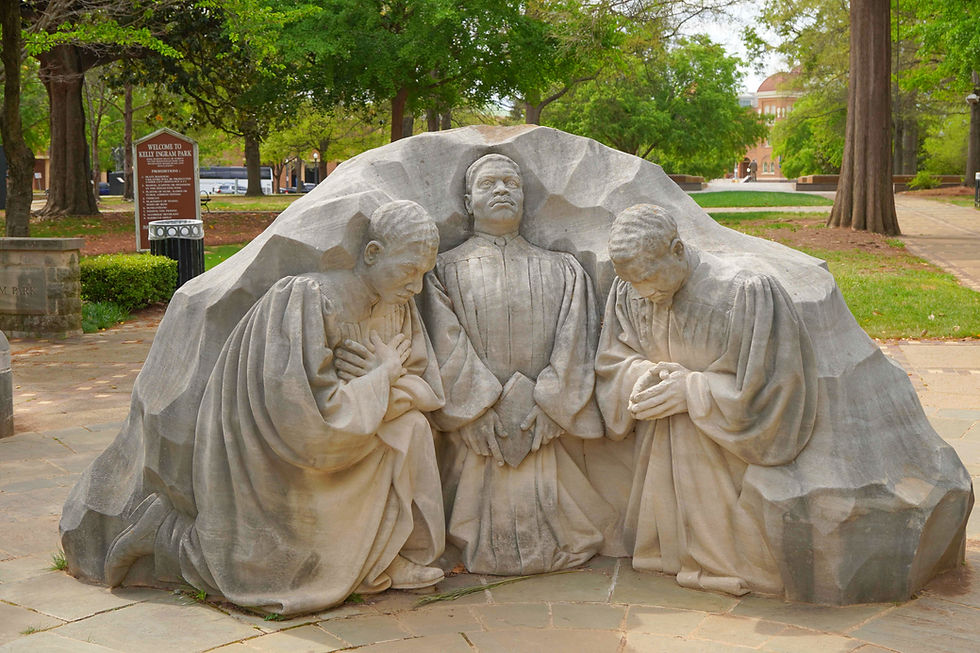
What Birmingham Taught Me — Before the Court Decided History No Longer Counts
By Javar Juarez — CUBN New Progressive Journal | Sunday Feature
I went to Birmingham, Alabama, with a camera and expectancy in my heart. I had never been before, but I knew — the way you know certain things before you can explain them — that I would find exactly what was waiting for me.
I arrived as part of a movement alongside Black leaders from across the American South — Virginia, North Carolina, South Carolina, Tennessee, Georgia, Florida, and Alabama — under the banner of the International A. Philip Randolph Institute.
On a typical Wednesday night in South Carolina, I would be at my own church for Bible study, or at the very least watching online. But this was my first night in Birmingham, and at the direction of the Rev. Nelson Rivers, I chose to visit the Sixteenth Street Baptist Church instead.
What I did not fully understand when I walked through those doors is what I am going to try to explain to you now — believer and skeptic alike — because this story belongs to both of you.
I did not go to Birmingham by chance. I went by charge. A divine assignment to stand inside the spaces where the civil rights movement organized, worshiped, bled, and refused to disappear.
Weeks later, the Supreme Court answered that question for me.
On April 29, 2026, six justices — Alito writing, joined by Roberts, Thomas, Gorsuch, Kavanaugh, and Barrett — issued their opinion in Louisiana v. Callais and diluted the very Voting Rights Act that a generation before us fought, bled, and died to produce. The majority said plainly that historical discrimination now gets "much less weight."
That older patterns of racial suppression do not, on their own, establish present intent.
Birmingham is not prologue to that decision.
Birmingham is its refutation.
What This Building Is

Before I tell you what I felt, you need to know what this place is. Not what it represents. What it is — factually, in the American record.
Sixteenth Street Baptist Church is not simply a house of worship.
Since its completion in 1911, it has functioned as the organizing center of Birmingham's Black civic life — a meeting hall, a lecture platform, a mass assembly point for people who were otherwise denied public space in their own city.
When Martin Luther King Jr. and the Southern Christian Leadership Conference came to Birmingham in 1963, this church was their operational headquarters.

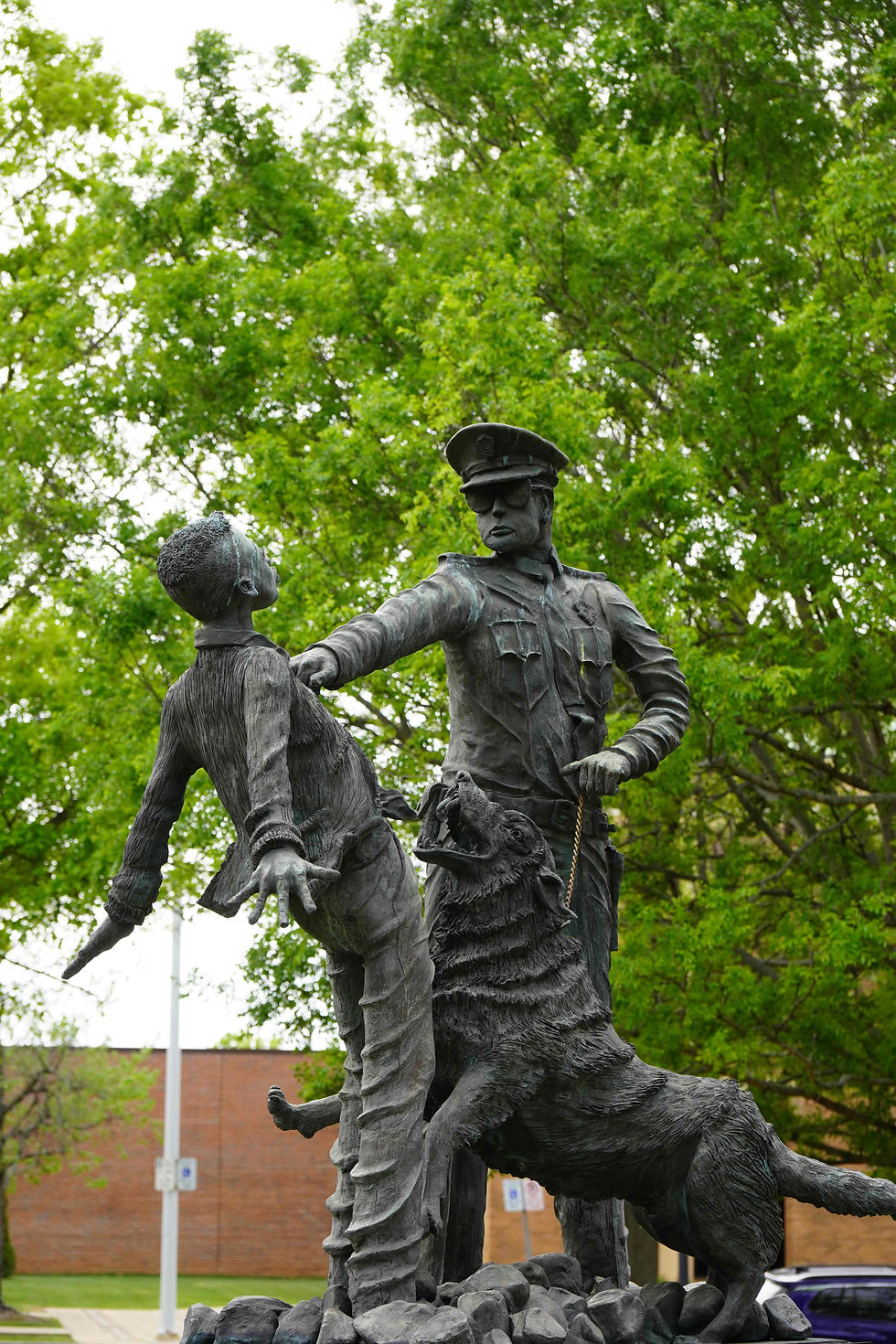
The marches that shocked the nation — the ones that put photographs of fire hoses and police dogs turned on children onto front pages from Birmingham to Boston and into America's living rooms — those marches departed from these steps.
But the story of this building does not begin in 1911. It begins earlier, and it begins with a pattern America should recognize by now.

The congregation was organized in 1873 as First Colored Baptist Church — Birmingham's first Black Baptist church, established just two years after the city itself was founded. They worshipped first in a small building at 12th Street and Fourth Avenue North, then moved to a site on Third Avenue North between 19th and 20th Streets.
In 1880, they acquired their current location at Sixth Avenue and Sixteenth Street.

Under the leadership of Rev. Dr. William Reuben Pettiford — a man born free in North Carolina in 1847, educated at the State Normal School at Marion, Alabama, and a close associate of Booker T. Washington — the congregation raised $25,000 and completed a Gothic Revival brick structure on that site in 1884.
The city of Birmingham condemned it in 1908 and ordered it demolished.
Many in the Black community understood exactly why: a Black institution had grown too prominent, too close to the downtown commercial district that white Birmingham was building around it.
The historical marker outside the building documents this moment without flinching. What the marker cannot fully convey is what the congregation did next.
They did not leave the site.
They did not dissolve.
They commissioned Wallace Rayfield — at that time the only Black architect in the state of Alabama — to design a new building. They hired T.C. Windham, a Black contractor from Birmingham who was also a member of the congregation, to build it. The result, completed in 1911, was the largest and most architecturally significant Black church building in the Birmingham area — a modified Romanesque and Byzantine design with twin towers, pointed domes, and a cupola over the sanctuary. It was the only large, centrally located Black-owned structure in the city.

The city forced them to tear down what they built.
They built something larger.
That is the building the Klan bombed on September 15, 1963.
That is the building still standing today.
The building has always been targeted because the people inside it refused to stop.
10:22 A.M.

The ground-level memorial slab at the church entrance gives you the timestamp with no commentary:
Sunday, September 15, 1963 — 10:22 A.M.
That is the moment the dynamite detonated.
By September 1963, Birmingham had earned an unofficial name: Bombingham.
Between 1947 and 1963, the city had sustained more than fifty bombings directed at Black homes and churches. What happened on the morning of September 15 was not a departure from the pattern. It was the pattern, pushed to its furthest conclusion.
Several members of the United Klans of America had planted at least 15 sticks of dynamite under the church's east steps, close to the basement, timed to go off during Sunday morning services.

The bombing was the third in eleven days, coming directly after a federal court order mandating the integration of Alabama's public schools.
It was not random.
It was a response to law.
At 10:22 a.m., a phone call came into the church. A 15-year-old girl named Carolyn Maull, the acting Sunday School secretary, answered. The anonymous caller said two words: "Three minutes." Less than one minute later, the bomb went off.
In the basement, five girls were changing into choir robes for a service whose sermon had been titled "A Rock That Will Not Roll."
The bomb detonated on the other side of the wall from where they stood.
Four of them died.
Addie Mae Collins, 14. Carole Robertson, 14. Cynthia Wesley, 14. Denise McNair, 11.

The fifth was Sarah Collins — Addie Mae's 12-year-old sister. She survived. The blast drove 26 shards of glass into her face and destroyed her right eye.
Sarah Collins Rudolph — now in her seventies, still speaking, still testifying — has described the moment this way: she heard the explosion, and then she called out to her sister.
"Addie. Addie. Addie."
Addie did not answer.
The last thing Sarah remembers before the bomb went off is one of the other girls asking Addie to tie the sash on the back of her dress. Addie reached out to do it.
Then the world came apart.
"All I could do was holler, 'Jesus,'" Rudolph has said.
That word — Jesus — is not incidental to this story. Hold onto it.
More than 20 other people were injured in the blast. When Martin Luther King Jr. learned what had happened, he sent a telegram directly to Alabama Governor George Wallace — the man who had stood at the state Capitol and declared "segregation now, segregation tomorrow, segregation forever." King's telegram was brief:
"The blood of our little children is on your hands."
What the Blood Produced

The people who planted that bomb believed they were striking at the movement.
They were not.
Historians, archivists, and the United States Congress have reached the same documented conclusion: the bombing of Sixteenth Street Baptist Church was the turning point of the American civil rights movement.
The outrage was immediate and national. James Bevel, an SCLC organizer, was galvanized by the murders to create what became the Alabama Project for Voting Rights — the direct organizational precursor to the Selma-to-Montgomery marches.
More than 8,000 people attended the funeral for the four girls.
Less than a year later, on July 2, 1964, President Lyndon Johnson signed the Civil Rights Act.
The following year, Congress passed the Voting Rights Act of 1965.
This is essential to understand — not as history, but as causation. The Voting Rights Act was not born in a courtroom. It was not born in a legislature that suddenly found its conscience. It was born here. In this city. In this building. In a basement where four girls were putting on choir robes.
The law exists because the blood demanded it.


The bombers were not held accountable swiftly. The FBI, under J. Edgar Hoover, accumulated evidence against the perpetrators and buried it, withholding findings from county prosecutors. Robert Chambliss was not convicted until 1977 — fourteen years after the murders. Thomas Blanton was convicted in 2001. Bobby Frank Cherry in 2002. Herman Frank Cash died in 1994 without ever facing trial.

Sarah Collins Rudolph testified at Chambliss's trial. She watched justice move at the pace of a country that had to be shamed into delivering it.

"They kept promising they would do something," she has said of her mother. "And she died waiting."
What the Court Decided

Weeks after I stood in that sanctuary, the Supreme Court of the United States issued its opinion in Louisiana v. Callais, decided April 29, 2026.
The decision does not repeal the Voting Rights Act. That would be too blunt, and this Court is not blunt. It is precise — precise in the way a scalpel is precise when it is removing something the patient needs to survive.
What the Court did was reinterpret Section 2 of the Act from the ground up.
Writing for a six-justice majority, Justice Alito held that Section 2 must be read to align with the Fifteenth Amendment, which the Court has long held bars only state action "motivated by discriminatory purpose." The practical consequence of that alignment is this: Section 2 now "imposes liability only when the evidence supports a strong inference that the State intentionally drew its districts to afford minority voters less opportunity because of their race."
Intent. Not result. Intent!
That shift is enormous. For forty years, under the framework established in Thornburg v. Gingles (1986), a plaintiff could prove a Section 2 violation by showing discriminatory results — that minority voters had less opportunity to elect representatives of their choice. The system asked: what happened? Now the system asks: what was in their minds?
And the Court goes further.
To prove racial bloc voting — one of the foundational elements of any redistricting claim — plaintiffs must now provide an analysis that "controls for party affiliation," showing that voters engage in racial-bloc voting "that cannot be explained by partisan affiliation."
In a country where race and party are deeply correlated in exactly the states where Section 2 suits are most common — the Court's own opinion acknowledges this — that burden is not merely difficult. It is designed to be nearly impossible to meet cleanly.
Then there is the question of history.
The Court's majority opinion states directly that on the "totality of circumstances" inquiry, "discrimination that occurred some time ago and present-day disparities characterized as ongoing 'effects of societal discrimination' are entitled to much less weight."
Read that again.
The history — the documented, uncontested, congressionally affirmed history of systematic racial discrimination in voting — now counts for less. What matters most, the Court says, is "present-day intentional racial discrimination regarding voting."
You must prove they meant to do it. You must prove it now. And you must untangle race from politics to do so, in states where race and politics have been deliberately entangled for over a century.
The bombers didn't announce their intentions either. They just planted the dynamite and called in a warning two minutes before it went off.
The Court Says History Matters Less. This Building Says Otherwise.
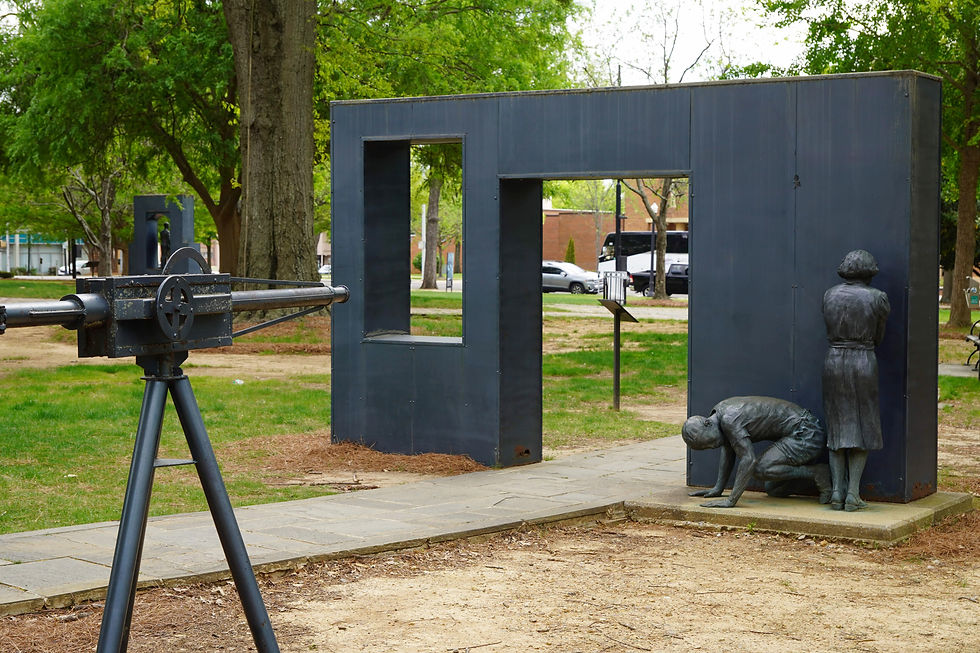
I want to be precise about what the Court has done, because precision matters here.
Section 2 of the Voting Rights Act still exists. The statute has not been repealed. What has been narrowed is its enforceability in redistricting cases — specifically, the path available to plaintiffs proving vote dilution.
What was lost before this decision: in 2013, Shelby County v. Holder gutted the preclearance mechanism — the requirement that certain states and jurisdictions get federal approval before changing voting laws. That guardrail is gone. The harm now has to happen before it can be challenged.
What Callais adds to that: once the harm happens and a plaintiff tries to challenge it, they now carry a heavier burden of proof, must disentangle race from politics in states where the two are structurally fused, can use only illustrative maps that don't employ race as a criterion while also satisfying the state's partisan objectives, and must show that older patterns of discrimination — including the very patterns that justified the Voting Rights Act's existence — don't constitute sufficient evidence of present intent.
Justice Kagan, joined by Justices Sotomayor and Jackson in dissent, understood exactly what the majority had done. The dissenters recognized that the majority was not merely updating a framework. It was dismantling the scaffolding that allowed the law to function.
Standing in Birmingham, that dismantling feels different than it does reading it in a press release.
Because Birmingham is not an argument about history.
It is physical evidence of a pattern.
The fire hoses are history. The dogs are history. The bomb at 10:22 A.M. is history. But the Court has now decided that history — the documented, specific, consequential history of racial suppression — is too old to weigh heavily in determining whether discrimination is still happening.
The Voting Rights Act was a response to a pattern. Not a single act. Not a single bad actor. A pattern that ran across decades and jurisdictions and manifested in literacy tests, poll taxes, gerrymandered districts, and dynamite under church steps.
The pattern did not disappear when the law passed. It evolved.
And now the Court has made it harder to prove the evolution.
What I Found Inside

I tell you all of this before I tell you what happened to me inside that church because I need you inside the building before you can feel what I felt.
This is the architecture of witness. You cannot receive what a place holds until you understand what it costs.
When I arrived, there was a boy in the sanctuary. Twelve years old — the same age Sarah Collins was when the bomb went off.
He was sitting quietly in a space where the dead are still present in the walls.
I gave him a warm South Carolina greeting and we talked. He told me he was raised in that church. Shortly after, he disappeared toward the basement, where choir rehearsal was already underway.
The same basement.
The same building.
Children singing where children were murdered.
I had the entire first floor to myself.
I came with worship in my mind and in my heart. What transpired was something I did not plan and cannot fully render in print.
I put my camera down.
This is not a choice I make lightly on assignment. But there are moments when the journalist has to become the witness, and the witness has to become still.
I was caught up in worship. Not performance, not documentation — worship. The kind that happens when you stop managing your environment and start receiving it.
I want to speak plainly to the reader who does not share my faith, because this story belongs to you too.
What I experienced inside those walls is not something I can prove in a deposition.
But I can tell you what it corresponds to in the documented record: a congregation that was bombed did not leave. People who were told their sacred space was not safe came back to it the following Sunday, and the Sunday after that, and every Sunday for sixty-one years. They did not seal the building off. They did not surrender it to history or allow it to calcify into a site of mourning that people visit and then leave.
They kept preaching there.
Kept teaching there.
Kept raising children there.
That is what I walked into on a Wednesday night: not a museum, not a monument, but a living congregation holding prayer meeting and choir rehearsal in a building the Klan tried to bring down.

For those who do not know God in the way I know God, I want you to understand something about what faith produces in Black people in this country. It is not an escape. It is not denial. It is not a refusal to reckon with what has been done to us. It is the capacity to absorb historical trauma in full — to look at it without flinching, to name the names of the dead, to speak the timestamp on the stone, to sit with Sarah Collins Rudolph's testimony — and then to return to the place where it happened and call it home.
That is not psychology. It is not resilience in the therapeutic sense. It is theology.
It is what Paul named when he wrote: "We are troubled on every side, yet not distressed; we are perplexed, but not in despair; persecuted, but not forsaken; cast down, but not destroyed" (2 Corinthians 4:8–9).
He was not writing metaphors. He was writing the operational reality of a people for whom the place of worship has always also been the place of danger.
The American Experience of the Negro

The four girls killed in that basement were not activists.
They were not marching. They were not carrying signs or chanting slogans.
Addie Mae Collins was tying the sash on a little girl's dress.
They were in church. They were doing what Black children in America have always done on Sunday morning — putting on their best clothes, going to the one institution their community built and owned, preparing to worship.
And they were killed for it.

That is the specific American experience of the Negro. The shedding of our blood has not been limited to battlefields or confrontations. It has come for us in the most ordinary moments — in churches, in homes, in basements where children change into choir robes.
The site of worship has never been guaranteed as a site of safety.
The Birmingham church was bombed. Mother Emanuel in Charleston was not bombed with dynamite — it was bombed with a young man who sat in Bible study for an hour before he opened fire.
The pattern does not end. It recurs.
This is why our history is not merely cultural heritage. It is survival documentation. It is the record of a people who have had to understand, with clarity, that the act of gathering in faith is itself a political act. That the sanctuary is not exempt from the hostility of the state or the terrorism of those who enforce racial hierarchy outside the law.
And it is why the continuation of Sixteenth Street Baptist Church — its open doors, its Wednesday choir rehearsals, its twelve-year-old boys sitting quietly in the sanctuary — is not simply inspiring.
It is evidence.
Evidence that what was intended to destroy did not destroy.
Evidence that the theology of refusal, practiced quietly and without performance, is more durable than dynamite.
"Surely the wrath of man shall praise thee: the remainder of wrath shalt thou restrain" (Psalm 76:10).
What I Carried Out

The memorial bronze outside the church shows the building in relief — its dome, its arched windows — and figures of children walking toward it. The plaque beneath lists the names and birth dates of the four girls in plain text. No adjectives. No editorial. Just names and dates, as if the stone itself understood that the facts are enough.
The ground slab gives you the clock. 10:22 A.M. And then Genesis 50:20:
"...ye thought evil against me, but God meant it unto good, to bring to pass, as it is this day, to save much people alive."
That scripture was chosen by people who had every reason to choose bitterness.
They chose witness instead.
I eventually picked my camera back up. But I understood, in that moment, that documentation has limits.
Some things are not meant to be captured.
Some things are meant to be carried.
The boy in that sanctuary does not need to fully understand yet what he is inheriting. He only needs to remain inside it long enough for it to shape him. That is how legacy works — not through lectures, but through presence. Not through explanation, but through inheritance.
He is not an observer of history.
He is its continuation.
And somewhere in Birmingham, on a Wednesday night, the choir is still rehearsing in the basement. The lights are still on. The word is still being preached in the building the Klan tried to bring down.
"They shall build the old wastes, they shall raise up the former desolations…" (Isaiah 61:4).
The Supreme Court has decided that what happened "some time ago" deserves less weight.
Birmingham disagrees.
Not with argument. Not with outrage. With presence.
The blood that produced the Voting Rights Act did not ask the Court's permission to matter. It bled. It demanded. It changed the law of the land.
And if six justices in 2026 have decided that the weight of that history should now be reduced — that proving discrimination requires disentangling race from the very political machinery that was built to weaponize race — then Birmingham's answer is the same answer the congregation gave in 1908 when the city condemned their building:
We are not leaving.
We are building something larger.
"...the remainder of wrath shalt thou restrain."
That is not grief preserved in amber.
That is resurrection, practiced weekly.
And if the law forgets what it cost to be written, the building remembers.
The stone remembers.
The choir still rehearsing in the basement remembers.
We cannot afford to forget.


Javar Juarez is an investigative journalist and publisher of the Columbia Urban Broadcast Network (CUBN), an independent news outlet covering South Carolina politics, civic affairs, and the communities that power and policy too often overlook. He serves as President of Capital City APRI — the A. Philip Randolph Institute — in Columbia, South Carolina. His reporting is grounded in Black American history, the specific experience of Black Southerners, and the belief that the difficult truth beneath the surface is always worth finding. He has covered Dominion Energy rate hearings, legislative suppression of hate crimes legislation, municipal election manipulation, and the long shadow of Reconstruction on present-day South Carolina. CUBN is published at CUBNSC.com.