Heritage or Harm? Why Won't Shane Massey Allow a Hate Crimes Vote in South Carolina


Anthony Shane Massey, the Senate Majority Leader of South Carolina, controls what legislation lives and what dies. The Clementa C. Pinckney Hate Crimes Act has passed the House. It has support. It has urgency. It has never reached the Senate floor for a vote. To understand why, you have to leave Columbia and go to Edgefield.
By Javar Juarez | CUBNSC
Edgefield

Edgefield is not large. It is not wealthy in the conventional sense. But it is a place where power has been cultivated, preserved, and passed down like property — from one generation of lawyers to the next, from one set of courthouse relationships to another, across decades and constitutions and political realignments that have come and gone while something essential here has remained fixed.
The courthouse anchors the town. The streets are quiet. The homes are kept. The past is not buried. It is displayed.

The law offices of Blair and Anthony Shane Massey sit just steps from the center of town.

Across the street stands Oakley Park Museum, a plantation home built in 1835 by a cotton planter and enslaver named Daniel Bird. A plaque that reads “Red Shirt Shrine,” and dedicated by the United Daughters of the Confederacy adorn the building's exterior facade.

Nearby, the childhood home of J. Strom Thurmond — the man who ran for president in 1948 on a platform of explicit racial segregation, who filibustered the Civil Rights Act of 1957 for twenty-four hours and eighteen minutes, and who died in office at the age of one hundred — still stands at the center of Edgefield.
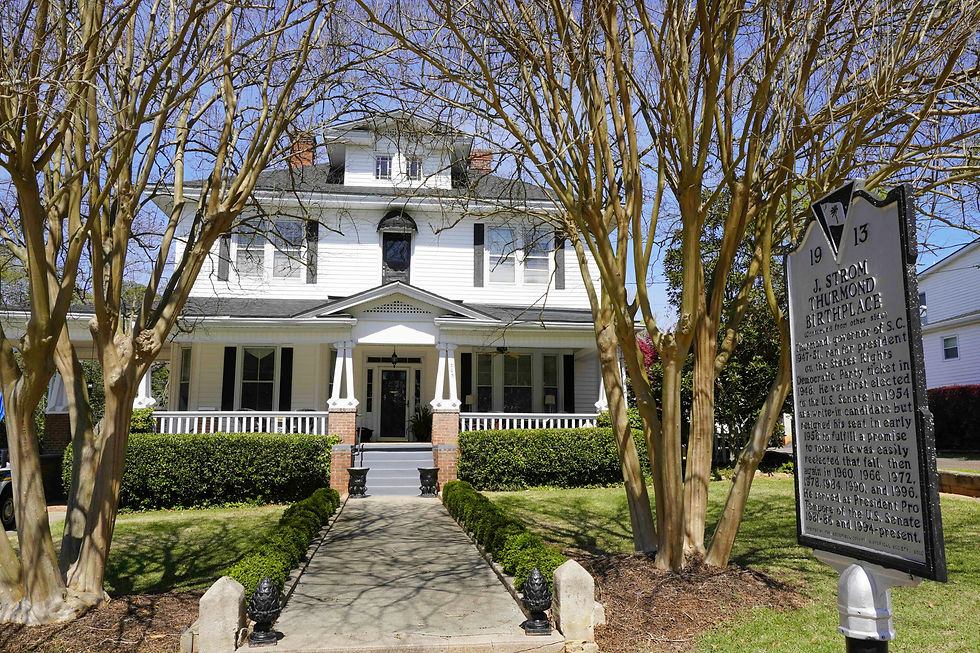
Down the road at Willowbrook Cemetery, Thurmond himself is buried among four former governors, 150 Confederate soldiers, and four Brigadier Generals of the Confederacy. Francis W. Pickens, who governed South Carolina at secession, rests in the Village Cemetery alongside Preston S. Brooks, the Edgefield congressman famous for beating abolitionist Senator Charles Sumner unconscious on the floor of the United States Senate with a metal-tipped cane.

That act — a Southern congressman walking into the Senate chamber and beating a Massachusetts senator bloody at his desk over the question of slavery — was celebrated in Edgefield. Brooks came home to public dinners and the presentation of commemorative canes. The message was not subtle. Political violence in defense of white power was not just tolerated here. It was an honor.
The geography is tight. The history is closer. And what it means to live and work and build a political career in a place like this cannot be separated from what happened here.
What Hamburg Was

Before there was a modern structure of South Carolina Republican power, before there was a Senate Majority Leader, before there was a hate crimes bill dying without a vote, there was Hamburg — and understanding what happened there requires understanding first what Hamburg had become.
Hamburg was a small town on the South Carolina side of the Savannah River, directly across the water from Augusta, Georgia. After the Civil War, it became something the white political establishment of South Carolina could not reconcile itself to: a thriving Black community, governed by Black men, functioning with Black dignity.
In the years following emancipation, freed people and free Black residents built
Hamburg into a real municipality. They elected their own leaders. They formed their own institutions.
When the state reorganized itself under Reconstruction, Hamburg sent Black men to the legislature. Prince Rivers — a formerly enslaved man who had escaped slavery, served in the Union Army, and returned to South Carolina as one of the most capable political organizers of the era — was elected Intendant of Hamburg, the equivalent of mayor. John Gardner and Samuel Lee, fellow Hamburg residents, were among the Black legislators serving in Columbia.
Their presence in office was not a novelty. It was part of something much larger. The 1868 South Carolina constitutional convention produced the most progressive state government in America at the time. The legislature that assembled under it was majority Black — the first in American history. More than 200 Black men served in the state House of Representatives. Public education was expanded and codified for the first time. The state's new constitution guaranteed rights and protections that had never existed before.
Democracy, for a brief and fragile window, was functioning as it was supposed to function.
White Edgefield — and white South Carolina — could not accept it.
The events that ended it began, with deliberate irony, on the Fourth of July.
July 4th, 1876

On the afternoon of July 4, 1876, Company A of the Ninth Regiment of the South Carolina National Guard — an all-Black militia unit stationed in Hamburg — was conducting military exercises in the street. It was the centennial of American independence. The militia was doing what militias do: drilling on a public road.
Two white farmers from neighboring Edgefield County, Thomas Butler and Henry Getzen, arrived in a horse-drawn buggy and demanded that the militia clear the road so they could pass through. The militia's captain, a man named Dock Adams, explained that there was ample room on either side of the formation. Butler and Getzen got through. But they did not let it go.

Two days later, on July 6th, Butler and Getzen appeared before the local magistrate in Hamburg and filed a formal complaint accusing the militia of obstructing a public road. The hearing was set for July 8th. What happened next was not the spontaneous result of a legal dispute. It was the execution of a plan.
By the time the hearing convened on July 8th, more than one hundred armed white men had gathered in Hamburg. They had come from Edgefield County and surrounding areas. They were members of what were officially called "rifle clubs" — private paramilitary organizations that had been proliferating across South Carolina as the 1876 gubernatorial election approached.
Their leader, in the broader strategic sense, was Major General Martin Witherspoon Gary of Edgefield — the man whose plantation home, Oakley Park, now sits across the street from Anthony Shane Massey's law office.

Gary had devised what came to be known as the Edgefield Plan: a systematic strategy for using armed intimidation to suppress Black Republican voting and return white Democrats to power in South Carolina. The Hamburg confrontation was not a coincidence. It was the first scheduled application of that plan.
The militia, outnumbered and surrounded, barricaded themselves in their armory. The white mob brought a cannon over from Augusta, Georgia, and aimed it at the building. Under cannon fire, the armory wall was breached. What followed was not a battle. It was a hunt.
Militiamen and civilians attempted to flee. Several were shot as they ran. Twenty-five were captured. Four of those men were pulled from the group and executed where they stood.
Prince Rivers arrived the following morning, July 9th, to stand over the bodies of his men and convene a coroner's inquest. He issued arrest warrants for eighty-seven white men, including Matthew Butler, who would later serve as a United States Senator, and Benjamin Ryan Tillman, who would later become governor of South Carolina and one of the most powerful architects of racial disenfranchisement in the state's history.
The names of the men killed that day are these: Allen Attaway. Nelder John Parker. James Cook. David Phillips. Albert Myniart. Moses Parks. Hampton Stephens.
They have been recorded. They have been largely ignored. For nearly a century after the massacre, no marker or monument acknowledged them. When the city of North Augusta celebrated its centennial in 2006, promotional literature described Thomas McKie Meriwether — the one white man killed in the attack — as "the only resident of Hamburg to be killed in the Hamburg riot of 1876." Seven Black men had been killed, four of them executed. The literature erased them entirely.
The grand obelisk honoring Meriwether had stood in a public park in North Augusta since 1916, erected with funds appropriated by the South Carolina legislature. One side of that monument reads that Meriwether gave his life so that "the civilization builded by his fathers might be preserved for their children's children unimpaired." Another side states that in life he exemplified "the highest ideal of Anglo-Saxon civilization" and that by his death he ensured "the supremacy of that ideal."

That monument still stands. In a public park. In 2026.
The marker acknowledging the seven Black men killed — a simple roadside panel, not a granite obelisk, funded not by the state legislature but by a local nonprofit — was finally installed in 2016. It stood in two churches for five years before anyone found a permanent location for it.
The Red Shirt Campaign

Hamburg was the opening act. What followed was a coordinated, statewide campaign of racial terror that its architects called "Redemption."
Martin Gary's Edgefield Plan was explicit about its methods. Written instructions distributed to white Democratic clubs across the state directed organizers to attend every Republican meeting held in their area, to disrupt those meetings, and to control Black voters "by intimidation, purchase, keeping him away." The word intimidation was not rhetorical. It described men arriving at political gatherings on horseback, armed, outnumbering the attendees, and making clear through their presence and their conduct that participation in democracy would carry consequences.
By the fall of 1876, an estimated 85,000 men across South Carolina had donned red shirts as the uniform of this campaign. They were not volunteers at a political rally. They were, as historians have documented, a white supremacist paramilitary force.
Their ranks were drawn heavily from former Confederate soldiers, men already organized, already armed, already experienced in coordinated violence, who regarded the Reconstruction government as an illegitimate occupation and the Black men who served in it as targets.
They rode through Black communities in formations. They attended Republican meetings with guns visible. They beat and killed organizers.
In September 1876, in the town of Ellenton — also in Aiken County, not far from Hamburg — white paramilitary groups rampaged for six days. Field workers, families in their homes, congregants at church gatherings: no one was safe. An estimated thirty to one hundred Black people were killed during the Ellenton massacre, including state legislator Simon Coker, who was shot in the head while on his knees praying for mercy just 29 years old.
One of the leaders present at Coker's killing was Benjamin Ryan Tillman.

The campaign worked. The 1876 election was, as one historian has called it, the most corrupt in South Carolina history. Through a combination of mass voter suppression, physical intimidation, ballot stuffing, and outright fraud, white Democrats swept to power. Wade Hampton III was named governor.
Federal troops, whose presence had made Reconstruction possible, were withdrawn as part of the Compromise of 1877 — the backroom deal between Southern Democrats and national Republicans that ended Reconstruction across the South in exchange for the presidency going to Rutherford B. Hayes.
Prince Rivers, standing over the bodies of his men, had told his son: "Now it will be a hundred years." He returned to driving a carriage. The arc of his life — from enslaved man to soldier to mayor to carriage driver again — captures precisely what was lost.

At Oakley Park, General Gary, who never formally surrendered after the Civil War and reportedly said "I'll never surrender" upon hearing of Lee's capitulation, had delivered a speech from his balcony on Election Day to fifteen hundred Red Shirts assembled before him. The movement that speech helped launch destroyed Black political power in South Carolina for generations.
That balcony still stands. That building, maintained today by the Edgefield Chapter of the United Daughters of the Confederacy, is listed on South Carolina's Heritage Corridor. It advertises itself to the public as a place to "marvel at the Lost Cause prints and Civil War relics on display." In its own literature and in the UDC's institutional publications, it is called, without apology, a shrine.

In 1944, the UDC's South Carolina Division published an article explaining why Oakley Park deserved restoration. It stated that "Oakley Park was the home of General Martin Witherspoon Gary, who with his Red Shirts, in 1876, did so much to restore white supremacy in South Carolina." That sentence has never been disavowed. It remains the stated rationale for the building's preservation.

The Red Shirts are, as researchers have noted, largely unknown to the general public — which is precisely why their glorification at Oakley Park escapes the scrutiny that monuments to other white supremacist organizations receive. The museum's language has grown more discreet over the decades, but its message has not changed. The Red Shirts are presented as patriots. The terror they inflicted is absent. The Black men they killed do not appear.
This is the institution that sits across the street from the Senate Majority Leader's law office.
Not down the road.
Across the street.
When Terror Became Law: Tillman

Benjamin Ryan Tillman was born in Edgefield County in 1847. He grew up in the culture of a county that had already built its identity around the violent defense of white political and economic dominance. He came of age during the Civil War and Reconstruction, watched the Black majority assert its democratic power, and spent the rest of his life working to undo it.
He was active in the Red Shirt campaign. He was present at Ellenton. He was indicted by Prince Rivers's coroner's jury for his role in the Hamburg Massacre, though he was never tried — because the men who would have prosecuted him were swept from power by the very campaign he helped lead. He boasted about all of it, openly, for the rest of his career.
At a Red Shirt reunion in Anderson, South Carolina in 1909, he celebrated his role in the murder of six Black militia members, whom he called "negro thugs," as a victory.
He became Governor of South Carolina in 1890. In 1895, he convened and led the state's constitutional convention. He did not pretend the purpose was anything other than what it was.
Standing before his fellow senators on the floor of the United States Senate on March 23, 1900, he said:
"We did not disfranchise the negroes until 1895. Then we had a constitutional convention convened which took the matter up calmly, deliberately, and avowedly with the purpose of disfranchising as many of them as we could under the fourteenth and fifteenth amendments."
Calmly. Deliberately. Avowedly.
He was not confessing.
He was bragging.
In the same speech, on the question of Black political rights, he told the Senate: "We of the South have never recognized the right of the negro to govern white men, and we never will."
The 1895 constitution established poll taxes and literacy tests as barriers to voting. But the literacy test was not administered neutrally — it was administered by white registrars who had complete discretion over whether a given applicant had demonstrated sufficient "understanding" of the constitution.
The mechanism was a trap, designed to look like a civic requirement while functioning as a racial gate. It worked for seventy years.
The system it built — one-party white rule in South Carolina — persisted effectively until the Voting Rights Act of 1965.
Tillman understood clearly what he had done.
More than a decade after Tillman's death, his political allies and admirers began raising funds for the statue that stands today on the grounds of the South Carolina State House.
The fundraising letters made the purpose explicit. Governor John Gardiner Richards Jr., who spearheaded the effort, wrote to potential donors that it was through Tillman's efforts that the 1895 constitutional convention
"Made Democracy forever safe for white people in South Carolina."
Other pamphlets from the same campaign praised the constitution for having "legally disenfranchised the negroes and gave the common white man a firmer hold on political power."
When the monument was unveiled in 1940, it called Tillman a "patriot" and "statesman." It speaks of service to the common people. It does not mention Hamburg. It does not mention the 1895 convention's stated purpose. It does not mention Ellenton, or the Red Shirts, or the seventy years of disenfranchisement that followed from Tillman's work.

That statue stands on the State House grounds today. Students walk past it. Legislators walk past it. Journalists walk past it on their way to cover the Senate chamber where the Clementa C. Pinckney Hate Crimes Act is held, session after session, from a vote.
There is a through-line. It does not require inference. The men who built it said so themselves.
The Man and the Position

Shane Massey was born in 1967 and raised in Edgefield County. His father, Hugh M. Massey, was a prominent attorney. The family name has been documented in Edgefield for roughly 225 years — among the old families of a county where that designation carries a specific meaning: a relationship to land, to law, to governance, built in a particular era and preserved across the transformations that followed.
Massey attended the University of South Carolina and the University of South Carolina School of Law — the same institutional pipeline that has produced generations of South Carolina political leadership, where relationships are formed and maintained that shape what is possible in Columbia.
He practiced civil litigation and business law at Richardson, Plowden & Robinson, P.A., a well-connected firm.
He was elected to the South Carolina Senate in 2006.
He became Senate Majority Leader in 2016.
He is, by any measure, among the most powerful people in the South Carolina government.
As Senate Majority Leader — only about the third or fifth person to hold that role in the modern South Carolina Senate — he controls the legislative agenda.
He coordinates votes.
He determines what reaches the floor and what does not.
That is not symbolic power.
It is the actual machinery of governance, and it functions with very little visibility to the public that lives under its results.
I am not calling Anthony Shane Massey a white supremacist. I want to be direct about that, because what I am arguing is more precise and more documented than a characterization of his private beliefs.
What I am saying is this: Massey holds a gatekeeping position in a legislative system whose modern architecture was built, deliberately and openly, to exclude Black South Carolinians from political power.
He practices law across the street from the shrine of the paramilitary campaign that made that architecture possible.
He represents a county whose political identity was forged in racial terror and has been maintained, in part, through the institutional cultivation of a particular version of that history. And he has used the authority of his position, year after year, to prevent the state from taking a formal vote on whether hate crimes deserve to be named.
Those are facts. They can be checked. They are on the record.
The Bill and the Silence

On the evening of June 17, 2015, a twenty-one-year-old white man walked into Emanuel African Methodist Episcopal Church in Charleston, South Carolina. He sat with the congregation for a Bible study session that lasted approximately an hour. Then he stood up and killed nine people. He had come to the church with a documented ideology of racial hatred, a manifesto, and a Glock .45.
Among the dead: Clementa C. Pinckney, senior pastor of Emanuel AME and state senator for the 45th district. Cynthia Marie Graham Hurd. Susie Jackson. Ethel Lee Lance. DePayne Middleton-Doctor. Tywanza Sanders. Daniel Simmons. Sharonda Coleman-Singleton. Myra Thompson.
The killer had chosen Emanuel AME because of what it represented. One of the oldest and most historically significant Black churches in the South, a congregation that had survived arson, earthquake, and the repeated prohibitions of a state that made it illegal for Black people to worship freely.
He wanted to start a race war. He wanted to kill Black people where they gathered to pray.
South Carolina has no hate crimes law.
It did not have one then.
It does not have one now.
The Clementa C. Pinckney Hate Crimes Act was first introduced during the 2021–2022 legislative session. It passed the South Carolina House of Representatives, demonstrating clear majority support in the people’s chamber. It has never received a vote in the Senate.
Most recently, during the 2023–2024 legislative session (H.3014):
The House passed the bill on March 8, 2023, by a vote of 84–31 and sent it to the Senate.
It was referred to the Senate Judiciary Committee and advanced out of committee.
Outcome: The bill never received a full Senate floor vote and ultimately died in the chamber.
Not defeated. Not debated in committee and found lacking. Not put to a vote and rejected by the majority.
Simply prevented from reaching the floor. Session after session.
Massey has said publicly that there is not enough appetite in the Senate for the bill.
That framing is worth examining.
The House has an appetite.
Prominent senators have discussed it.
Legal advocates, civil rights organizations, and crime victims' families have called for it. What appears to be missing is not support. It is the willingness of the man who controls floor access to allow the full Senate to decide.
South Carolina is one of only a handful of states in the country without a hate crimes law.
It is a state where a man shot nine people in a church because of who they were.
It is a state where the Hamburg Massacre occurred.
It is a state where seven Black men were executed by a mob and one white man got a granite obelisk.
It is a state where the man most responsible for building the architecture of Black disenfranchisement has a statue on the State House grounds and is called a statesman in stone.
And it is a state where the bill bearing the name of a murdered pastor cannot get a vote.
The Pattern

What I found in Edgefield, and in Trenton, and along the banks of the Savannah River where Hamburg once stood, is a pattern that this state has practiced with varying degrees of sophistication for one hundred and fifty years.
It does not require new personnel or new ideology in every generation. It requires only that the structure be maintained and that the people who hold positions within it understand, whether consciously or by absorption, what the structure is for.
In 1876, the mechanism was guns and horse-mounted militias and a cannon brought across the river from Augusta to blow a hole in the armory wall.
In 1895, the mechanism was a constitutional convention and literacy tests and poll taxes and an "understanding clause" administered by white registrars who understood their job.
In 2025, the mechanism is a legislative calendar. A decision about which bills reach the floor.
A Senate Majority Leader who says there is not enough appetite and moves on to the next item of business.
The names change.
The result is the same.
Black citizens asking for protection from targeted violence are told, through the management of process and procedure, that now is not the right time.
That the Senate will not be speaking on this.
That is political violence.
It does not require a weapon. It requires a position and the willingness to use it to protect some people while leaving others unprotected.
It requires a system built for that purpose and a person willing to be the system's instrument.
Prince Rivers stood over his dead men and did what you do after a massacre: he built the first link in the chain of justice.
He issued warrants.
He sent testimony to the New York Times.
He tried.
He had no illusions about his odds.
Then the federal government looked the other way, and Rivers drove carriages for the rest of his life.
Clementa Pinckney did not come from the lineage of power that Edgefield represents.
He came from faith and community and the tradition of Black civic leadership in South Carolina that stretches back to Hamburg and before.
He rose through service.
He became a senator.
He led a congregation.
He was killed in that congregation by a man who hated him for what he was and what he represented.

The bill that bears his name asks South Carolina to formally recognize, in law, that hate is a distinct and measurable harm.
That targeting individuals because of who they are is not just criminal, but a specific category of crime the state acknowledges, defines, and is obligated to address.
To refuse that bill a vote is not a procedural decision.
It is a statement.
It says that the question is not worth deciding.
That the people who need this protection are not worth the floor time.
That the Senate of South Carolina will not be weighing in on whether it stands against hatred.
What Remains

I drove back from Edgefield with more than I came with.
I came with a political story.
I left with a lineage.
The names of the men killed at Hamburg have been recorded. They have been largely ignored. I will not ignore them. Allen Attaway. Nelder John Parker. James Cook. David Phillips. Albert Myniart. Moses Parks. Hampton Stephens.
The monuments to Tillman stand. The shrine to the Red Shirts is open Thursday through Saturday, ten to four, and by appointment.
The obelisk honoring Thomas McKie Meriwether still reads, in stone, that he died for the supremacy of Anglo-Saxon civilization.
The Clementa C. Pinckney Hate Crimes Act has not received a vote.
Anthony Shane Massey is not Benjamin Tillman. But he operates within the system Tillman built, in the county where Gary organized the campaign that made that system possible, across the street from the shrine where that campaign is still honored.
He holds the position that determines what the Senate of South Carolina is permitted to decide.
He has not allowed this decision to be made.
At some point, the question of why becomes impossible to avoid. And the answer, in this state, in this county, in the shadow of this history, does not require much imagination to find.
Somebody has to go to these places and stand in them and read what is written on those walls and those stones and come back and report what they found.
I went.
I read.
It hurt.
South Carolina is still deciding whether it is finished with its past, or still living inside it.
The Senate floor is where that question is currently being held.
And the man holding it is from Edgefield.
— Javar Juarez is an investigative journalist based in Columbia, South Carolina, covering politics, policy, and the structures of power.