SC SENATE KILLS $3.2 MILLION MID-ELECTION REDISTRICTING PUSH


Inside the Blatt Building hearing on H.5683, the bill designed to elect seven Republicans and dismantle the only congressional district Black South Carolinians have ever meaningfully controlled.
By Javar Juarez| CUBNSC | Statehouse
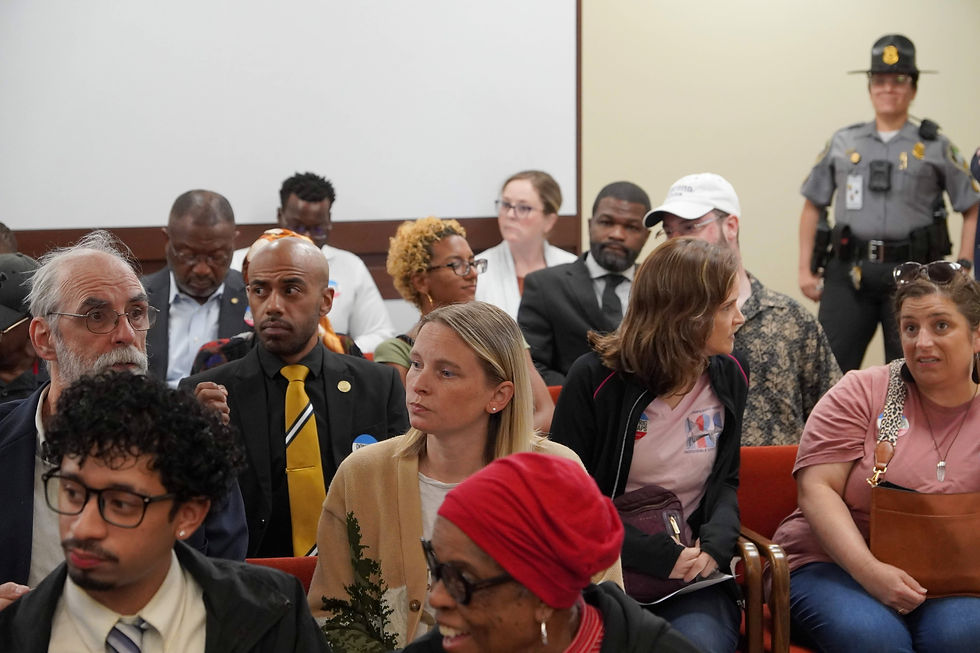
COLUMBIA, S.C. — The room inside the Blatt Building was tight Tuesday morning. Not merely crowded. Tight in the way government rooms become when the people inside understand the outcome has likely already been decided before testimony begins.
Lobbyists lined the walls. Staffers moved quickly between rows. Legislators leaned into side conversations beneath fluorescent lights while members of the public packed the gallery waiting to speak on legislation that could fundamentally alter political representation in South Carolina for the rest of the decade.
At the center of the hearing was House Bill 5683, a mid-decade congressional redistricting proposal designed to redraw all seven of South Carolina’s congressional districts outside of the normal census cycle.
Paired with House Bill 5684, which restructures filing deadlines and election dates to accommodate the redraw, the legislation would trigger special elections costing taxpayers at least $3.2 million while exposing the state to litigation lawmakers openly acknowledged is almost certainly coming.
But long before public testimony began, the purpose of the legislation had already been made clear.
“This map was recently produced following the Supreme Court’s decision in Louisiana versus Callais and achieves the state’s political goal of maximizing the state’s ability to elect Republican Congress folks from each of the seven congressional districts,”
Chairman Jay Jordan told the subcommittee as he introduced Adam Kincaid, Executive Director of the National Republican Redistricting Trust.
Kincaid, appearing remotely by Zoom, confirmed the objective himself.
“What I went through and tried to accomplish is a district, a map for South Carolina that would elect seven Republicans,” Kincaid said.
The proposed map would transform South Carolina’s Sixth Congressional District — the majority-Black district represented by Congressman James E. Clyburn for more than three decades — from a Democratic-leaning seat into what Kincaid described as an “R plus five” Republican district that President Donald Trump would carry by ten points.
That district is not politically incidental in South Carolina. It is the only congressional district in the state where Black voters have historically held decisive electoral power.
THE TRUMP CONNECTION

Opening debate on H.5683, bill sponsor Representative Luke Rankin cast South Carolina Republicans as victims of entrenched Democratic political power.
"Are Republicans willing to use the constitutional authority given to us by the people of South Carolina," Rankin asked, "or are we going to sit back and allow the political status quo to continue unchecked?"
Rankin accused Democrats nationally of "perfecting the art of gerrymandering districts to protect their power and weaken conservative representation."
"This bill is about leadership," Rankin said. "It's about having the courage to act instead of backing down because the media, the ACLU or the radical left might complain about it tomorrow."
By the time Lieutenant Governor Pamela Evette took her seat before the committee, the hearing had already shifted from procedural debate into ideological confrontation.

Rankin had established the grievance. Jordan had named the partisan goal on the record. What Evette brought was the national political machinery that gave both meaning.
"I come before you this morning with a clear and urgent message," Evette told lawmakers. "South Carolina must immediately redraw our congressional districts by any means necessary."
Evette framed the redistricting push not as a technical or constitutional exercise but as a political battle against Democrats, voting rights litigation, and what she described as "activist courts."
"For far too long, Democrats and their activist allies have abused the courts to impose racial gerrymandering and cling to the power they could not win at the ballot box," she testified.
She then invoked President Donald Trump directly.
"President Trump has made his expectations unmistakable," Evette said. "There is no more time for hesitation or half measures."
The significance of the moment was difficult to ignore. South Carolina's second-highest elected official was openly urging lawmakers to redraw congressional districts "by any means necessary" while endorsing maps specifically designed, by the testimony of their own architect, to produce seven Republican congressional seats.

Representative Justin Bamberg challenged Evette directly on the central contradiction.
"You do understand as lieutenant governor, do you not, that the Democrats didn't draw the congressional map," Bamberg said. "Your own party did."
Bamberg later sharpened the point further.
"Is it just fair to say that you were okay with the map until Donald Trump told you not to be?"
Evette denied the claim, but offered no clear explanation for what had changed between the last redistricting cycle — when she did not testify — and this one beyond the shifting political climate in Washington.
As the exchange continued, Evette struggled to answer from a position of clear authority on the composition of the chamber or the political structure she was criticizing, exposing the deeper contradiction at the center of the hearing: Republicans portraying themselves as victims of Democratic manipulation inside a state government they already overwhelmingly control.
THE MAPMAKER LEFT

While the ideological argument played out at the podium, the technical architecture of the redraw was presented by a man most South Carolinians have never heard of — and one who left the hearing before lawmakers could fully question him.
Adam Kincaid is not a South Carolina official. He is the Executive Director of the National Republican Redistricting Trust, a Washington-based organization whose purpose is to advance Republican mapmaking strategy at the state level nationwide.
He drew this map. He presented it remotely. And when members of the subcommittee moved to question him, he was already counting down to his exit.
“I’ve got a 10 o’clock hard stop,” Kincaid informed lawmakers.
The moment immediately collided with the broader argument Republicans had spent the morning making about fairness, legitimacy, and restoring public confidence in the redistricting process itself.
Representative Bamberg moved to adjourn the hearing until Kincaid could return and answer questions in full.
The motion failed 3-2.
Representative Spencer Wetmore then pressed the contradiction directly with Lieutenant Governor Pamela Evette, questioning whether a process built around fairness and voter confidence could simultaneously limit lawmakers’ ability to question the very person who designed the maps.

“Would you consider prohibiting members of this committee from asking questions of the map maker to be part of a clear process?” Wetmore asked.
Evette did not defend the process on transparency grounds. Instead, she defended the speed.
“I think time is of the essence,” she said, citing election deadlines and administrative concerns election officials had raised earlier in the hearing.
Those same election officials had spent much of the morning warning lawmakers that the rushed process itself was creating the crisis now being used to justify the acceleration.
THE $3.2 MILLION PROBLEM

Before the maps were ever presented, before Evette delivered her remarks, before Rankin framed his grievance, South Carolina Election Commission Executive Director Conway Belangia walked to the front of the room and told the subcommittee what this legislation will actually cost.
What he described was not a routine election adjustment.
It was a compressed and expensive logistical emergency created by the legislature’s decision to pursue mid-cycle congressional redistricting during an active election year without allocating a single dollar to execute it.
“These timelines are incredibly tight,” Belangia testified. “State and county resources will be stretched.”
Under the proposed schedule, South Carolina must still comply with federal UOCAVA requirements mandating that overseas and military ballots be mailed 45 days before any federal election.
That deadline does not move.
The Department of Justice, Belangia noted, scrutinizes South Carolina specifically on this requirement and reviews compliance the day after the deadline passes.
The original proposed primary date of August 11 would place the state out of compliance with federal law.
Election officials requested the primary be moved to August 18, with a runoff on September 1. Even with those adjustments, Belangia warned there would be no margin for error — no room for legal challenges, no buffer for disputed results, no slack in a system being asked to sprint while being handed no additional resources.
The financial burden is direct and immediate.
Belangia estimated the special congressional primary at approximately $2.2 million, with an additional $1 million required if a runoff becomes necessary.
A minimum of $3.2 million for elections that were not scheduled, not budgeted, and for which no appropriation has been attached to either bill.
Nearly every county in South Carolina has already finalized its annual budget.
Counties will now be required to absorb unexpected election costs while managing poll worker shortages, database reconstruction across hundreds of ballot styles per county, and compressed certification timelines that leave almost no room for dispute resolution.
Bamberg named it plainly.
“That is the definition of irresponsible government in a state that’s supposed to be small government and fiscally conservative.”
THE LEGAL CONTRADICTION
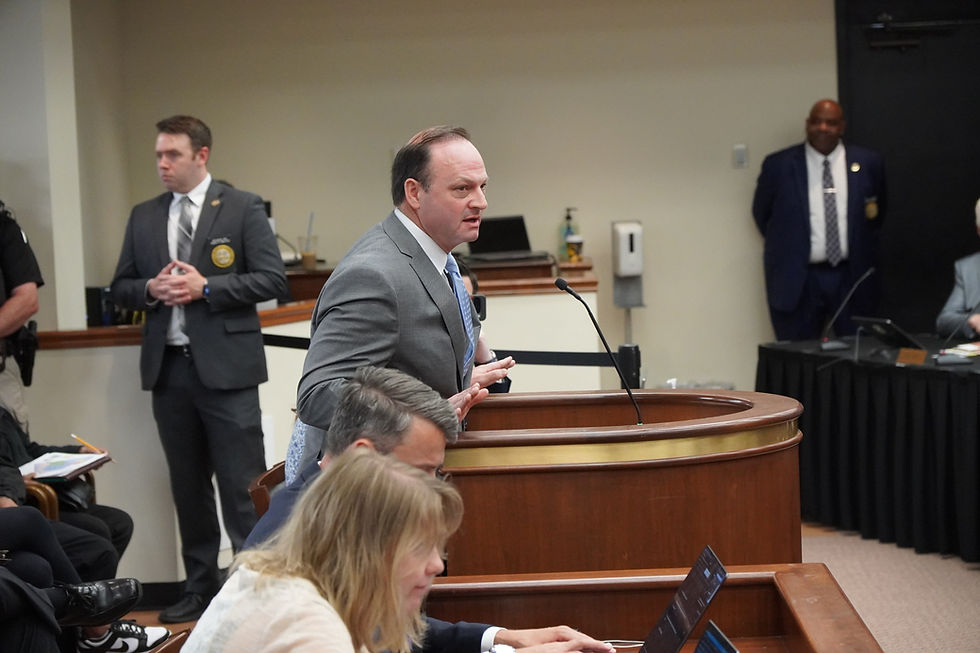
Republican lawmakers, the lieutenant governor, and the attorney general all invoked recent Supreme Court rulings — particularly Louisiana v. Callais and Alexander v. South Carolina State Conference of the NAACP — as legal authority for the redraw.
The argument has a structural problem Democrats pressed throughout the hearing.
In Alexander, South Carolina Republicans successfully argued before the Supreme Court that the state’s previous congressional maps were driven primarily by partisan rather than racial considerations.
Republicans won that case by insisting race was not the predominant factor in how districts were drawn.
Now those same Republicans are attempting to redraw the state’s only majority-Black congressional district into a Republican-leaning seat while again insisting race is irrelevant to the process.
Kincaid testified racial data was removed entirely from the mapping software.
But the predictable racial consequence of dismantling the Sixth District and the question of whether race was an input in a computer program are two distinct legal inquiries.
Courts have recognized that distinction before. They are likely to recognize it again.
Bamberg was direct.
“The Supreme Court dealt with Louisiana. This is not Louisiana.”
He is correct.
South Carolina’s current congressional maps were not struck down by any federal court. Republicans are voluntarily reopening the process in pursuit of more aggressive partisan outcomes — outcomes their own mapmaker confirmed under testimony.
Attorney General Alan Wilson acknowledged Tuesday the state will likely become a party to litigation challenging the new maps.
He encouraged the committee to pass them anyway and allow the courts to sort it out.
South Carolina taxpayers would have funded both the litigation and the elections that followed.
THE BILLS DIES IN THE SENATE

By Tuesday evening, the legislation that consumed the Blatt Building for much of the day was effectively dead in the South Carolina Senate.
In a statement released after the collapse of the proposal, South Carolina Democratic Party Chair Christale Spain framed the outcome as a rejection of what critics described throughout the hearing as a rushed and politically motivated attempt to redraw congressional districts in the middle of an active election cycle.
“South Carolina Democrats stood firm and helped apply the pressure necessary to stop this reckless attempt to redraw congressional maps as voting has already begun for the June 9 primary,” Spain said. “Senate Republicans were forced to confront the chaos this proposal would have caused voters across our state.”
Spain continued by pointing directly to the logistical and democratic concerns raised repeatedly during testimony before the House subcommittee earlier in the day.
“With ballots already mailed and voting preparations already underway, changing the rules in the middle of the game would have undermined voter confidence and damaged trust in our elections,” she said. “This outcome is a testament to the South Carolinians who spoke out and refused to stay silent, and today democracy wins.”
The collapse of the legislation brought an abrupt halt to what would have been one of the most aggressive mid-decade congressional redistricting efforts in modern South Carolina history.
What happened Tuesday inside the Blatt Building was not difficult to understand.
A national Republican redistricting organization drew a congressional map designed to produce seven Republican congressional seats. Lieutenant Governor Pamela Evette publicly invoked President Donald Trump while urging lawmakers to pass the legislation “by any means necessary.”
The architect of the maps left the hearing before lawmakers could fully question him.
Election officials warned the proposal was dangerously compressed, unfunded, and administratively unstable.
And by the end of the day, the legislation collapsed under the weight of its own contradictions.
The record now belongs to the public.


