Held by Grace: At Emanuel 9 Memorial, a Place to Remember and a Call to Carry On


Eleven years after nine Black worshippers were murdered during Bible study, Charleston’s Emanuel Nine Memorial opens a space for remembrance, fellowship and reflection.
By Javar Juarez | New Progressive Journal | November 15, 2026
CHARLESTON, S.C. — When the fountain touched the ground, the church bells began to ring.
Deona Smith, the Emanuel Nine Memorial’s executive director, remembers the hour: 11 in the morning. She had watched the memorial take shape from its groundbreaking, when the site was still a parking lot.
She had followed the construction, the preparations and the work of bringing a long-held vision into being.
But the day workers lowered the fountain into place reached her differently.

“As soon as it touched ground,” Smith recalled, “all the church bells started ringing.”
She cried.
For Smith that moment carried the fulfillment of years of work. A place conceived in the aftermath of unbearable loss was becoming somewhere people could finally enter.
On Saturday, Nov. 14, the Emanuel Nine Memorial opened to the public beside the historic Mother Emanuel African Methodist Episcopal Church.

More than eleven years after a white supremacist murdered nine Black worshippers during Bible study on June 17, 2015, visitors could come into a courtyard built to hold their names, their memory and the fellowship that hatred sought to destroy.
At its heart is the Fountain of Grace.
Water flows over stone bearing the names of the nine. Curving marble benches gather visitors into a shared space. The church remains before them, a living congregation whose story continues.

I came to Charleston to report on the opening. Standing there, I found myself drawn into worship.
The water, the names and the knowledge of what happened here brought grief and anger close to the surface. Then I began to sing.
It was a public expression of faith I had not planned. The emotion remained with me hours after I left the grounds.
That is the experience I carried away. Others will bring their own beliefs, memories and questions. The memorial gives them somewhere to sit with those things.

For William Gregorie, who grew up at Mother Emanuel and has served on its trustee board, creating that space was essential.
“This is home,” he said.
The nine people killed were friends and family. Susie Jackson, the eldest victim, was his sister’s mother-in-law. The years since the massacre have included the painstaking work of choosing an architect, reviewing drawings and considering how a memorial might serve people living with loss.
Gregorie described the opening as bringing “a sense of completeness.”
He remembered an unmet need: somewhere a person could sit alone and reflect.
Now there are benches, a fountain and a quiet place near the cross. He has sat there by himself.
“It’s an unbelievable experience,” he said.
The memorial honors the Rev. Clementa Pinckney, Cynthia Graham Hurd, Susie Jackson, Ethel Lee Lance, the Rev. DePayne Middleton-Doctor, the Rev. Sharonda Coleman-Singleton, Tywanza Sanders, the Rev. Daniel Lee Simmons Sr. and Myra Quarles Thompson.

Their names ask visitors to remember nine individual lives. To those who knew them, each name carries relationships, conversations and ordinary moments that a stranger may never know.
The space makes room for those memories.
Architect Michael Arad, who designed the National September 11 Memorial in New York, conceived the Emanuel Nine Memorial. Guy Nordenson helped resolve the structural challenge of building its embracing forms from solid stone.

Nordenson recalled their early conversations about the project roughly eight or nine years ago. One of his first contributions was proposing solid stone construction. The team ultimately used white marble from Vermont.
The engineering required careful attention to how the pieces would stand and support one another during an earthquake.
Nordenson explained that curved, interlocking joints allow the stones to lean into neighboring pieces under horizontal movement. Each piece has its own stability; together, they gain more.
Installation required patience. Workers began with the center piece and slid others into place from either side, carefully protecting the marble edges.
The result has an emotional quality that Nordenson said he understood more fully when he entered the finished space.
“It feels enclosed like an embrace,” he said.
Facing the church from within it, he found the experience comforting and peaceful. He also felt the devotion required to bring the project this far.
“This project took a lot of energy,” he said. “It took a lot of devotion and tenacity on everybody’s part.”
That persistence extends beyond construction.
For state Rep. Wendell Gilliard, remembrance carries a continuing obligation at the South Carolina State House.

He spoke emotionally about hearing survivor Polly Sheppard recount the attack. He also recalled spending the night outside Mother Emanuel after the massacre with then-Mayor Joe Riley and others.
The commitment he made in that period remains, he said: to secure a state hate crimes law.
“We owe that to the victims, to the survivors, to the citizens here in South Carolina,” Gilliard said.
He said he intends to pre-file the legislation again when the filing period opens.
“I won’t ever give up.”

His words bring a question into the memorial’s opening: What will people do with what they remember here?
The courtyard gives people a place to grieve, pray and gather. Gilliard urged visitors to carry that care into how they serve their communities.
For the congregation, caring for the memorial is part of the work ahead.
Gregorie spoke about preserving the church’s story and finding ways to sustain its work. He described possibilities that include a kitchen featuring church members’ recipes and a coffee shop connected to the garden space.
Those remain ideas, expressions of his hope that Mother Emanuel’s properties can help support its future.
He wants the church to keep telling the story while caring for the people who carry it.
Smith finds meaning in that daily work: talking with families, hearing their feedback and welcoming visitors. One of her favorite responsibilities is bringing people into the memorial and watching their reactions.
“I feel that it’s an honor to do this work,” she said.
On Saturday, I felt the weight of that invitation.
I thought about the nine people whose names the water passes over, the survivors who continue to bear witness and the congregation that has spent years making room for the world’s grief alongside its own.
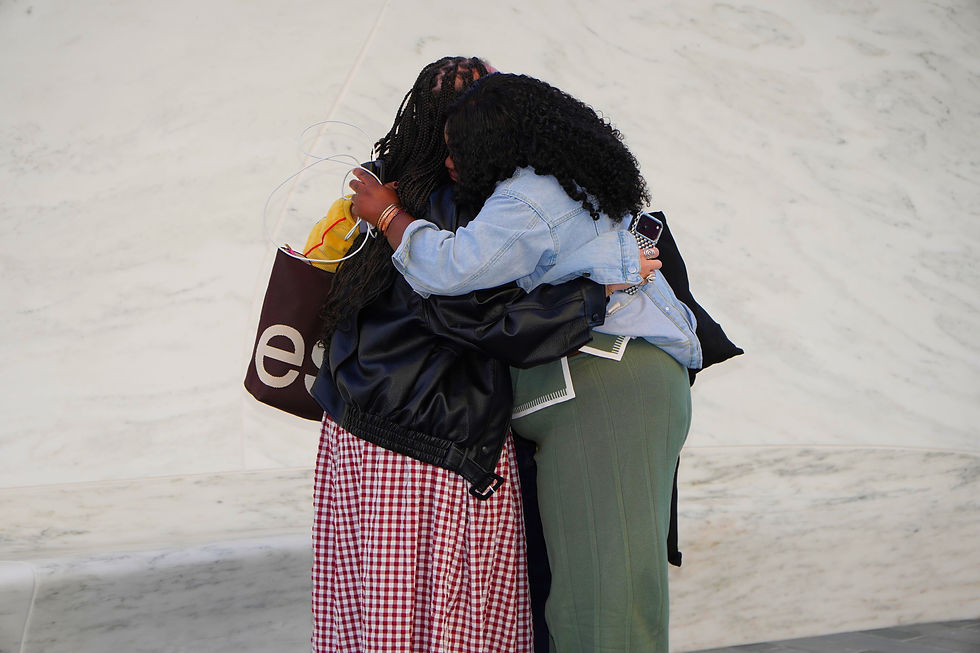
The fountain had been lowered into place. The stone had been fitted together. The gates had opened.
Now people could enter, sit down and remember.
And when they rose to leave, they would have to decide what to carry forward.

Visit the memorial
The Emanuel 9 Memorial is free and open to the public at 120 Calhoun Street in Charleston, beside Mother Emanuel AME Church.
Current visiting hours are:
Tuesday–Saturday: 9 a.m.–5 p.m.
Sunday: Noon–5 p.m.
Monday: Closed
Hours may change for special events. Check the memorial’s visitor information page before coming. For questions or assistance, call 843-928-2567.
Visitors can scan the mobile app QR code at the memorial to access a self-guided tour and information about the site.
Help care for this space
Donations support the memorial’s upkeep, preservation and ongoing work. Readers can give online through the Mother Emanuel Memorial Foundation.
Checks payable to Mother Emanuel Memorial Foundation can be mailed to P.O. Box 20331, Charleston, SC 29413. For information about volunteering or offering professional services, email info@emanuelnine.org.

Javar Juarez is Publisher and Editor-in-Chief of the Columbia Urban Broadcast Network (CUBN), an independent investigative news outlet based in Columbia, South Carolina, and a member of the South Carolina Press Association.


