Jermaine Johnson Becomes South Carolina's Democratic Nominee for Governor


By Javar Juarez | CUBNSC | ELECTION NIGHT 2026
Hopkins, S.C. — Tuesday, June 9, 2026
The rain came again.
It has come before. It came in 2015, when a young man named Jermaine Johnson — newly retired, newly inspired, newly determined — hauled food into a room, set up chairs, and waited. He waited to teach people about second chances. He waited to build something.
Only three people showed up. The food sat. The rain fell. And still, he stayed.
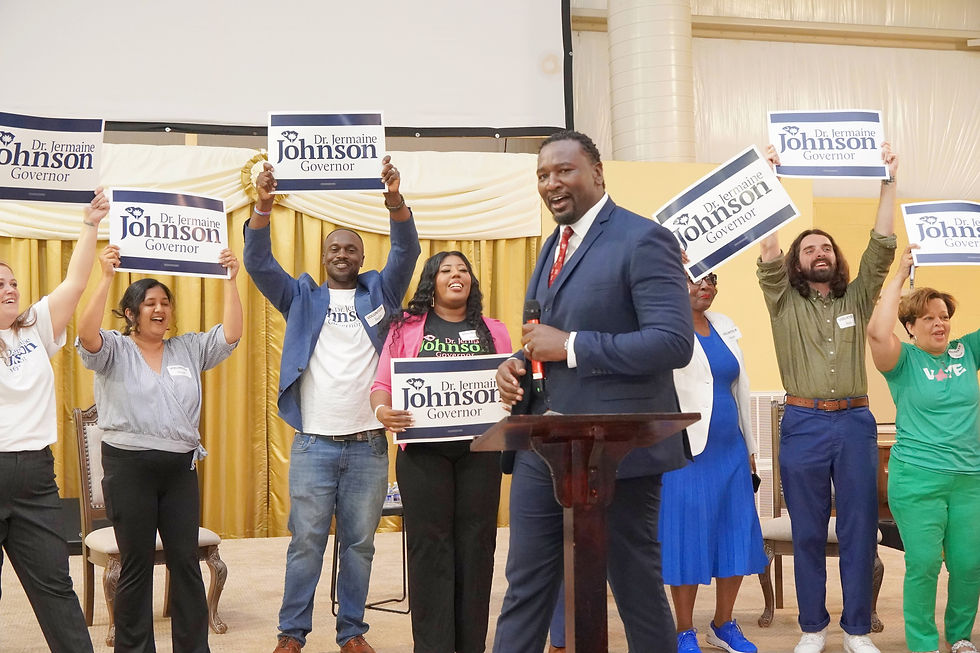
On Tuesday night, surrounded by his wife, his children, his sister from Minnesota, his in-laws, his pastor, his campaign manager, his volunteers who worked two, three, and four jobs without sufficient funding — Jermaine Johnson stood before a crowd in that same community, in that same spirit, and declared:
"I am honored to be your Democratic nominee."
Johnson took the nomination with 58.2% of the vote, well over the majority margin that would have necessitated a runoff. "This is a moment right now that is going to grow in history," Johnson said during his victory speech. He claimed the nomination decisively, substantially outspent by two self-funded millionaire candidates — White House alum Billy Webster and Charleston attorney Mullins McLeod — yet taking an early lead that the Associated Press called around 9 p.m.
The numbers: Webster received 31.1% of the vote. McLeod received 10.7%.
This was not a close race. This was a mandate.
The Room Where It Started

Johnson chose his victory venue deliberately. He told the crowd why.
Back in 2015, after retiring from basketball, he held his very first community event in that building — a modest gathering designed to educate people about second opportunities. The turnout was three. The weather was punishing. The food went largely uneaten. But that moment, he said, never left him.
A year later, he was back in another room in that same facility, advocating for a young man stopped by police three times in three days. That is where he first met State Representative Joe Neal — and where he said he first truly understood what it meant to be a servant leader.
"I will never forget what that meant for me," Johnson told supporters Tuesday night, "and what it did for my life going forward."
That liturgy of witness — the room, the rain, the three people, the young man and the police stops, State Rep. Neal — is not political autobiography. It is testimony. And testimony is the foundation upon which Johnson has built his political identity: not wealth, not dynasty, not party machinery, but the lived experience of a community that did not give up on him, and a man who refused to give up on his community.
The Nominee: Who Is Jermaine Johnson?
Johnson was born in Los Angeles, California, and lives in Columbia, South Carolina. He earned a bachelor's degree in communications from the College of Charleston in 2008, a master's degree in project management from Strayer University in 2014, and a doctorate in business administration from Northcentral University in 2018.
His journey from growing up homeless and losing his brother to gun violence to becoming a College of Charleston basketball star and eventually rising to political power was chronicled in a documentary released last November.
Johnson has represented a district in the Columbia area for three terms and was tapped to give this year's Democratic response to Gov. McMaster's State of the State address — a rare distinction that signaled his standing within the party and his readiness for a larger stage.
Johnson was close to dropping out in March after claims that he was facing pressure from state Democratic Party officials to do so. He did not. He stayed in the race, ran a grassroots campaign against millionaires, and won by nearly 30 points. That detail should not be glossed over. It tells you something about who this man is and what kind of governor he intends to be.
His wife, Evan Johnson, joined him on stage Tuesday night. She told the crowd they had been together for 16 years. She has watched him meet person after person across South Carolina who believes in a New South Carolina — people who love them, who are happy to see them. "This has not happened since 1990," she said of the Democratic energy she has witnessed.
The Road Ahead: A Republican Runoff — and a Divided Party
While Johnson claimed a decisive and uncomplicated victory on the Democratic side, the Republican Party's primary descended into exactly the kind of chaos that wide-open, post-term-limits races tend to produce.
None of the Republican candidates in the primary for governor reached the majority threshold needed to avoid a runoff. Republican candidates Pamela Evette and Alan Wilson are advancing to a runoff, with the election scheduled for June 23.
Evette secured a runoff berth after garnering Trump's endorsement just one week before the election. She will face Wilson on June 23. Others in the race included U.S. Reps. Nancy Mace and Ralph Norman. Mace quickly threw her support to Wilson.
The dynamics on the Republican side are telling.
From the outset, the crowded primary race centered on an all-out battle among the top candidates to land Trump's endorsement. Evette emerged with the nod in the closing weeks and repeatedly promoted it — her campaign even blasted out a news release headlined "President Trump Doubles Down on his 'Complete and Total Endorsement'" of her.
And yet — with the full weight of the presidency, the sitting governor's backing, and the Republican machine behind her — Pamela Evette could not even clear 30% of her own party's vote on primary night. Trump named her his candidate. Her party said: not so fast.
Pamela Evette and the HBCU Reckoning
Before this primary concluded, Evette handed her opponents — and frankly, history — a defining moment that cannot be separated from the general election narrative now forming.
South Carolina State University announced that Lt. Gov. Pamela Evette would no longer serve as Spring 2026 commencement speaker, reversing earlier plans amid controversy over her selection. SC State, the state's only publicly funded HBCU, moved in a different direction after days of sustained student protest.
Evette's combative responses on social media about the protest told a different story than her claims of a "non-political" address. She repeatedly challenged her opponents to "bring it on," referred to the protesting students as "woke mobs," and promised "they are really going to hate my speech."
Evette notably referred to the protesting students as a "woke mob" multiple times and said she does not intend to apologize for the remark. Students argued that Evette's political leanings do not align with the university and its history.
She then went further. Evette backed a group of state lawmakers pushing to defund SC State entirely following the commencement controversy.
This is the woman who wants to be governor of a state whose only publicly funded HBCU she threatened to defund for the political crime of exercising civic courage. That detail will matter in November. It should matter now.
Alan Wilson: The Attorney General Who Outlasted the Field

Alan Wilson, the son of 2nd District Congressman Joe Wilson, has been South Carolina's attorney general for over 15 years. He also serves as a Colonel in the Judge Advocate General's Corps for the South Carolina Army National Guard.
Wilson enters the runoff with momentum from an unlikely source: Nancy Mace's concession and endorsement. In a post on social media Tuesday night, Mace said: "As a survivor, I chose to stand on principle and stand against the Epstein cover-up. And apparently, I chose wrong if the goal was winning an election." Mace endorsed Wilson, throwing what remains of her coalition behind the attorney general heading into June 23.
Wilson now heads into the runoff backed by Mace's voters, and positioned as the Trump-skeptic alternative — though he is hardly that. Both men in this race have competed fiercely for MAGA credibility. The difference, it appears, is that only one of them got the call from Mar-a-Lago.
The Historical Weight of This Moment
South Carolina hasn't had a Democratic governor since Gov. Jim Hodges, who left office in 2003. Donald Trump won the state with 58% of the vote in 2024, making the Republican candidate the heavy favorite to win in November.
No one should pretend otherwise. The road ahead is steep. South Carolina is deep red at the statewide level, and the structural disadvantages facing any Democrat in a November gubernatorial race here are real and documented.
But structural disadvantages are not destiny.
Johnson himself has been defeating rooms with three people his entire adult life. He has built nonprofit organizations from the ground up. He has mentored formerly incarcerated people toward second chances. He has walked into communities where no candidate had ever set foot before, and he asked people to believe that tomorrow could be brighter. On Tuesday night, nearly 60% of Democratic primary voters said: we already do.
He defeated a 22-year incumbent to first win his House seat. He survived a gubernatorial primary against millionaires who vastly outspent him. And he did it with boots on the ground, with doors knocked, with a campaign run by people who stretched one paycheck across three jobs.
That is the testimony. That is the record.
The Running Mate Question
Johnson has not yet named a lieutenant governor running mate. However, whispers circulating within Democratic circles suggest he may select former South Carolina State Senator Katrina Shealy — one of the celebrated "Sister Senators" who risked her political career to stand against a total abortion ban.
Shealy was the last of the three Republican women who filibustered South Carolina's near-total abortion ban in 2022 to lose her primary, defeated by Republican Carlisle Kennedy in a runoff in 2024. She and her colleagues — state Senators Sandy Senn and Penry Gustafson — were all awarded the John F. Kennedy Profile in Courage Award for risking their careers for the greater good.
All three of the Sister Senators have now lost their primary bids to Republican men, leaving no Republican women in the state Senate.
Should Johnson choose Shealy, it would represent a crossover coalition ticket unlike anything South Carolina has seen in a generation — a Black Democratic nominee for governor and a former Republican state senator who paid the ultimate political price for refusing to strip women of bodily autonomy. It would be a ticket built on principle over party, on courage over convenience.
That pairing is still a whisper. But it is a whisper worth watching.
What Comes Next

The Republican runoff is June 23. South Carolina voters will then decide between the Trump-anointed Evette — who called HBCU students a woke mob and backed defunding their university — and Alan Wilson, whose family name is inseparable from South Carolina Republican politics.
Either way, Jermaine Johnson will be waiting.
He has been waiting before. In rooms with three people. In courtrooms advocating for young Black men. In committee chambers. In legislative halls where people said he wasn't ready, wasn't rich enough, wasn't connected enough.
They said it wasn't popular. He stood anyway. They said he needed to be a millionaire. He ran anyway. And on the night of June 9, 2026, in the same community where he once taught second chances to a nearly empty room in the rain — the people of South Carolina gave him the only currency that matters in a democracy.
Their votes.
The job's not done. The job's not done until everybody in this state has an opportunity.
— Rep. Dr. Jermaine Johnson, Democratic Nominee for Governor of South Carolina

Javar Juarez is Publisher and Editor-in-Chief of the Columbia Urban Broadcast Network (CUBN), an independent investigative news outlet in Columbia, South Carolina, affiliated with the South Carolina Press Association.


Excellent commentary.