Senate Debate: Graham Defends Trump. Andrews Challenges Graham’s Record. Whitener Rejects Both Parties.


Andrews challenges Graham on healthcare and Iran, Whitener pushes less government, and the sitting senator declines another debate says "Ice is doing a good job."
By Javar Juarez | New Progressive Journal | October 11, 2026 | News Analysis
COLUMBIA, S.C. - Sen. Darline Graham defended President Donald Trump’s policies Sunday night at SCETV, declined Annie Andrews’ challenge to debate again and left the post-debate questions to her campaign consultant.
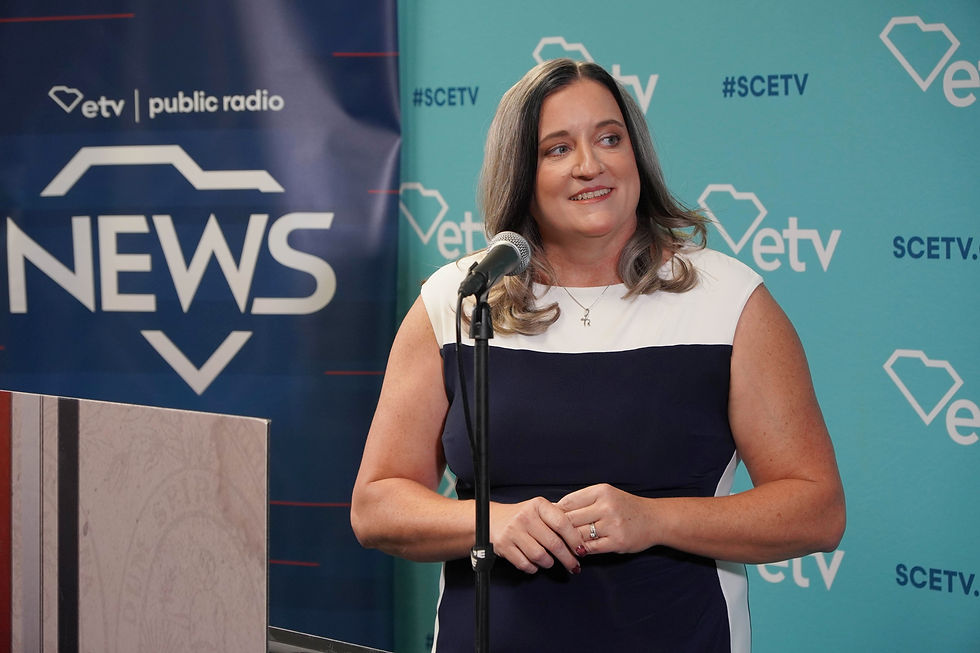
Andrews and Libertarian candidate Kasie Whitener met with reporters themselves.
T.W. Arrighi appeared for Graham.
“Winners of the debate don’t usually come to spin rooms,” Arrighi said. “That’s the history of that.”

Reporters were seeking answers about Social Security, energy policy and Graham’s relationship with Trump. T.W. Arrighi declared victory, but could not provide her position on raising the retirement age or the president’s Russian diesel agreement.
The debate, moderated by Gavin Jackson and Maayan Schechter, gave voters three competing approaches ahead of the Nov. 3 election. Andrews focused on healthcare and household costs. Whitener called for less government and an alternative to both major parties.
Graham defended her conservative credentials and her alignment with Trump.
“South Carolina still is Trump country,” Arrighi said afterward, describing the president’s relationship with the Graham family as a friendship beyond politics.
“I don’t think you’ll ever see Darline Graham running too far from Donald Trump,” he said.
Healthcare and rural hospitals

Graham repeatedly accused Andrews of supporting government-funded healthcare for everyone and warned that her proposal would drive up the national debt. Andrews described an optional public insurance plan that families could purchase.
“I want to hold insurance companies accountable, and I want to be sure every hardworking South Carolinian family has the option to purchase an affordable public plan, if that’s what they choose to do,” Andrews said during the debate.
Speaking to reporters afterward, she said competition from a federal public plan would pressure private insurers to offer better coverage at lower premiums.
Graham defended the One Big Beautiful Bill Act’s $50 billion rural healthcare fund and approximately $200 million awarded to South Carolina. Andrews called the funding “a drop in the bucket” compared with the law’s Medicaid cuts.
Asked by New Progressive Journal about rural hospitals and obstetric care, Andrews described visiting Bennettsville, where the hospital closed 11 years ago, and Allendale, where she said hospital officials fear the cuts could force their facility to close.
“Also, we never expanded Medicaid here in South Carolina,” Andrews said. “We have 15 counties without an OB/GYN.”
She warned that losing maternity services would leave pregnant patients farther from care and worsen infant and maternal mortality.
CUBN’s reporting in Edgefield has documented that pressure. County leaders described declining Medicare and Medicaid funding, their reliance on a larger healthcare partner to sustain the hospital and the longer emergency transport times residents would face without it.
Graham defended Medicaid work requirements. “Yes, count me in. I’m all for it,” she said. Andrews told reporters that reversing the Medicaid cuts would be her first priority in Washington.
Whitener advocated removing barriers to healthcare businesses and said government should be completely removed from the space. She did not explain how that approach would protect patients from unsafe care or unfair insurance practices.
On Social Security, Whitener blamed AARP for blocking reform, claiming it funds candidates “willing to say nothing about Social Security.” That claim is false. AARP does not endorse or donate to candidates, political parties or political action committees.
Whitener proposed a bipartisan commission and allowing younger workers to opt out and invest independently. Graham’s position on raising the retirement age remained unanswered. T.W. Arrighi said she had not made a public statement on it.
Iran and the president’s decisions
Andrews opposed the war with Iran and sending ground troops. She challenged Graham’s national security judgment and accused her of repeatedly opposing efforts to end the conflict.
Graham voted against a Sept. 24 resolution directing Trump to withdraw U.S. forces from the conflict. The measure failed, 49–50.
Graham said she wanted the war to end but argued against stopping while Iran remained dangerous. She blamed Democrats for allowing Iran to approach a nuclear weapon and invoked “peace through strength.”
Yet in June 2025, Defense Secretary Pete Hegseth said U.S. strikes had “obliterated Iran’s ability to create nuclear weapons.” Graham did not explain what had changed or what would bring the war to an end.
Whitener opposed preemptive wars and ground troops, favoring diplomacy, trade and cultural exchange.
On Israel, Graham emphasized support for the U.S. ally. Whitener said Israel should defend itself. Andrews said Israelis and Palestinians both deserve safety and called for an expedited path to peace.
Graham cited the Lindsey O. Graham Sanctioning Russia and Iran Act of 2026 as a legislative accomplishment. Trump signed it Sept. 18. But when reporters asked whether she supports his Russian diesel agreement, T.W. Arrighi declined to give her position.
Fuel prices and household costs
Graham supported temporarily suspending gas taxes and easing restrictions on drilling and refineries. She blamed Democratic regulations for California’s refinery closures and high gas prices.
The U.S. Energy Information Administration identifies other supply problems: the West Coast has limited connections to refineries elsewhere in the country, and California requires a special gasoline blend that only certain refineries can make.
Closures make replacement fuel harder to obtain and increase dependence on imports. www.eia.gov
Andrews called for suspending federal and state gasoline and diesel taxes, ending the Iran conflict and stopping tariffs that she said were driving up grocery prices. Federal Reserve Bank of New York researchers found that tariffs raise prices on imported goods and American-made products that use imported parts or compete with foreign goods. libertystreeteconomics.newyorkfed.org
Afterward, Andrews called for incentives for childcare workers and restoring childcare vouchers. Suspending federal fuel taxes would require action in Washington; suspending South Carolina’s tax would require approval from state lawmakers.
Whitener blamed rising prices on scarcity and national debt, claiming people would not buy U.S. Treasury securities. Four days before the debate, on Oct. 7, investors purchased $39 billion in 10-year Treasury notes, contradicting her claim. www.barrons.com
Data centers and local control
Andrews supported a two-year data center moratorium, protections against shifting costs onto residents and greater local control. Graham opposed the pause as a threat to American competitiveness with China, while saying communities should decide whether projects are built.
Graham cited the Ratepayer Protection Act as a safeguard against higher electricity bills. But the bill stalled in the Senate on Sept. 30, receiving 57 of the 60 votes needed to advance. Opponents called it “toothless” because it required regulators to consider protections without requiring their adoption. www.senate.gov
Whitener warned that companies positioned to benefit were driving the urgency around data centers and urged communities to set their own priorities. All three candidates supported nuclear energy; Andrews also emphasized wind and solar.
Immigration and accountability

“I think ICE is doing a great job,” Graham said, supporting its funding and saying people in the country illegally should leave.
Her praise came three days after an ICE officer shot 28-year-old Oscar Belgal in the neck in New York while his five-year-old son sat in the back seat.
The shooting sparked protests and demands for accountability. Federal officials said Belgal had rammed government vehicles and officers feared for their lives; the Bronx district attorney opened an investigation. Graham did not address the shooting in her answer.
Andrews supported border security and deporting people who commit crimes, while insisting on due process and criticizing masked agents operating around schools and hospitals. Whitener proposed registration and a progression toward citizenship for those who want it.
Afterward, Whitener rejected the suggestion that she was merely a spoiler. “My goal is to win, absolutely,” she said.
Andrews said her focus was reaching South Carolina voters and securing more debates.
Graham said her time was better spent meeting voters than debating Andrews again.
T.W. Arrighi repeated that position while declaring her the winner.
Graham left without answering reporters’ questions herself. Her campaign could not state her position on raising the Social Security retirement age or Trump’s Russian diesel agreement.
A campaign consultant can declare victory. South Carolinians still deserve answers from the senator herself.

Javar Juarez is Publisher and Editor-in-Chief of the Columbia Urban Broadcast Network (CUBN), an independent investigative news outlet based in Columbia, South Carolina, and a member of the South Carolina Press Association. He is also President of the Capital City Chapter of the A. Philip Randolph Institute.