MAGA MAP MAYHEM: Redraw Push Passes 12-2 in South Carolina Committee


By Javar Juarez | CUBNSC | Statehouse
Columbia, S.C. - South Carolina Republicans are once again moving to reshape the political battlefield. This time, critics say, they are doing it under the shadow of a weakened Voting Rights Act and with the full weight of a MAGA-driven agenda aimed at tightening partisan control ahead of critical federal elections.
On Wednesday morning, House lawmakers advanced an amendment to Senate Bill 883 by a vote of 12-2, opening the door for lawmakers to potentially redraw South Carolina’s congressional maps even after the regular legislative session concludes next week.
The move comes just days after the U.S. Supreme Court issued a ruling on April 29 that voting rights advocates say further erodes protections established under the Voting Rights Act of 1965. Civil rights groups across the nation warn the ruling could make it significantly harder to challenge racially discriminatory district maps in court.
At Wednesday’s committee hearing, Representative Brandon Newton, R–Kershaw and Lancaster Counties, introduced the amendment specifically to give lawmakers the authority to revisit congressional redistricting following the Supreme Court decision.
Newton stated:
“This will give us the General Assembly the ability, if we see fit, to come back after session ends next Thursday, to look at congressional redistricting.”
A Procedural Bill With Major Political Consequences

On paper, Senate Bill 883 appears procedural. The legislation extends the General Assembly’s ability to reconvene after the May 14 adjournment deadline for budget matters, vetoes, appointments, conference reports, and related legislative business.
Politically, however, critics argue the measure could become a vehicle for reopening the session deep into election season and enabling controversial actions like congressional redistricting.
The timing has alarmed Democrats and voting rights advocates who see the effort as a direct response to recent federal court developments and national Republican pressure to redraw districts in states where GOP lawmakers already hold overwhelming power.
South Carolina Republicans currently maintain a supermajority in the House and, for the first time in modern political history, hold comparable dominance in the Senate as well. Republicans have controlled virtually every major lever of state government for decades.
For opponents of the amendment, the issue is not simply partisanship. They argue it represents another chapter in a long-running struggle over race, voting access, and political power in the South.
Fear of Targeting Jim Clyburn’s District

Online conservative activists and MAGA-aligned figures have increasingly focused attention on South Carolina’s lone Democratic congressional district, the 6th Congressional District currently represented by Congressman James E. Clyburn.
Critics say the push to redraw maps is less about fairness and more about eliminating one of the last remaining Black-led Democratic strongholds in the Deep South.
Clyburn himself recently warned that America is drifting toward “Jim Crow or something very close to it,” a statement that resonates deeply among Black voters who view the latest redistricting efforts as part of a broader rollback of civil rights protections nationwide.
During Wednesday’s hearing, Representative Micah Caskey chaired the meeting as lawmakers debated the amendment to Senate Bill 883 that would allow the General Assembly to revisit South Carolina’s seven U.S. House congressional districts after session ends.

Representative Jackie “Coach” Hayes, D–Dillon County, raised concerns about how the process could affect candidates who are already campaigning and organizing for the 2026 election cycle. Hayes noted that candidates who had already filed paperwork, printed campaign materials, and launched campaigns could suddenly find themselves shifted into entirely different districts if new maps are adopted.
Newton acknowledged during questioning that no maps had yet been publicly produced during the meeting.
Democrats Sound Alarm

The sharpest criticism came from Representative Spencer Wetmore, D–Charleston County, who delivered a blistering rebuke of the amendment and the broader political culture surrounding the effort.
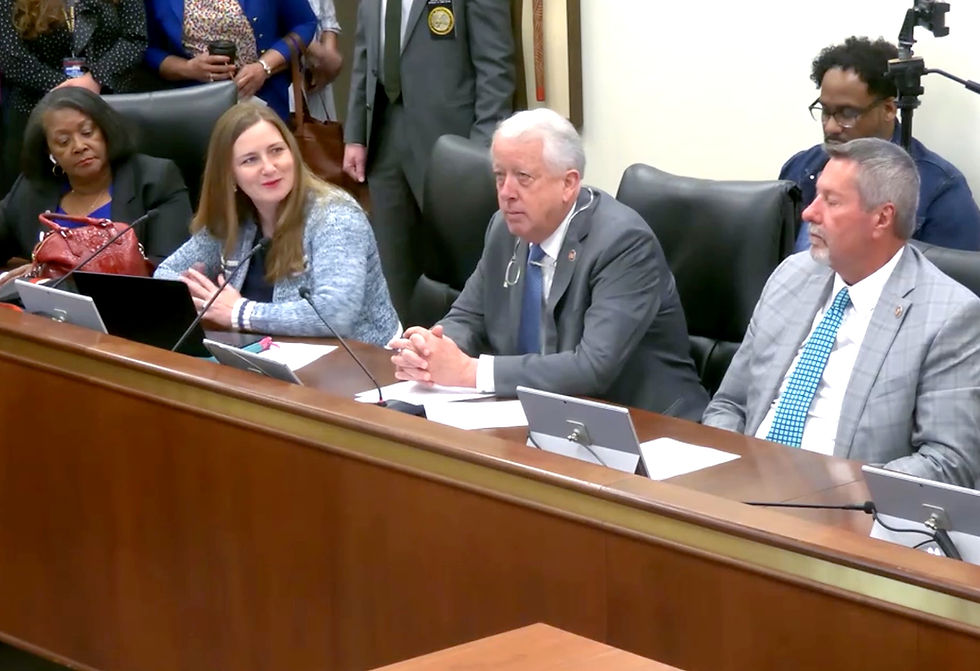
Wetmore accused Republicans of prioritizing ideological loyalty and partisan fear over substantive governance.
“We’re so afraid of upsetting the 9% of South Carolinians that vote in Republican primaries that we just trip all over ourselves to do their bidding.”
Wetmore continued:
“Now daddy Trump calls and needs to grasp at some power, and once again, we jump and run.”
She further argued that the effort was not being pursued in good faith and warned that lawmakers had become consumed by ideological culture wars instead of addressing pressing issues facing South Carolinians.
Chaos Before Campaign Season
The amendment ultimately passed despite objections, with the committee voting 12-2 to give the bill a favorable report as amended.
For political observers, the implications are enormous.
Candidates across South Carolina are already organizing campaigns for the 2026 election cycle. Redrawing congressional maps this late in the process could create confusion among voters, candidates, donors, and election officials alike.
Critics argue the uncertainty itself may serve a political purpose.
This debate is not merely about district lines on a map. It is about power, voter influence, and whether communities, particularly Black communities, retain the ability to elect representatives of their choice.
The rhetoric surrounding the debate has also intensified online, particularly among members associated with the South Carolina Freedom Caucus and lawmakers aligned with anti-DEI and anti-Black campaigns.
Former Freedom Caucus Chair Adam Morgan and other hardline conservatives have fueled broader political narratives attacking diversity initiatives, racial equity discussions, and systemic racism frameworks in education and government.

For many Black South Carolinians, the redistricting debate feels less like routine politics and more like a direct challenge to democratic representation itself.
And with the legislature now positioned to potentially reopen congressional maps after adjournment, the political battle ahead may become one of the most consequential fights over voting rights South Carolina has seen in years.
