Orangeburg: What’s Fueling Gun Violence Around South Carolina State University?


By Javar Juarez | CUBNSC FEATURED WRITING
ORANGEBURG, S.C. — Two young men are dead and a South Carolina State University student remains hospitalized after a shooting inside campus housing that has once again forced Orangeburg to confront a question it has been wrestling with for years: why does deadly gun violence keep returning to the same corridors, the same age groups, and the same overlapping spaces between campus and community?
Authorities have identified the two men killed as Henry L. Crittington, 19, of Orangeburg, and Terrell Thomas, 18, of Norway, South Carolina. Officials have stated that neither victim was a student at South Carolina State University. A third victim, a student, was injured and remains in the hospital. His name and condition have not been publicly released.
This shooting comes just months after another fatal incident during homecoming weekend, when 19-year-old Jaliyah Butler was killed at the same university.
In Orangeburg, these tragedies are not experienced as isolated events. They are felt as echoes—each one reopening questions about safety, access, and what forces are operating beneath the surface.
That is why we went to Orangeburg.
We did not travel there simply to recap a crime scene. We went to hear from residents, business owners, students, and young people living along the Chestnut Street corridor, especially in and around The Hill, to understand what they believe is driving the violence and why it has proven so difficult to stop.

Orangeburg’s leadership often sells a “progress” narrative through buildings and recruitment. But the lived economy along the Chestnut Street corridor still reflects concentrated poverty, thin ownership, and fragile legitimacy in public safety. Those conditions make gun violence more likely to repeat, and harder to contain, particularly when campus and community operate as one ecosystem.
This is not a story about a single shooting. It is a story about structure.
Orangeburg: The Progress Façade

Orangeburg’s “progress” is mostly a narrative and a few isolated investments, while downtown itself still looks like decline, disrepair, and frozen history.
Orangeburg’s leadership often speaks in the language of “progress.” There are announcements, recruitment headlines, and photo opportunities. The city now has a new City Hall downtown, and there are public-facing projects meant to signal that Orangeburg is moving forward.
But walking through downtown Orangeburg does not feel like walking into the future.
It feels like walking back in time. It feels like a place time forgot.

The prominent buildings bordering Middleton and Russell Streets carry a ghostly stillness. Many of the city’s most visible structures are in disrepair. “For sale” and “for lease” signs appear again and again, as if downtown is not a thriving center of commerce, but a corridor waiting to be repurposed by someone else.
And Orangeburg’s history is not hidden. It is on full display.
An old Confederate statue, remnants of Civil War-era symbolism, and the architectural footprint of racial hierarchy still haunt the city’s center. Residents told us that sometimes Orangeburg feels like it is in its own way—trapped between what it once was, what it could be, and what powerful interests have allowed it to become.

The legacy of racism, Jim Crow, and slavery’s long shadow remains visible in the landscape, not just in memory.
That reality matters because downtowns are supposed to be the economic heart of a city. Downtown Orangeburg, instead, reflects an unresolved struggle over identity, ownership, and belonging.
The hope for a thriving African American business district feels remote when the city’s most prominent spaces remain anchored by Confederate memorials, long-standing white institutions, and the slow erosion of Black economic footholds.
Residents pointed to the historic Blythewood Funeral Home as a symbol of that erosion — once one of Orangeburg’s oldest Black-owned institutions, now reportedly in the hands of a white developer and slated for redevelopment.
To many locals, that transition represents a familiar pattern: Black legacy builds something, time and policy weaken it, and outside ownership ultimately takes control.
One Black business owner downtown framed it bluntly. Renting space may be tolerated, he said. Ownership is not.
“When you try to buy anything, they run you out,” he told us. “They would rather sell to the city than sell directly to Black folks.”
He went further, alleging that law enforcement is sometimes used as a tool to create pressure against Black business growth. Those are serious allegations and remain unverified. But the frustration behind them is clear.

“It’s easy to get a factory job,” he said. “But anything else? Nah.”
Even when Orangeburg residents do have income—particularly those working in industrial facilities across the county—many describe a city where disposable income has nowhere productive to go.
People told us Orangeburg changes at night, and not in ways that feel safe or welcoming. With limited options for recreation, entrepreneurship, and family-centered social life, residents described cycles of stress relief that often lean toward drinking, smoking, and survival behaviors instead of community-building.
The deeper economic problem is not simply wages. It is circulation.

Because Black people do not own enough businesses, the disposable income of Black residents often does not circulate within Black communities. It leaks outward. It is spent elsewhere. It builds someone else’s wealth. And without ownership, there is no compounding—no generational anchor that can stabilize neighborhoods, employ local people, and create long-term upward mobility.
The result is a city where progress is promoted, but the lived reality is stagnation. Where downtown is advertised as a civic center, but feels like a hollow shell. Where development appears to happen most visibly in parts of the county inhabited by wealthier white residents and some upper-middle-class Black families, while working-class Black neighborhoods remain locked out of the growth story.
In Orangeburg, “progress” is not a consistent experience. It is a selective one.
And that selectivity is one of the conditions that helps explain why the city’s violence problem cannot be separated from its economic and historical reality.
And then you realize something even more unsettling: Orangeburg is not simply underdeveloped. It is strategically uneven. The city does not fail everywhere. It succeeds in pockets. It invests in symbols. It produces headlines. But it leaves entire corridors to absorb the cost.
The decline is not random. It has an address. It has boundaries. It has a predictable footprint, and it shows up most clearly in the communities closest to the institutions that are supposed to represent Black advancement and public protection.
That is where the economic story stops being about “revitalization” and becomes about containment.
The Donut Economy

Orangeburg is not a city where poverty is spread evenly. It is concentrated, mapped, and familiar to the people who live inside it.
The closer you get to the university corridor, the clearer the pattern becomes. Downtown carries the look of decline and frozen history. The outskirts hold the industrial facilities, the newer retail, and the growth county leaders point to when they talk about opportunity.
But between those two realities sits the hollow center:
neighborhoods where the weight of survival is not hidden behind language, but visible in the streets, the housing, and the daily rhythm of life.
That is why Orangeburg feels like a donut.
It is not just a metaphor. It is a description of how opportunity is distributed: growth on the rim, hardship in the middle, and a corridor near the heart of the city where residents feel trapped inside the same cycle generation after generation.
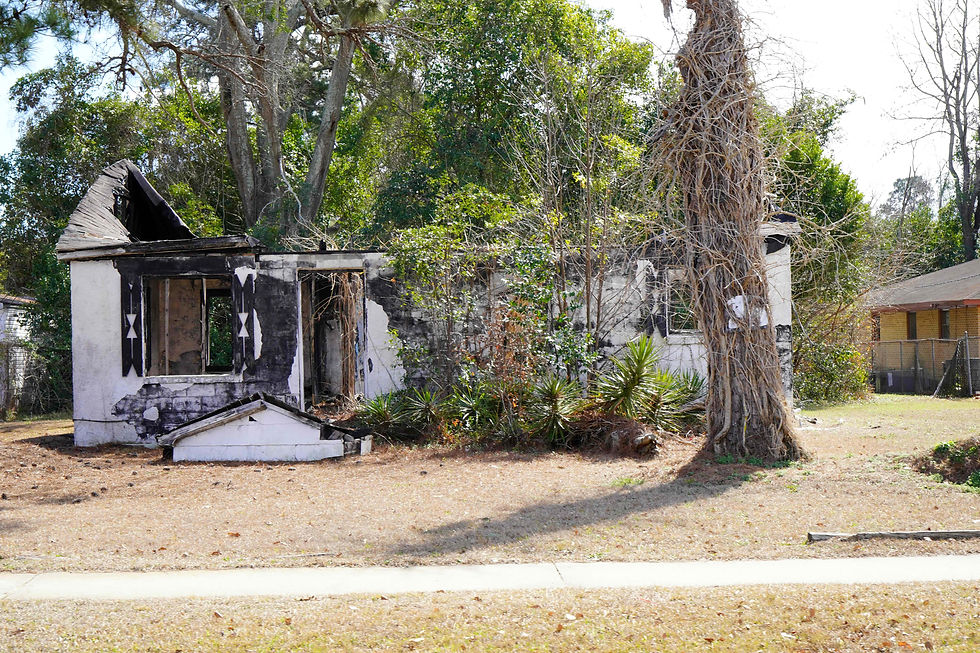
Along Chestnut Street and into the Goff Road area—what residents consistently refer to as “The Hill”—the city’s contradictions become unavoidable. Driving through the corridor reveals visible neglect in certain pockets. Residents describe economic stagnation, generational poverty, and again limited ownership. They speak about families surviving under extreme conditions while the language of “progress” continues to float above them like a separate reality.
And this is where the economic argument becomes essential.

Concentrated poverty is not simply a lack of income. It is pressure. It is stress density. It is crowded housing, thin opportunity, limited transportation, and constant exposure to environments where underground economies can appear more realistic than legitimate ones.
It is daily friction. And daily friction eventually produces conflict.

In Orangeburg, the deeper problem is not simply whether people have jobs. It is whether people have pathways to ownership, stability, and the kind of economic circulation that allows communities to build wealth instead of simply spending wages.
The HBCU Border Zone: Chestnut as the Artery

Chestnut Street is not just a road. It is the dividing artery.
It runs along the campus edge. It connects downtown to residential corridors. It separates and binds at the same time. Students cross it. Residents cross it. Conflicts cross it.
South Carolina State University and Claflin University sit at the center of this geography. They are economic engines and symbols of Black advancement. But they do not exist in isolation. The campus border is porous, and the relationship between the universities and the surrounding community is not merely physical. It is emotional, historical, and often tense.

In interviews across Orangeburg, one message came through clearly: violence does not begin in one place and stay there.
A community member we spoke with, who said he had direct ties to the victims and had previously worked alongside campus security, described what he believes is the most overlooked part of the story. In his view, the public keeps focusing on the university as if it exists behind a wall. But the reality, he said, is that the wall is psychological—not physical.
“It’s the security team,” he told us. “They're full of [expletive].” He alleged that many were not properly registered or credentialed in the way the community expects for a public university facing high-risk conditions.

We were not able to independently verify those specific allegations about registration and credentials. But the significance lies in the perception itself. In communities where residents believe security is ineffective or compromised, people stop reporting, stop cooperating, and start relying on informal systems instead of institutional ones. That shift alone changes how safety operates on the ground.
He also described what many residents believe is the central vulnerability: access. According to him, entering campus is not difficult if you know the area and know the students. “If it wouldn’t mess with so much people money, I’ll show you so many different ways to get on campus,” he said. “I’ll show you at least eight different ways to get on camp… it’s nothing to invite somebody on campus.”

That statement matters because it reinforces a fact officials have already confirmed in multiple incidents: the people harmed are not always students. In the most recent shooting, authorities stated that the two men killed were not enrolled at South Carolina State University.
Residents argue that the reason outsiders keep showing up in the university’s most sensitive spaces is simple: social relationships make it easy. Students invite visitors. Visitors move through dorms. Conflict follows. And when conflict enters a campus where firearms are increasingly normalized, the outcome becomes predictable.

The same community member described a cultural reality that many young people in Orangeburg now treat as normal: widespread firearm possession.
“Everybody strapped in Orangeburg,” he said. “It’s war right now. You ain’t strapped your ass ain’t safe.”
He also described the campus itself as a “gold mine,” not only socially, but economically. In his telling, people come for homecoming, for parties, for access to students—particularly young women—and for the kind of nightlife that the broader city does not provide.
He told us he was on campus during the homecoming weekend shooting in which 19-year-old Jaliyah Butler was killed. In his words, the atmosphere was typical for a celebration—people drinking, smoking, arguing—until it suddenly wasn’t. “Literally the only thing you see, they start arguing… next thing you know, [shots] start flying.”
His description aligns with the broader pattern of reporting: arguments, crowd density, and firearms turning conflict into fatality in seconds.

When we attempted to confirm details and seek comment from South Carolina State University’s police and security leadership, we were redirected to SLED, which is leading the investigation into the most recent shooting. We were also told that campus officials have made it clear that campus police are not to speak with the press.
A downtown business owner offered a different explanation. When asked why gun violence feels so prevalent, he blamed South Carolina’s gun laws—particularly open carry—and what he described as a lack of responsible and present parenting. That view was echoed in other conversations across the city: that the culture of carrying has become normal, while the culture of accountability has weakened.
What emerges from these conversations is not a single accusation. It is a portrait of fragile legitimacy. When trust erodes—in security, in policing, and in political leadership—silence expands. And in environments where silence expands, violence becomes harder to interrupt.
Gun Violence as a Symptom, Not an Incident
The data reinforces what residents already feel.
Between 2020 and 2024, Orangeburg County recorded 131 firearm deaths, with an average rate of 31.4 per 100,000 residents. That is not an anomaly. It is a pattern.
But the numbers do not stand alone. They sit inside a larger statewide and national reality: firearm homicide disproportionately impacts Black communities, while firearm suicide rates tend to be higher among white residents across the state. That distinction matters because it changes what “gun violence” means on the ground. In communities like Orangeburg, gun violence is less about isolated self-harm and more about interpersonal conflict and homicide — violence that grows from the environment.
When you overlay the county’s firearm death trends onto what residents describe in real time —
concentrated poverty along the Chestnut Street corridor and around The Hill,
historic distrust between community and law enforcement,
porous access between campus and surrounding neighborhoods,
and the presence of underground economies that residents fear naming publicly,
— you begin to see gun violence not as random chaos, but as a recurring output of the same structural pressures.
In other words: Orangeburg does not simply have a violence problem. It has a system problem.
And South Carolina State University, despite its history, its mission, and its advanced security infrastructure, is not insulated from that system. It sits at its center.
History in Plain Sight

There is another layer to this story — one that lives in brick, stone, and silence.
All around South Carolina State University are symbols of formidable and violent history. Confederate memorials. Graveyards. Historic churches. The Episcopal Church of the Redeemer and Trinity United Methodist Church sit along a corridor that tells a story of racial and religious struggle.
Just down Boulevard Street stands the Cecil Williams South Carolina Civil Rights Museum, currently under development — a living testament to a movement that reshaped this nation.
Cecil J. Williams, a son of Orangeburg and a student of Claflin University, documented the civil rights movement through photographs that forced America to confront what it preferred not to see. His museum preserves images that many institutions once resisted acknowledging.

And yet, residents told us that many people in Orangeburg do not fully know the history embedded in the land around them. Some refer to the Orangeburg Massacre only as a “dark period.” Few speak openly about the political forces that shaped it.
The irony is extraordinary.

Within walking distance of Confederate gravesites stand historic Black churches like Mt. Pisgah — a congregation whose fellowship hall carries a Veterans Wall of Honor honoring generations of Black men and women who served in World War II, Korea, Vietnam, Desert Storm, and beyond. Purple Heart recipients. Generals. Patriots.

A 123-year-old church structure stands across from a modern law enforcement complex, its walls having witnessed Reconstruction, Jim Crow, segregation, civil rights unrest, and now a new era of contested memory.

Residents at Mt. Pisgah spoke not only of violence, but of annexation. Of boundaries shifting. Of neighborhoods slowly changing. Of gentrification creeping into historic Black spaces. They fear not only crime — they fear erasure.
The land remembers. The politics of the land remember. And the people who live on that land feel the weight of it — because what is erased economically is often erased historically next.
The Real Question

We reached out to Orangeburg County Council Member Latisha Walker, whose District 7 includes Claflin and South Carolina State University, but did not receive a response before publication.
The grievances we heard were not aimed at one office. They were aimed at all levels — city, county, and state.
The real question is not whether Orangeburg can build new facilities or recruit industry.
The real question is whether the economic and institutional stability of South Carolina’s only publicly funded HBCU can remain insulated from the pressures directly outside its walls — and whether those pressures are the result of policy decisions that stretch far beyond campus boundaries.

If The Hill remains economically strained…
If Chestnut Street remains a porous boundary without coordinated public safety strategy…
If trust in government remains fragile…
If ownership remains out of reach for the very communities that built the city…
Then shootings will continue to appear as breaking news, but they will not be surprises.
Orangeburg is not without hope. It has historic institutions, deep faith roots, intellectual capital, and a civil rights legacy that shaped this nation.
But hope without structural change becomes symbolism.
The future of South Carolina State University — and of Orangeburg itself — depends on whether leadership at the city, county, and state level is willing to confront not just the violence, but the geography, the history, and the politics that allow it to repeat.
Because this is not only about who pulled a trigger.
It is about who shaped the conditions that made it inevitable.