Fireworks in Myrtle Beach: Pascoe and Goldfinch Clash as Stumbo Emerges as Steady Hand in GOP Attorney General Debate
- Javar Juarez

- Apr 30
- 5 min read

By Javar Juarez | CUBNSC | Elections
Myrtle Beach, South Carolina — What began as a routine Republican primary forum quickly evolved into one of the most spirited and revealing Attorney General debates in South Carolina this election cycle.

Hosted by the Horry County Republican Party and supported by the Republican Women’s volunteer network, the event drew a packed audience and showcased three sharply contrasting candidates: Senator Stephen Goldfinch, longtime prosecutor David Pascoe, and Circuit Solicitor David Stumbo.
From the outset, the tone was clear. This was not a polite exchange of policy differences. It was a political knife fight.
Pascoe vs. Goldfinch: A Battle Over Corruption and Money

The central conflict of the evening belonged to David Pascoe and Stephen Goldfinch, who repeatedly clashed over ethics, campaign funding, and what each described as a deeply entrenched culture of corruption in South Carolina.
Pascoe, a former special prosecutor known for high-profile corruption cases, leaned heavily into his record. He emphasized his role in prosecuting legislators and promised sweeping reforms, including banning lawyer-legislators from lucrative state contracts and creating a Public Corruption Unit to enforce transparency laws and campaign disclosures.
Goldfinch fired back forcefully, dismissing Pascoe’s claims as political theater. He defended the use of outside legal counsel in major cases, arguing that high-stakes litigation requires elite expertise that state salaries cannot attract.
The exchange escalated into direct accusations.
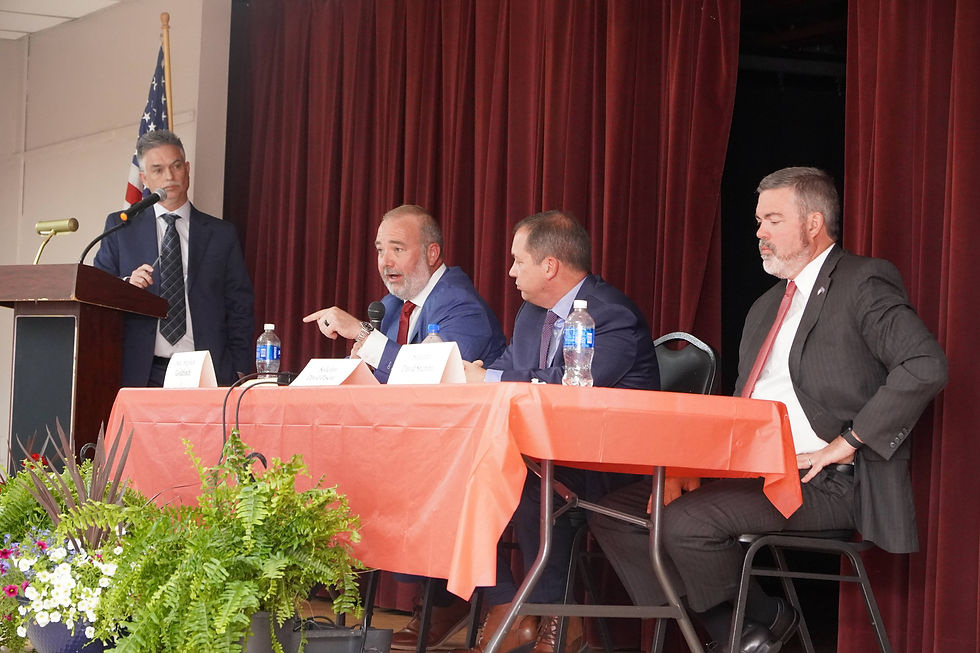
Pascoe charged that Goldfinch was aligned with “lawyer-legislator” interests profiting off state contracts. Goldfinch countered by highlighting Pascoe’s own campaign contributions from trial lawyers, calling the criticism hypocritical and misleading.
At one point, the rhetoric reached a crescendo, with both candidates effectively challenging each other’s credibility and integrity in front of the audience.
The result was less a policy discussion and more a referendum on trust.
Stumbo’s Strategy: Calm, Controlled, and Calculated

Amid the chaos, David Stumbo stood out not for what he said loudly, but for what he didn’t.
While Pascoe and Goldfinch traded blows, Stumbo maintained a measured tone throughout the debate. Drawing on over two decades of prosecutorial experience, he positioned himself as a steady, disciplined alternative.
Stumbo emphasized practical governance over political theatrics. He highlighted his work prosecuting violent crime, supervising statewide grand jury cases, and building diversion programs, including a veterans treatment court aimed at reducing recidivism among former service members.
His approach to criminal justice reflected a balance between accountability and rehabilitation. He spoke about mentorship programs for youth offenders and partnerships with community organizations to prevent repeat offenses before they escalate.
On policy, Stumbo avoided ideological extremes. Even when addressing popular Republican talking points, he did so with restraint. His brief reference to Donald Trump, intended to resonate with the audience, landed without much impact, reinforcing the sense that his candidacy is less about energizing a base and more about governing with consistency.
In a debate defined by volatility, Stumbo’s composure became his defining strength.
Key Issues: Transparency, Crime, and the Role of Government
Beyond the personal clashes, the debate revealed clear divisions in how each candidate views the role of the Attorney General’s office.
On corruption and transparency: Pascoe called for aggressive enforcement of Freedom of Information laws and a proactive approach to investigating public officials. He argued that citizens should not have to bear the cost of holding the government accountable.
Goldfinch acknowledged concerns but emphasized structural reform and legal practicality.
Stumbo focused on efficiency and institutional competence rather than sweeping anti-corruption rhetoric.
On crime and prosecution: All three candidates emphasized tough-on-crime credentials, but their approaches diverged. Pascoe highlighted his record of securing convictions and pursuing the death penalty in certain cases.
Stumbo stressed experience in the trenches and collaboration with law enforcement, while also advocating for targeted reforms like addressing juvenile justice gaps and expanding diversion programs.
Goldfinch leaned into broader systemic critiques, including judicial reform and bureaucratic overreach.
On government power: Goldfinch framed himself as a fighter against the “agency state,” warning about regulatory overreach.
Pascoe positioned the Attorney General as the most powerful check on corruption in South Carolina.
Stumbo emphasized operational leadership, arguing that effectiveness comes from experience and discipline rather than ideology.
Moments That Defined the Night
Several exchanges captured the intensity of the debate:
Pascoe’s pledge to “turn tables” on corruption drew both applause and skepticism.
Goldfinch’s presentation of court backlog statistics sparked a heated dispute over prosecutorial performance.
Stumbo’s rebuttal, grounded in data and context, highlighted his methodical approach to criticism.
Each moment reinforced the broader narrative: two candidates fighting for dominance, and one quietly building credibility.
The Bigger Picture: A Two-Man Race?
By the end of the night, a clear political reality began to take shape.
Despite Goldfinch’s aggressive performance, much of the debate revolved around Pascoe and Stumbo. Their contrasting styles—Pascoe’s prosecutorial fire versus Stumbo’s disciplined restraint—suggest a primary that could ultimately narrow to these two candidates.
The possibility of a runoff looms large.
Goldfinch remains a formidable presence, particularly among establishment-aligned voters, but the sustained pressure from both opponents raised questions about his positioning in the race.
What Was Missing
Perhaps most notable was what the debate did not address in depth.
There was little substantive discussion about federal overreach in elections, data privacy concerns tied to emerging technologies, or the broader implications of national political influence on state legal systems. These issues, increasingly relevant in a rapidly evolving political landscape, remain largely unexamined by the field.
Conclusion: A Test of Temperament and Trust

The Horry County debate was more than a policy forum.
It was a stress test.
Pascoe demonstrated his willingness to confront power head-on, but at times risked being defined by confrontation itself.
Goldfinch showed political resilience, yet faced persistent scrutiny over his alliances and funding.
Stumbo, meanwhile, offered a different proposition: stability in a moment of volatility.
In a race where the Attorney General’s office holds immense power over justice, transparency, and public trust, the question for voters is not just who can win a debate—but who can govern without losing control of it.
As the primary approaches, one thing is certain: South Carolina Republicans are not short on choices, but they are being forced to choose between very different visions of power, accountability, and leadership.


Comments