Governance or Retaliation? Richland Two Vote Sparks Community Pushback
- Javar Juarez

- Apr 28
- 4 min read

By Javar Juarez | CUBNSC
Northeast Richland County, S.C. - On Tuesday evening, under the rigid structure of a Richland County School District Two board meeting, a decision was made that has already begun to ripple through the community.
In a 6–1 vote, the board moved to remove Dr. Monica Elkins-Scott from her leadership positions, citing conduct they say undermines the board’s ability to govern effectively.
Yet, as the motion passed with procedural precision, one question lingered in the room and beyond: what exactly was that conduct?

The action, brought forward by Vice Chair Tamika Shuler Washington and seconded by Commissioner Joe Trapp, invoked Policy BC and asserted that Dr. Elkins-Scott would
“continue to engage in conduct that negatively impacts the board’s ability to effectively govern the district.”
The resolution resulted in her removal as Board Secretary and as Chair of the Alternative Pathways Committee. Notably, Dr. Elkins-Scott remains an elected member of the board.

The tone of the meeting was unmistakably procedural. Decisions were delivered with efficiency and little elaboration, reflecting a governance style rooted firmly in policy execution rather than public engagement. For some in attendance, that approach felt disconnected from the very community the board is elected to serve.
That disconnect became evident during the public participation segment, where two speakers offered sharply defined, yet complementary, defenses of Dr. Elkins-Scott.
The first speaker Abdullah Mustafa delivered a pointed critique grounded in governance and parliamentary procedure. They challenged the board’s use of “point of order,” arguing it had been misapplied to silence a duly recognized member.

Under Robert’s Rules of Order, they noted, such a tool is reserved strictly for addressing violations of procedure, not for interrupting disagreement or dissent. The speaker went further, questioning the legitimacy of the board’s action altogether.
“If there is no clear answer on the record,” the speaker said, “this is not governance. It is retaliation.”
Their argument centered on a fundamental principle: removal from leadership requires clearly defined cause—whether a violation of policy, failure of duty, or ethical misconduct.
Without that clarity, they warned, the board risks undermining public trust and setting a dangerous precedent where leadership is determined not by service or integrity, but by compliance.
The second speaker, Linda Wilder, approached the moment from a different angle—one rooted in community, emotion, and lived experience. Opening with a poetic reflection on unity and resilience, Wilder shifted into a direct defense of Dr. Elkins-Scott and a broader critique of the board’s internal dynamics.

“We are the weave of countless hands,” she began, before turning her attention to what she described as visible division among board members.
Wilder expressed concern that the board’s internal conflicts were overshadowing its responsibility to students and families. She also raised an accessibility issue that struck a quieter but significant chord: the use of a digital barcode system for public sign-in, which she argued could exclude residents unfamiliar with the technology.
“What happened to the paper and the pen?” she asked, pointing to a barrier that may prevent full community participation.
Together, the testimonies painted a picture of a community not only engaged, but deeply attentive to both the process and the principles guiding its elected officials.
When given the opportunity to respond before the vote, Dr. Elkins-Scott delivered a statement that reframed the moment—not as an end, but as a continuation of her service.
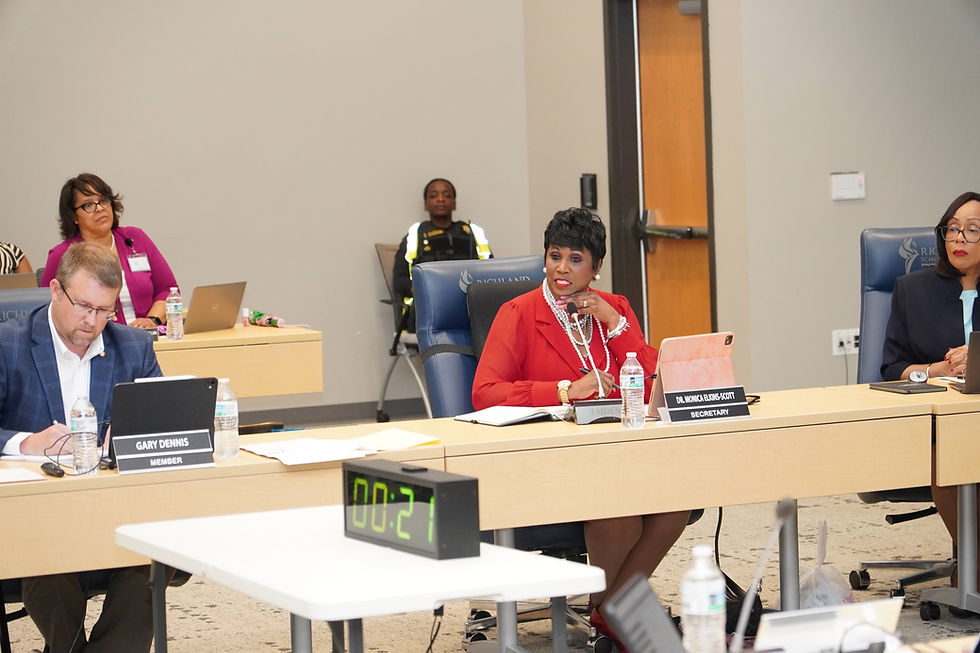
“I may be moved from my seat, but my voice will always be loud and clear for the people, for the students, for the teachers and for the community,” she said.
A veteran of the board with 14 years of experience, Dr. Elkins-Scott emphasized her electoral legitimacy, noting that she has been elected four times, each with strong voter support. While acknowledging the board’s decision, she signaled no retreat from her role as an advocate.
“The community… you haven’t seen the last,” she added, reaffirming her commitment to remain engaged and responsive to those who placed her in office.
In the end, the vote itself was decisive, but the meaning behind it remains contested. To some, it reflects necessary governance and internal accountability. To others, it raises concerns about transparency, fairness, and the balance between policy enforcement and representative leadership.

What is clear is this: the community is watching. And as Richland Two moves forward, the question is no longer just about one vote, but about the standard it sets for how power is exercised—and how voices are heard—within one of the region’s most important public institutions.



xosoplus hôm trước mình thấy mấy bạn nói qua nên tiện tay mở thử cho biết. Mình không quan tâm lắm chuyện dự đoán trúng hay không, chủ yếu xem bố cục có dễ theo dõi không thôi. Vào là thấy ngay kiểu phân mục “XSMB Chủ Nhật”, rồi bài ghi rõ ngày 19 07 2026 nên đỡ bị lạc, nhìn phát biết mình đang ở trang nào. Lướt xuống có cái bảng “Đầu Lô tô Đuôi Lô tô” chia cột rõ ràng, kiểu dữ liệu đặt thẳng hàng nên đọc nhanh cũng không rối mắt. Mình thích nhất là phần bảng đó nằm ngay trong nội dung, nhìn gọn và dễ scan “Đầu Lô tô Đuôi Lô tô” theo…
https://keonhacai5.com/ mình ghé thử cho biết vì thấy bạn bè share, kiểu vào xem giao diện thôi. Ấn tượng đầu là trang chia khối nội dung khá gọn, nhìn lướt không bị ngợp chữ. Mình có đọc qua bài nhận định Girona vs Athletic Bilbao (03h00 ngày 05/11) thì tiêu đề để nổi bật, kéo xuống là nội dung chia đoạn ngắn nên đọc nhanh cũng ổn. Phần kèo/tỉ lệ trình bày theo cột, mắt mình nhìn phát là nắm được ý chính chứ không phải dò từng dòng. Mình cũng thích cái menu đặt ngay chỗ dễ thấy, bấm qua lại mấy bài không bị lạc. Nói chung bố cục thoáng và các khung thông tin được căn đều,…
Gavangtv link mới dạo này mình thấy có người nhắc tới khi nói về các nền tảng giải trí trực tuyến nên cũng thử mở vào xem cách họ bố trí giao diện ra sao. Mình không đi sâu vào nội dung hay từng trò cụ thể, mà chủ yếu quan sát cách các chuyên mục được phân chia trên trang và cách thông tin hiển thị cho người dùng. Nhìn tổng thể thì các khu như thể thao, casino, game bài hay slot thường được sắp xếp theo từng nhóm khá rõ, hiển thị dạng khối và danh sách nên lướt qua cũng dễ theo dõi. Các bảng dữ liệu được trình bày dạng cột khá gọn, giúp quan…
tỷ lệ kèo nhà cái hôm trước mình thấy ai đó nhắc nên bấm vào nghía thử cho biết thôi. Mình không đọc kỹ hay tham gia gì, chủ yếu xem giao diện có dễ nhìn không. Vào cái là thấy trang làm khá thoáng, nhìn không bị rối mắt kiểu nhồi chữ. Mấy phần nội dung được chia thành từng khối rõ ràng nên lướt xuống cũng nhẹ nhàng, không phải căng mắt tìm. Mình cũng để ý cái menu đặt khá dễ thấy, bấm qua lại vài chỗ là tới luôn, không phải mò lâu. Nói chung chỉ cần vậy là đủ để mình xem sơ sơ, và mình thích cách họ sắp xếp các khối thông tin…