Finlay Park: Public Space or Luxury Venue

By Javar Juarez | CUBNSC
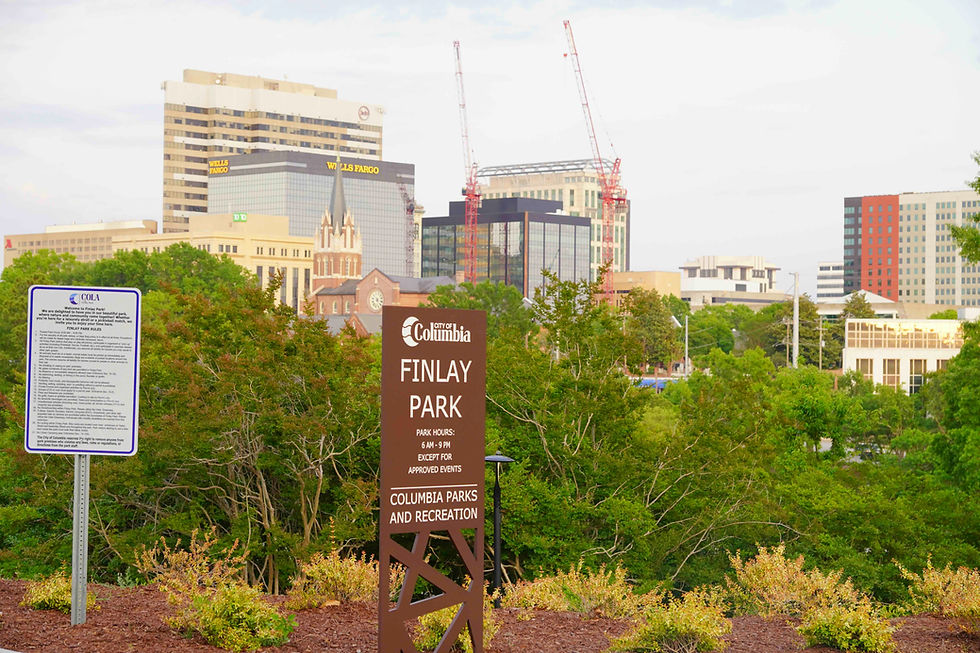
On April 22, 2026, the City of Columbia announced that Finlay Park would be closed to the public for ten hours on Monday April 27, 2026 to accommodate a private University of South Carolina student event. From noon until 10:00 p.m., a park built with public dollars will be inaccessible to the public it was intended to serve.

The explanation is simple: it’s temporary.
But the real question is not about one day.
It is about precedent.
A Simple Question with a Complicated Answer

Finlay Park was recently restored through a $24 million public investment. That money did not come from the University of South Carolina. It came from taxpayers.
So the question residents are asking is straightforward:
If the public paid for it, why does the public have to leave?
This Is Not About One Event
Some have argued that this is being overblown.
“It’s one day.” “Parks get rented all the time.” “There are other places to go.”
And those points deserve to be acknowledged.
Yes, cities do rent public space. Yes, programming requires funding. Yes, this is not a permanent closure.
But what makes this situation different is not the event itself.
It is who is asking for the space—and what they already have.
An Institution With Resources

The University of South Carolina is not a small organization in need of public accommodation.
Its own FY 2025–26 budget outlines:
Over $480 million in state appropriations
More than $400 million in total reported public funding support
A significant increase in funding year over year
This is a publicly supported institution with vast land, facilities, and infrastructure across Columbia.
So the question becomes unavoidable:
Why does an institution with that level of public funding need to close an entire public park to host a student event?
If the goal is to support free programming in Finlay Park, USC has the financial capacity to sponsor those efforts—without displacing the public.
What Residents Are Saying

The public response has been mixed, but consistent in one key way: people are paying attention.
Some see this as a clear misuse of public space:
“Don’t they have like an entire campus they could have done this at?”
“I don’t agree with closing a public park for any reserved use… USC has more than enough facilities.”
Others are focused on fairness:
“They take our taxes to fund these parks and then tell us when we can and cannot go? That’s a problem.”
Some are less concerned:
“Public parks rent space out all the time. Not a big deal.”
And others dismiss it entirely:
“It’s one day. There’s other parks.”
But even among those differing views, a deeper question continues to surface:
If public space can be closed for a private institutional event once, what stops it from happening again?
Why This Matters to Everyone

There is a tendency in Columbia—and in cities like it—to assume that issues like this only affect certain communities.
That assumption is a mistake.
History shows that when large institutions are given consistent priority over public interest, the impact does not stay contained. It expands.
It starts with one neighborhood.One decision.One “temporary” accommodation.
And over time, it becomes standard practice.
This is not about race alone. It is about access, control, and who ultimately has the final say over public assets.
Because if public space can be reallocated based on institutional influence, then no community is insulated from that reality.
Not Black residents.Not working-class residents.Not long-time homeowners.Not anyone.
The Real Issue: Public Investment vs. Public Control

The University of South Carolina is a major contributor to the state. That is not in question.
But contribution does not equal control.
Finlay Park exists because the public invested in it. The expectation is not just that it will generate activity or revenue—but that it will remain accessible.
Once access becomes negotiable, the definition of “public” begins to shift.
Quietly.
The Line That Cannot Be Crossed
This is not an argument against USC.
It is an argument for clarity.
If Finlay Park is going to function as a rentable venue for institutions, then the City of Columbia owes its residents transparency:
What are the rules for full park closures?
Who qualifies for them?
How often will they happen?
What does the public receive in return?
Because without those answers, decisions like this stop looking temporary—and start looking intentional.
The Bottom Line

This is not about a movie night.
It is about whether public space remains public when it is most convenient not to be.
The University of South Carolina has the resources to support this city without displacing it.
The City of Columbia has the responsibility to protect what belongs to its residents.
And the public has every right to ask a simple question:
If we paid for it, why would it be closed?


Comments