CHAOS OR COMMUNITY The 2026 Juneteenth Freedom Fest at Finlay Park Ends in Shutdown — and a Reckoning Columbia Cannot Afford to Avoid

By Javar Juarez | Publisher & Editor-in-Chief, Columbia Urban Broadcast Network | June 21, 2026 | Op-Ed
Columbia, S.C.- By yesterday afternoon, the 2026 Juneteenth Freedom Fest at Finlay Park was over. A fight broke out among young people. The festival was shut down.
Somewhere between twenty and thirty thousand people — our people — were sent home early from one of the most sacred commemorations on the Black American calendar.
Before the dust settled, the arguments started. Who do we blame? Who gets to judge? And who, if anyone, is asking the harder question — not who shut it down, but who dropped the ball.
I am asking that question. Not with contempt. With love.
The Children Are Not the Whole Story

Let us start with what actually happened. According to sources who have reviewed video from yesterday's events with CUBN, somewhere between twenty and fifty young adults — ages sixteen to twenty-five — were involved in the incident that shut this festival down.
Not a mob. Not a riot.
What the video shows is a fight that began the way so many do: one young person slapped in the face, and everything that followed from that moment.
A specific group of young people, in a crowd of thirty thousand, responding to an act of disrespect the only way they have been equipped to respond to it.
The community commentary will collapse all of that into one familiar story about young Black people who don't know how to behave.
I am not writing that story.
What the video actually reveals — across multiple angles — is something more painful and more instructive than a brawl.
It reveals young people who have never been taught conflict resolution.
Who have no framework for reading a room, for checking themselves before the moment overtakes them, for navigating an emotional flash point in a public space.
That is not an indictment of their character.
It is an indictment of every institution that was supposed to give them those tools and didn't.
Dr. Barbara Sizemore — the scholar, the educator, the woman who gave her life to the intellectual and moral development of Black children — told us what our group requires for its own survival.
She laid it out plainly: we must ensure that the self we are cultivating has sufficient mental, moral, physical, spiritual, and emotional condition not merely to survive, but to reproduce that self in conditions worthy of what it produces.
We are failing that standard.
And we are failing it not primarily in the streets, but in the institutions that were designed to prepare children to navigate them.
These young people did not arrive at Finlay Park as strangers to chaos.
They came from it.
They came from school systems that have systematically defunded the imagination and over-policed the body.
Many came from communities bound together by an abundance of shared conditions — where redlining is not a historical abstraction but a present geography, where certain zip codes are permitted to develop and others are permitted only to deteriorate.
They came from a post-COVID America that never healed the wound it opened in the psyche of a generation already told, in a thousand quiet ways, that their lives were expendable.
And then we brought them to Finlay Park, put a massive speaker in front of them, served alcohol around them, and called it a celebration.
There are many who will read this and assume it ends there — with a superficial call to hold Black people accountable. But the truth is more demanding than that. We must hold ourselves accountable precisely because the survival of our group depends on it.
And survival is not merely breathing.
Dr. Sizemore required more of us than that.
She required that we not lie to our children.
That we not dress up the world they actually live in and present it as something gentler than it is.
Because when we lie to children long enough, and they live long enough to know better, they will reject the lie with their whole bodies.
They will buck and jerk and war against it.
They will not sit quietly inside a fairytale that their own experience has already disproven.
And here is the harder truth underneath that one: a space that is not intentionally curated to help young people navigate their emotions will not protect them from those emotions.
When you have never been taught to read a venue, to pause before you react, to find somewhere to put your frustration that is not another person's face — and then you are placed in a loud, compressed, alcohol-adjacent environment with no relief valve and no guidance — you are not setting young people up to succeed.
You are setting up the conditions for exactly what happened yesterday.
These young people are not mysteries. They are responses. The question is not what is wrong with them. The question is what are we doing to change what they are responding to.
The Weight of the Moment
We are living in Donald Trump's America. That is not a political statement so much as a structural one.
We are living in a moment when the federal government has actively dismantled investment in Black mental health, Black communities, and the instruments of civic relief that might have addressed what is driving young people toward tribal conflict.
We are living in a moment when Elon Musk has hijacked federal systems, stolen Social Security data, and weaponized the machinery of government against the very people it was designed to serve — keeping us distracted, divided, and spending what little we have on things that pacify rather than liberate.
Our children feel this.
They may not be able to name it, but they feel the weight of a country that has told them they do not matter.
They feel the environmental toxins that follow Black zip codes like a shadow — the data centers, the industrial exhaust, the PFAS chemicals, the slow poisoning of communities where powerful people have decided the land has no political value.
And when we expect them to show up to a park and behave as though none of that is true, we are asking them to perform a peace that has not been offered to them.
I am not excusing what happened yesterday. I am contextualizing it, because context is where real accountability begins.
You cannot hold people responsible for a fire and refuse to acknowledge who built the tinderbox.
Who Dropped the Ball — and What That Actually Means

Now I must speak plainly about the event itself. Decisions made in the planning and execution of the Freedom Fest contributed materially to the conditions that produced this shutdown.
I was there. I walked Finlay Park yesterday. And I want to say first what I also believe is true — the ceremonial programming that anchored the Juneteenth week leading up to the festival carried real intentionality.
I saw programming for women.
I saw programming for men.
I saw libation.
I saw something genuinely spiritual in the early architecture of that week. Those things matter, and I do not wish to erase them in this critique.
But the Freedom Fest itself was not designed with the crowd it attracted in mind. That is a structural failure, and we need to name it as one.

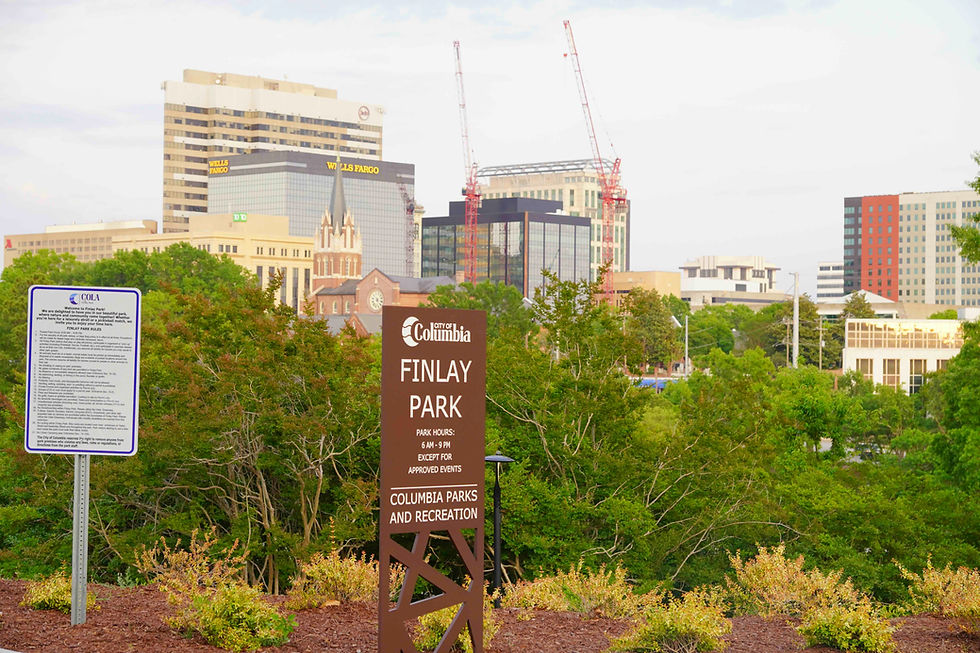
Finlay Park is a place of intimate architectural genius. Bridges and waterways.
Fountains and art installations. Elevated overlooks with murals that narrate this city's story. Quiet corners and open amphitheater space. The park is designed to slow people down — to pull them into different pockets of experience so that a crowd disperses naturally and the temperature of the gathering stays manageable.
None of that was used.
What I encountered was a sea of lawn chairs packed into the large circular space in front of the main stage. No clear walking paths. No quadrant design. No intentional flow.

If you were not there for food or alcohol, there was nothing to slow your feet or engage your mind.
The fringe areas of the park offered nothing that drew families away from the main stage. And the main stage itself was the problem — less festival, more juke joint. Loud. Chaotic.
Feeding the temperature of the crowd instead of managing it.
The organizers brought the club to the park.
What they did not bring — not genuinely — was the edification that Juneteenth demands.
And Finlay Park cannot hold that.
It is not a Colonial Life outdoor venue.
It is not a concert space.
It is a space of intention, and everything placed inside it should work to highlight the park itself — not bury it under thirty thousand people with nowhere to go.
So let me be precise about what intentionality actually means at that scale, because this is where events either hold together or fall apart.
It means every transition point in the park — every place where a crowd might bottleneck, every space where a young person might feel cornered or compressed — is designed to break tension rather than amplify it.

It means welcome stations. It means nonprofit partners and city departments occupying the secondary and elevated spaces, at no cost to them, in exchange for family-centered programming. It means the music for the evening show shifts in register as the crowd grows — pulling toward calm rather than toward intensity.
It means the park's best features become the programming itself, so that people are moving through beauty rather than standing in a field with nowhere to put their energy.
That is not a luxury.
At thirty thousand people, that is a safety plan.
A Grace Note — and a Hard Question
I want to extend genuine grace to the organizers. I do not yet know what city resources were made available to them or withheld. I do not yet know whether they were expected to produce something institutional-grade on a community-organization budget. I do not yet know whether the people who showed up to do this work were given what they needed to do it safely and at scale.
Those are not rhetorical questions. They are the questions that responsible journalism asks before it assigns blame. And the answers are not yet in my possession.
What I do know is this: an event of this size does not happen without a chain of decisions — about funding, permits, security, scope, and infrastructure — that runs well beyond the organizers themselves.
The City of Columbia and Richland County are part of that chain. So are whoever approved the footprint, the capacity, and the plan.
The shutdown is the visible thing. What produced it may be several conversations removed from the moment the fight broke out. CUBN will be asking those questions in the days ahead, and we expect answers.
We will not forget, and we will not stop asking.
What Juneteenth Is Really For

Juneteenth is not a music festival with a historical theme. It is not a marketplace. It is not a vibe. It is the commemoration of the moment that enslaved Black people in Galveston, Texas — more than two full years after the Emancipation Proclamation — finally heard what had already been decided about their freedom.
It is a day that carries in it the full weight of what it means to be held in bondage by a system actively working to conceal your liberation from you.
It is, if anything, a warning: that official pronouncements mean nothing without the organized power to enforce and extend them.
I drove out to McCormick County this week to attend a Juneteenth fish fry because I needed to feel that. I needed to stand in places where the blood of our ancestors is still in the soil — in the cemeteries that no map shows, in the crossroads that the curriculum does not mention, in the landscape of rural South Carolina that carries a history this state has spent generations trying to bury.
I have driven sixty-five thousand miles since 2024 in my own vehicle going into those places.
Not because it is comfortable.
Because the ancestors are calling.
And they are calling loudest at our children. Because the children's high vibrational frequency — their undiminished essence, their innocence that adulthood has not yet numbed — allows them to hear things that we as adults have spent years training ourselves not to feel.
We have become desensitized to our own pain.
We are fighting for position, for influence, for money, for material things, and in that hustle we have neglected peace, tranquility, love, family, art, creativity, and community.
And when we overlook the children in that hustle, we look up one day and see blood and destruction everywhere and wonder how it got there.
We need to re-examine what Juneteenth means to us.
If we are going to gather in mass, we must curate the kind of program that is less like a juke joint and more like a spiritual awakening — one that infuses calm, positivity, and the actual history of this land into the experience of being together.
We have African American monuments in this city.
Historic places that carry the record of our inventions, our innovations, our property ownership, our architecture, and our scholarship — the full evidence of what we as a people have always been capable of when left to build.
We walk past that evidence every day and call it scenery.
The landscape around us is not a backdrop.
It is testimony.
It is a lesson.
And we need to start treating it that way.
Where Do We Go From Here

We are on fragile ground, beloved. People are waiting for us to fail each other. They are watching to see whether we can hold ourselves accountable with the same energy with which we demand accountability from others. And the answer to that question will not be found in the comment sections that are already filling up, or in the arguments about who gets to speak and who should stay quiet.
It will be found in what we do next.
The ancestors did not endure what they endured so that we could settle for chaos.
They did not survive the Middle Passage, the auction block, the lash, the lie, and two years of withheld freedom so that we could gather in their name and leave in disorder.
They endured it so that we could build something worthy of them.
Something that lasts.
Something that tells the truth.
Something that holds our children with enough intention and enough love that the next time we gather, no one has to go home early.
Let us begin. Again.

Javar Juarez is Publisher and Editor-in-Chief of the Columbia Urban Broadcast Network (CUBN), State President of the A. Philip Randolph Institute of South Carolina (APRI-SC), and Senior Director of the Broad River Business Alliance (BRBA). Columbia Urban Broadcast Network | CUBNSC.COM | Member, South Carolina Press Association.


Comments