Before the Gavel Falls: Hamilton Grant Leads a Rare Civic Reckoning in Richland County


By Javar Juarez | CUBNSC | Monday January 12, 2026
Columbia, S.C. - On the eve of South Carolina’s legislative session, while most lawmakers prepared to return to business as usual, Representative Hamilton Grant (House District 79) chose a different path.
Hamilton Grant and the Work of Civic Preparation

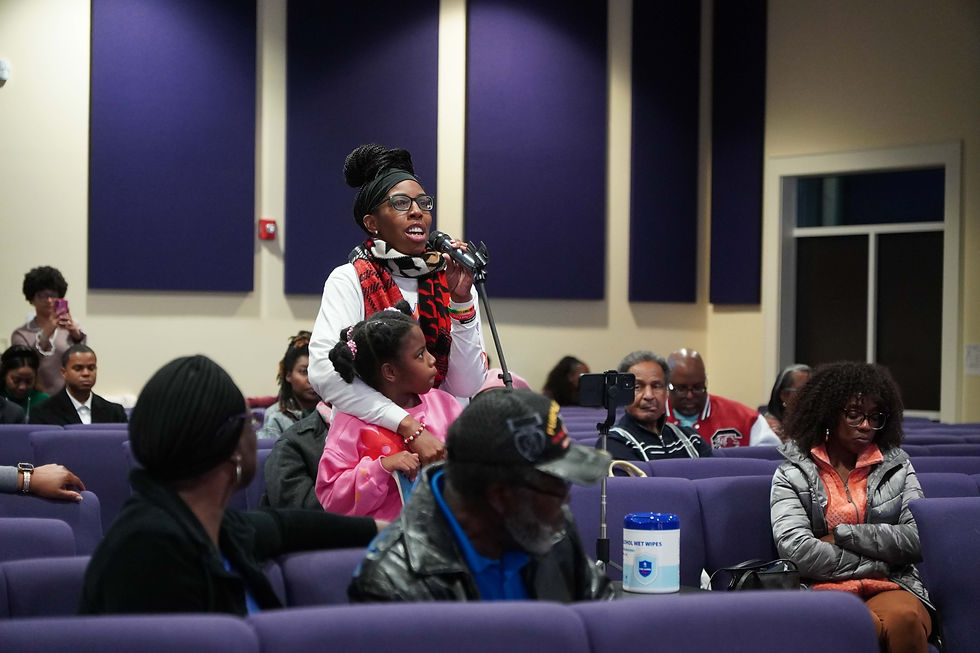
Instead of waiting for constituents to react after decisions were already made, Grant convened his district before the gavel fell, inside Brookland Baptist Church Northeast, to do something increasingly rare in American politics: teach people how power actually works.
This was not a rally. It was not a campaign stop. And it was certainly not performative politics.
It was a civic lesson, delivered with intention, humility, and urgency, at a moment when democracy itself feels increasingly opaque, inaccessible, and captured by interests far removed from everyday South Carolinians.
Grant, whose district spans a large and complex portion of Richland County invited Brenton Brown, Chief of Staff for the South Carolina Commission for Community Advancement and Engagement, to walk residents through the machinery of state government, from the House and Senate chambers to committees, budgets, and executive power. Brown’s credentials and lived experience made clear that this was instruction rooted in reality, not theory.
What unfolded was something closer to political self-defense training than a lecture.
Civic Lessons in an Age of Political Amnesia

Brown methodically broke down South Carolina’s three branches of government, emphasizing how much real power resides not in speeches or floor debates, but in committees, subcommittees, and budget line items. He explained that while the House has 124 members and the Senate 46, far fewer individuals truly control what moves and what dies quietly in committee rooms.
Residents learned that:
The House operates through 13 standing committees, with most representatives serving on only one.
Committee assignments are made by House leadership, not by voters.
Entire bills often disappear without ever receiving a hearing.
Counties and legislative districts frequently do not align geographically, leaving many residents unsure who actually represents them.
These details matter. Without them, the public is left blaming the wrong people, misunderstanding where decisions are made, and missing the narrow windows where citizen intervention actually counts.
As Brown made clear, democracy does not fail only because of bad actors. It also fails when people are kept uninformed long enough to disengage.
Why This Matters More Than Ever
Behind the scenes, a Republican supermajority continues to advance policies that expand state power while restricting public benefit, often through procedural maneuvers invisible to most voters. Corporate interests and industry lobbyists remain ever-present, shaping outcomes through access, money, and influence rather than public consent.
Grant’s colleagues, including lawmakers like Representative Robert Reese, have previously acknowledged publicly that large industries and special interests frequently dominate the legislative agenda, often through opaque and dark-money-driven channels. Without civic literacy, communities cannot distinguish between symbolic politics and real power.
That is why what happened at Brookland Baptist Church was not merely educational. It was preventative.
The South Carolina Legislative App: A Tool for Survival

One of the most consequential moments of the night came when Brown urged attendees to download the South Carolina Legislature app, a tool that effectively collapses the distance between the Statehouse and the public.
Through the app, citizens can:
Track bills from introduction through committee and floor votes.
Follow their own representative’s voting record in real time.
Receive agendas for upcoming committee and subcommittee meetings.
Watch live or archived committee hearings.
Submit written testimony to be included in the official legislative record.
Access the South Carolina Constitution, Code of Laws, and regulations.
In a political environment where major decisions are often made during subcommittee hearings attended by only a handful of people, this level of access is not a convenience. It is essential.
A Practice That Should Be Common, Not Exceptional

South Carolina’s state government includes 27 cabinet-level agencies and nearly 100 agencies overall, yet meaningful public understanding of how oversight, budgeting, and legislative authority intersect remains limited. In that vacuum, policy outcomes are too often shaped by those with the most access, the most resources, or the greatest familiarity with the system.
Civic education is not an add-on to governance. It is a prerequisite for accountability.
Equipping residents with clear, practical knowledge about committees, timelines, budgets, and available tools such as the South Carolina Legislative App allows engagement to happen before decisions are finalized, not after frustration has set in. Prevention, not damage control, is the point.
The broader lesson is not about any one district or any one official. It is about capacity. A well-informed public is better positioned to participate, to monitor, and to respond with intention rather than anger. That benefits constituents and legislators alike.
If South Carolina is serious about strengthening democratic participation in an era of heightened polarization and expanding executive power, civic instruction of this kind cannot be occasional. It must be routine, accessible, and normalized across districts.
The work of democracy does not begin at the ballot box or after a bill has already moved. It begins with shared understanding, early engagement, and a public prepared to meet the Statehouse on informed ground—before the gavel ever falls.


Comments