“This Fight Isn’t Over”: Family Vows Civil Lawsuit as Protesters and Civil Rights Leaders Challenge Rick Chow Verdict

By Javar Juarez | CUBNSC | June 3, 2026
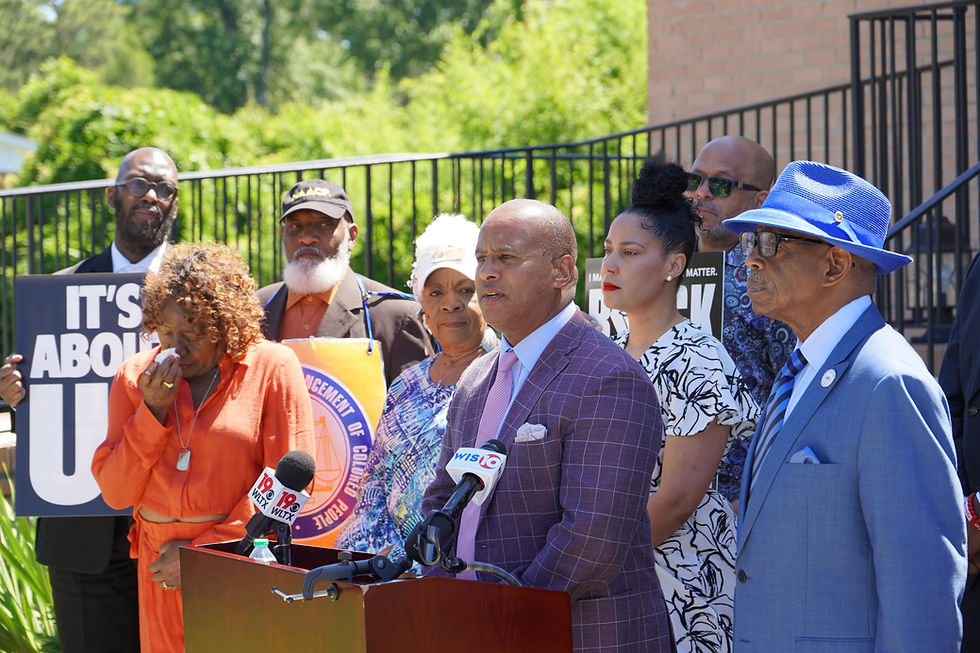
COLUMBIA, S.C. — Less than twenty-four hours after hundreds of demonstrators flooded Parklane Road in protest of the not guilty verdict in the killing of 14-year-old Cyrus Carmack-Belton, a different kind of resistance gathered Thursday morning outside New Laurel Street Missionary Baptist Church.
There were no chants. No traffic stoppages. No raised fists.
Instead, there were pastors, civil rights leaders, attorneys, grieving family members, and a mother whose visible pain spoke louder than any microphone ever could.
The press conference, organized by the National Action Network and the Columbia Branch of the NAACP, brought together Reverend Nelson B. Rivers III, NAACP Columbia Branch President Oveta Glover, New Laurel Street Missionary Baptist Church Pastor Damion Brown, House Minority Leader and family attorney Todd Rutherford, members of the Belton family, and a coalition of community leaders determined to make one thing clear:
The verdict may have ended the criminal trial, but it has not ended the fight for accountability.
And according to Rutherford, that fight is now moving into civil court.
A Family’s Pain Becomes a Community’s Cause
The emotional center of the gathering was not a speech.
It was the presence of Cyrus Carmack-Belton’s mother and grandmother.
Though overcome with emotion and unable to address the media, their presence served as a painful reminder that while the legal proceedings may be over, the grief remains.
The family stood surrounded by clergy, their attorney, and civil rights advocates who repeatedly emphasized that the loss of Cyrus is not merely a legal issue.
It is a moral issue.
It is a community issue.
It is an American issue.
Standing before reporters, Reverend Nelson B. Rivers III read a statement issued by the National Action Network Religious Affairs Department questioning whether justice in America remains equal when race enters the equation.
“At the heart of this case is a question that cannot be ignored,” Rivers said. “If the races had been reversed, if the shooter and his son had been Black and the victim had been White, would the outcome have been the same?”
The question hung heavily outside the sanctuary.
No one there appeared to believe the answer was yes.
“I Forgot to Factor in That He Was a Black Child”
If Rivers supplied the moral argument, Todd Rutherford supplied the legal one.
The veteran attorney, who has spent three decades practicing law and representing the Belton family, delivered one of the most forceful remarks of the morning.
Speaking directly beside Cyrus’s mother, Rutherford reflected on years spent assuring the family that justice would prevail.
“I told her it was going to be okay,” Rutherford said. “No, ma’am, he cannot get away with chasing a child 130 yards and shooting him in the back.”
Then he paused.
“I guess in my calculus, I forgot to include the fact that he was a Black child.”
For Rutherford, the verdict represents more than a disagreement over legal standards.
It represents what he described as the continuing devaluation of Black life.
“The diminution of the value of Black life has got to stop,” he said. “Our children have value. Our children are worth something.”
Throughout his remarks, Rutherford repeatedly returned to one detail that has become central to the community’s outrage: Cyrus was shot in the back.
To Rutherford, that fact alone should have been enough.
“This was a murder,” he said. “No different than if it had been a White store owner chased by Black children, or a Chinese child running from two Black men.”
The veteran attorney also rejected criticism suggesting prosecutors should have pursued a lesser charge.
In South Carolina, murder is murder, he argued.
The suggestion that prosecutors should have sought voluntary manslaughter instead, he said, effectively asks the public to accept that the death of a Black child deserved less legal weight.
“We cannot believe for one more second that our children, because of the color of their skin, are worth less than those who don’t look like us.”
Rutherford confirmed that the family intentionally delayed filing a civil lawsuit while the criminal case proceeded. Now that the trial has concluded, he said civil litigation will move forward.
That announcement may prove to be one of the most significant developments to emerge from Thursday’s press conference.
“Let Cyrus Be the Last One”

For Reverend Rivers, the verdict represents part of a much larger historical pattern.
Drawing connections to Trayvon Martin, Ahmaud Arbery, George Floyd, Eric Garner, and even Emmett Till, Rivers argued that the Carmack-Belton case is not an isolated incident but another chapter in a long American struggle over whose lives are protected and whose fears are believed.
“I am convicted and convinced that if Cyrus had been White, he would not have been pursued 130 yards and shot in the back,” Rivers said.
His comments repeatedly returned to a central concern: the vulnerability of Black boys.
“As long as Black lives do not matter, especially our boys, every Black boy is in danger.”
Rivers challenged the notion that fear alone should provide legal justification for deadly force.
“All you have to do is one day decide you’re afraid of him. You think he did something. And then somehow you have a license to chase him down and kill him.”
That, Rivers said, must end.
“Let Cyrus be the last one.”
Oveta Glover Questions the Double Standard
“No verdict can ever fill the void left by the loss of a child. The not guilty verdict may have closed the court room door but it has not closed the wound left in this community.”
NAACP Columbia Branch President Oveta Glover echoed many of the same concerns.
She questioned whether the outcome would have been the same had Cyrus been White.
Would a White teenager have been pursued across a football-field length distance?
Would assumptions about danger have been made so quickly?
Would deadly force have been used?
The questions mirrored concerns expressed throughout the broader community since the verdict was announced.
For many in attendance, the issue was not only what happened to Cyrus.
It was what the verdict says about how Black youth continue to be perceived.
The Black Church Remains a Center of Resistance
Host Pastor Damion Brown made clear that New Laurel Street Missionary Baptist Church opened its doors because the church remains one of the few institutions capable of bringing together grief, advocacy, and moral leadership.
Historically, Black churches have served as sanctuaries during some of the nation’s most painful moments.
Thursday’s gathering was no exception.
The church again became a place where community leaders could articulate what many residents were already feeling.
Not simply sadness.
But disbelief.
And anger.
Then There Was Parklane

Yet to understand Thursday’s press conference, one must understand what happened the night before.
Outside New Laurel Street were elders.
Outside on Parklane Road were the children.
The contrast was striking.
The church represented institutional power, legal expertise, organizational structure, and decades of civil rights experience.
The streets represented raw frustration.
Many of the protesters who filled Parklane Road Wednesday evening were young Black residents from the corridor surrounding Springtree and Parklane.
Many spoke openly about poverty, hopelessness, limited opportunities, and a growing sense that systems designed to protect them have failed them.
Several expressed anger not only about the verdict, but about the way Cyrus has been portrayed publicly.
They argued that media narratives frequently amplified claims favorable to Rick Chow while reducing Cyrus to stereotypes associated with criminality rather than recognizing him as a 14-year-old child.
For many, the verdict became a symbol of something larger than a courtroom decision.
It became a symbol of accumulated frustration.
A tipping point.
Two Generations. One Message.

The story of this week cannot be told solely through the lens of a courtroom.
Nor can it be told exclusively through protests.
The power of this moment lies in the intersection of both.
Outside New Laurel Street Missionary Baptist Church stood the elders: pastors, attorneys, civil rights veterans, and organizational leaders who have spent decades negotiating with systems of power.
Outside on Parklane Road stood a younger generation demanding that those same systems finally change.
One group brought institutional authority.
The other brought urgency.
Together, they formed a continuum stretching across generations.
The message from both places was remarkably similar:
The verdict may stand.
The questions remain.
The civil lawsuit moves forward.
The protests continue.
And for many in Columbia’s Black community, the fight is no longer only about what happened to Cyrus Carmack-Belton.
It is about ensuring that another child never has to run 130 yards in fear for his life.

Javar Juarez is an award winning investigative journalist and publisher at the Columbia Urban Broadcast Network (CUBNSC), an independent news outlet covering South Carolina politics, civic affairs, and community issues. He serves as President of Capital City A. Philip Randolph Institute (APRI) in South Carolina, where he leads grassroots civic engagement and organizational advocacy. His reporting is rooted in Black American history and the political landscape of the American South.


