‘Every Kid Should Have a Fair Shot’: Sylvia Wright’s Case for Overhauling South Carolina Education

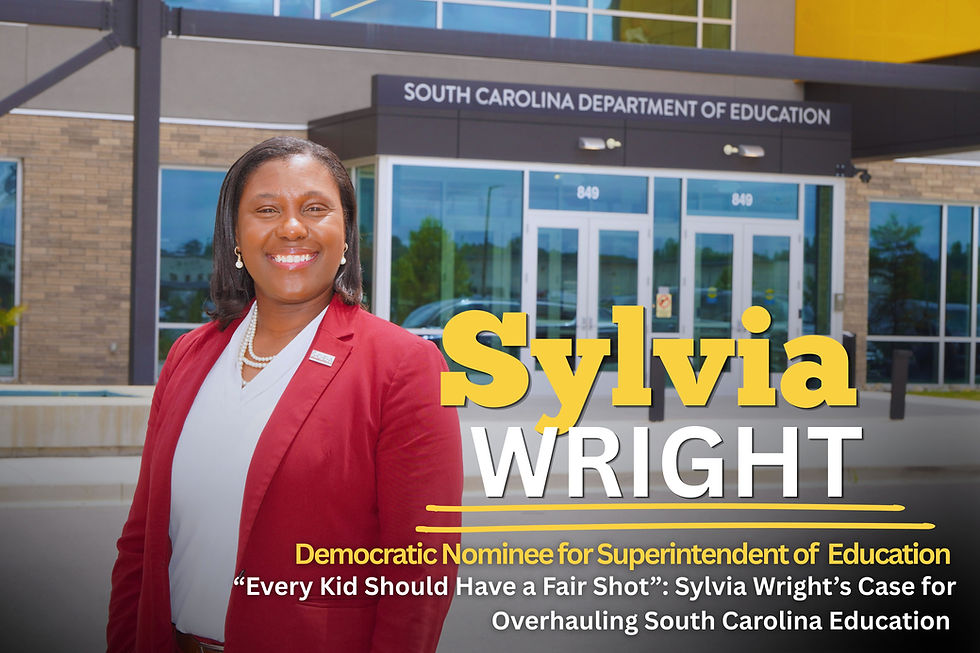
The Democratic nominee for superintendent of education says political control, unequal access and top-down decision-making have pulled the state away from the central purpose of public schools: giving every child a fair shot.
By Javar Juarez | New Progressive Journal | July 17, 2026
West Columbia, S.C. - The new headquarters of the South Carolina Department of Education is supposed to represent a new chapter. Sylvia Wright sees it as the command center of a system overtaken by politics—and she places responsibility squarely on Republican Superintendent Ellen Weaver.
Weaver came to the office through conservative politics, not public-school classrooms.
She has never been a teacher, principal or school administrator.
When her eligibility became an issue during the 2022 campaign, she completed an online master’s degree in educational leadership from Bob Jones University in roughly six months.

Her tenure has closely followed the national conservative education agenda.
Weaver appeared at a Moms for Liberty summit, brought PragerU materials into the department’s official resources and championed a voucher program whose original private-school tuition provision was struck down by the South Carolina Supreme Court.
The reworked program is now facing a legislative audit over how her department administered it.
Weaver promotes a “Southern surge” in student achievement, but the latest available NAEP results tell a more complicated story. South Carolina’s fourth graders showed progress, while eighth-grade students remained below the national average in both reading and mathematics. Only 24 percent reached NAEP Proficient in eighth-grade math and 26 percent in reading.
Wright argues that political loyalty cannot substitute for educational experience.
“When you put people in positions of power who are not qualified for the position, you get chaos,” she said.
Wright offers a stark contrast: more than 20 years as a teacher and education leader, graduate credentials from The Citadel and doctoral work in systems improvement at the University of South Carolina. Her case is simple: South Carolina’s schools should be led by someone who understands them from the inside.
A system that leaves too many children outside

The clearest dividing line may be South Carolina’s Education Scholarship Trust Fund program. The Department of Education announced in 2025 that the program had reached its statutory cap of 10,000 students. Supporters describe the scholarships as a way to give families more control over where and how their children learn.
Wright sees the cap itself as evidence of the problem. A program may transform the experience of the children who receive a scholarship, she said, while doing nothing to repair the system serving everyone else.
“A voucher system is not the solution to improving public education,” Wright said. “It just helps create a further divide.”
Her criticism extends beyond vouchers. Across South Carolina, access to advanced courses, career and technical education, artificial-intelligence programs, small class sizes and specialized schools varies not only from district to district, she said, but sometimes from one school to another in the same district.
That unevenness is often defended as choice. Wright calls it educational neglect when selective programs flourish while the children excluded from them are left with fewer resources and fewer pathways to opportunity.
Her alternative is not to eliminate innovation, but to make it broadly accessible without abandoning the public schools around it. Programs that prepare students for emerging careers should not be confined to favored campuses or affluent communities. If smaller classes and stronger programming improve learning, access to those advantages should not depend on winning a lottery.
Restoring expertise to the classroom

Wright has spent more than 20 years in education, including work as a classroom teacher, department leader, school coordinator and district coordinator. She earned graduate credentials in educational leadership at The Citadel and is pursuing a doctorate in systems improvement and innovation at the University of South Carolina.
That experience shapes another sharp contrast in the race: who should hold authority inside a school.
Parents deserve transparency, respect and a meaningful role in their children’s education, Wright said. She speaks about that issue not only as an educator but as a mother and grandmother. But she rejects the culture-war narrative that pits families against teachers and discounts educators’ professional training and expertise.
“The teachers are the professionals,” Wright said. “We need to work together with the parents. It shouldn’t be a parent-versus-teacher situation or families versus schools.”
She also objects to top-down mandates that strip judgment from principals and teachers. In her view, a scripted curriculum may satisfy a district pacing guide while preventing a teacher from slowing down when students need more time.
Administrators far from the classroom can demand uniformity, but they do not see the child who is confused, the lesson that did not land or the intervention that must happen today.
That is how a system built around compliance can lose sight of learning.
State power and the loss of local voice
The debate over state control is no longer theoretical. In June, the State Board of Education unanimously approved Weaver’s request for the department to assume full management of the Marlboro County School District. The department cited years of fiscal problems, governance failures and an independent State Inspector General report. It said lesser interventions had failed and a full takeover was necessary to restore stability.
Wright does not deny that struggling districts require accountability. She questions whether the state has demonstrated that its most sweeping interventions are always justified, effective and responsive to the communities that must live with them.
Her concern is especially acute in rural South Carolina, where a school district may be one of the strongest remaining expressions of local identity and democratic participation. Consolidation can promise efficiency, but it can also dilute the voting power of a smaller community inside a larger governing body.
“You’re taking away the community voice,” Wright said. “You’re taking away community schools.”
The same concern runs through her criticism of instructional policy. South Carolina’s Regulation 43-170 created a statewide process for challenging instructional materials.
Wright argues that such policies can be weaponized to narrow what students learn about Black history and women’s history. She also criticizes the department’s decision to make PragerU materials available as standards-aligned resources, saying students deserve history that prepares them to confront the full truth rather than retreat from it.
For Wright, these disputes are not isolated fronts in a culture war. They are distractions from a larger struggle over access, authority and public money. While adults battle over ideology, children still need qualified teachers, current special-education services, safe schools, career preparation and a fair distribution of resources.
Beginning before kindergarten
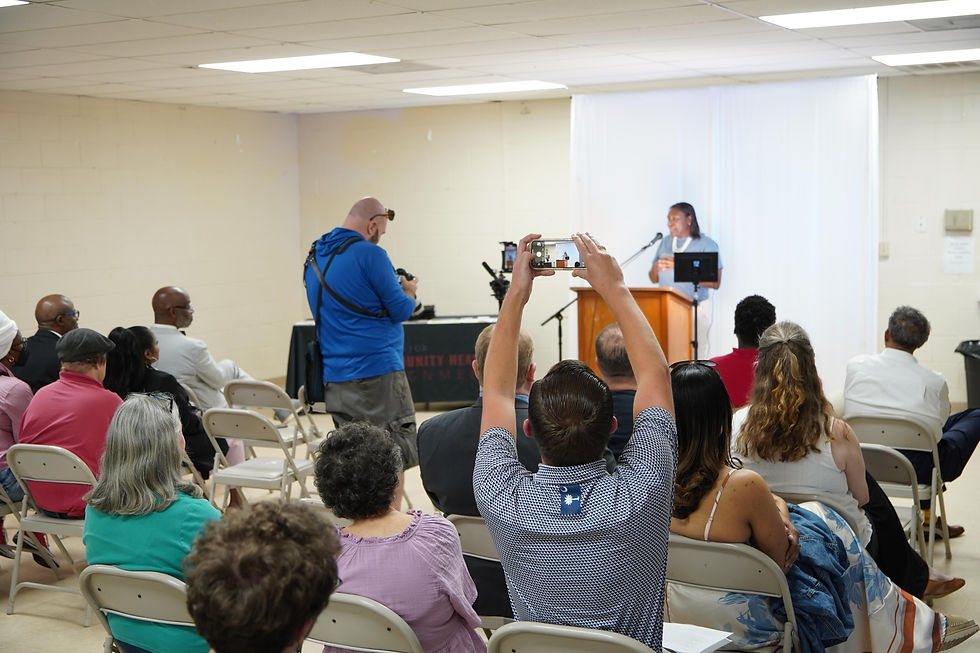
Wright’s campaign is not only an indictment. Her most developed affirmative proposal begins with universal prekindergarten for every South Carolina four-year-old, regardless of family income.
A classroom seat, she argues, is only part of what families need. Wright points to Georgetown’s Miss Ruby’s Kids, which brings educational activities into homes and helps parents support early development, as a model the state could adapt and scale. Her goal is to pair universal pre-K with community-based support before children fall behind.
For Wright, the issue is personal. When her grandson was one, she began searching for a private preschool because her daughter appeared to earn too much for income-based assistance but could not afford tuition. Wright could help her family bridge that gap. Many children, she realized, have no one with the time, knowledge or resources to do the same.
“I want every kid to have a fair shot,” she said. “What I was looking for for my grandson, every kid should have that.”
The experience distilled Wright’s broader argument: opportunity should not depend on winning a lottery, securing a voucher, living in the right attendance zone or having a relative who can find a way around the system.
Her alternative is to put trained educators at the center of educational decisions, treat parents as partners, protect local communities’ voices and invest before children fall behind. She says every policy should be judged by whether it strengthens public education for all children—not merely whether it offers an escape route for a few.
“No more of this only certain kids have access,” Wright said. “It’s time that we actually get into the communities.”
The building behind Wright during the interview houses the Department of Education. But, she argues, the department belongs to the people beyond its walls—and its success should be measured by what reaches every classroom, every family and every child in South Carolina.


