South Columbia Is Changing. A Historic New School Is Only Part of the Story.


By Javar Juarez | CUBNSC | September 17, 2026
C.R. Neal Academy is set to become the nation’s first HBCU-authorized public charter school. But inside a community meeting on Atlas Road, residents confronted a much larger question: As millions in public investment and hundreds of new homes reshape this part of Columbia, what happens to the people already living there?
COLUMBIA, S.C. — The first public charter school in the nation authorized by a historically Black college or university is coming to Columbia.
That is the headline.
But that is not the whole story.
C.R. Neal Academy is scheduled to open in fall 2027 near Atlas Road, beginning with 260 students in sixth and ninth grades. The school was unanimously authorized by Voorhees University’s Charter Institute of Learning on April 16 and plans to grow into a sixth-through-12th-grade school by 2030. The school describes itself as the first public charter school in the United States authorized by an HBCU.
CUBN was inside the community meeting where residents heard about the school firsthand.
What happened in that room revealed something considerably larger.
A new school. A new marketplace. A new health center. A magistrate court. A sheriff’s substation. Hundreds of apartments. Senior housing. Another 182 single-family homes. Road improvements. Sidewalks. Millions of dollars in state appropriations.
Piece by piece, the area surrounding Atlas Road, Bluff Road and Congaree Pointe is being transformed.
For residents who have spent decades asking for investment in this part of Columbia, much of that development represents things they have wanted for years.
But several people in the room were asking another question:
Will the people who already live here be able to afford to stay long enough to enjoy it?
A HISTORIC SCHOOL WITH DEEP LOCAL CONNECTIONS
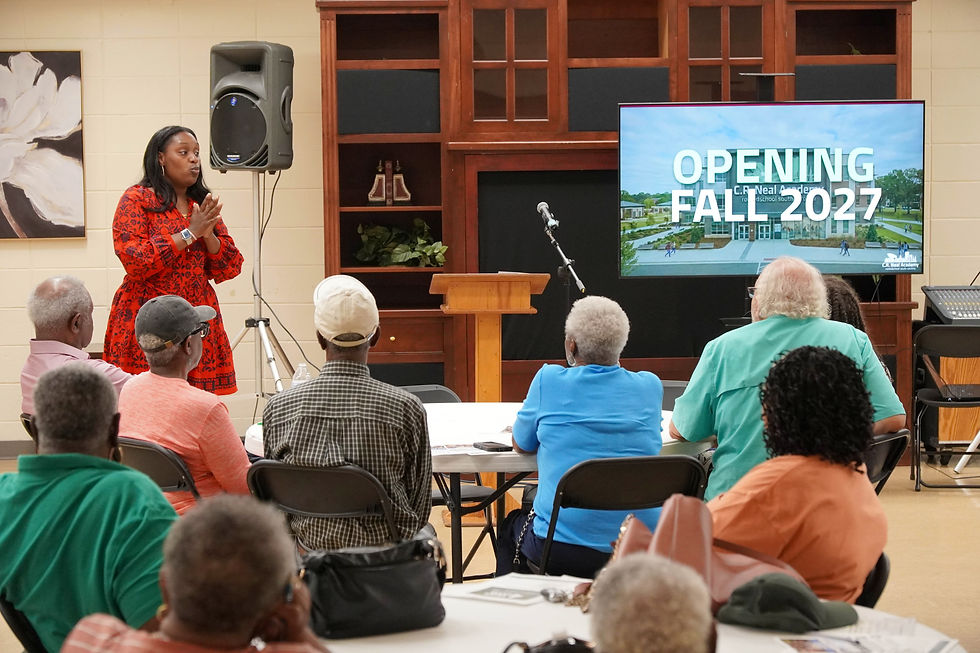
C.R. Neal Academy is expected to be built near Bible Way Church of Atlas Road.
The school says applications for its first class will open Oct. 28. It plans to enroll 130 sixth graders and 130 ninth graders, then expand one grade at a time.
Its academic model emphasizes STEM, career preparation and work-based learning, with founding pathways in health sciences, advanced manufacturing and information technology.
Its leadership also has deep connections to the community.
The school identifies Lalah S. Radney as its founding executive director and school leader. Randall Mack Jackson, assistant pastor of Bible Way Church of Atlas Road, is identified as founding board chair. Randall Jackson is Sen. Darrell Jackson’s brother.
Darrell Jackson remains senior pastor of Bible Way Church and represents Senate District 21 in Richland County.
At the community meeting, Darrell Jackson took pains to distinguish C.R. Neal Academy from Bible Way Church.
He told residents the school would be a public charter school, not a private school, not a Bible Way school and not a faith-based school. He said it would be open to students from different faiths and backgrounds.
THIS WAS NEVER JUST A SCHOOL MEETING
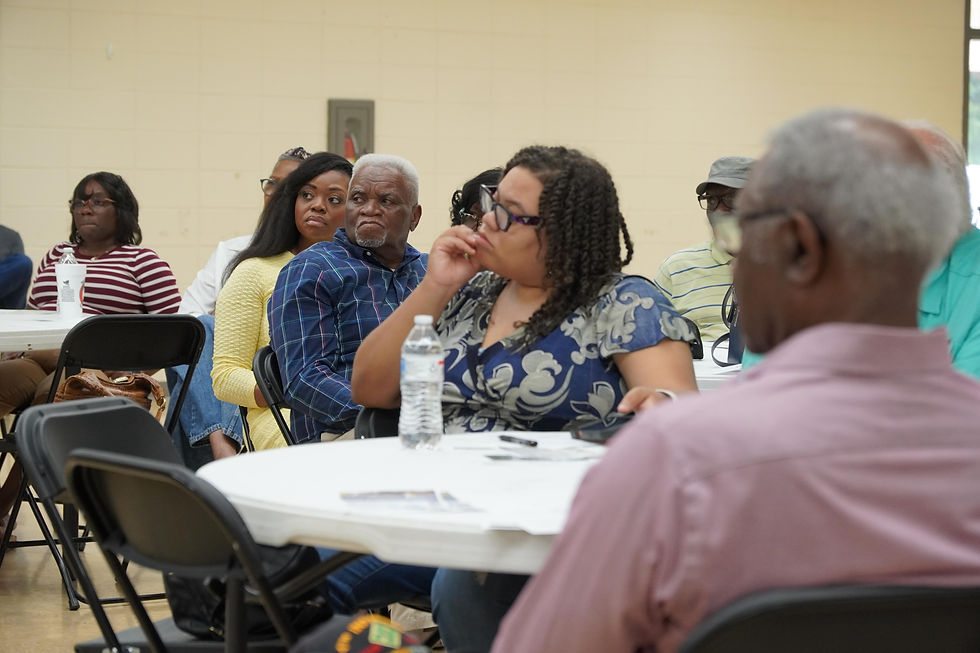
The meeting was about far more than C.R. Neal Academy.
Residents heard about The Station at Congaree Pointe, the school, a major Mungo Homes development and the widening of Atlas Road.
Jackson described the gathering as an update on “all of the projects in this area.”
One of the largest pieces is The Crossing at Congaree Point.
Jonathan Chambers, deputy director of Columbia Planning and Development Services and the city’s land development administrator, told residents the development would contain 182 single-family houses on approximately 44 acres.
Chambers said the project had gone through city review and Planning Commission approval. Land-disturbance plans had been submitted, although permits had not yet been issued at the time of the meeting.
Then residents started asking questions.
“WHO ARE THESE HOMES BEING BUILT FOR?”

One resident focused immediately on the expected price of the houses.
With homes discussed at around $250,000, he questioned whether families already living in the surrounding communities could afford them.
“Who are these homes being built for?” he asked.
Jackson’s response became one of the most consequential exchanges of the evening.
He said one goal was to “diversify” the community.
Jackson also revealed that the Columbia Housing Authority had been interested in the property, but said there had been a preference for single-family housing.
“We said that we would rather put single-family housing there, so that we can attract families to our community as well,” Jackson told residents.
Then came another statement.
“I think you have to look towards the future, and not necessarily to where we are now,” Jackson said.

He argued that Mungo would not build 182 houses if its market research did not indicate buyers existed for them.
A resident immediately explained why that worried him.
“It sounds like you may end up being gentrification,” he told Jackson.
The resident said people who looked like him frequently did not earn enough to purchase houses at those prices and worried the development could ultimately contribute to existing residents being pushed out.
Jackson disagreed with the premise that higher-priced housing necessarily meant Black families could not afford it. He pointed to nearby subdivisions where Black residents had purchased comparable homes and argued that bringing additional households and purchasing power into the area was necessary to attract businesses and amenities.
“You will never get a grocery store,” Jackson said without that economic growth. “You can never get the marketplace and the things that we want there.”
“We are keeping an eye on the future. Not just on where we are now.”
The residents were not necessarily arguing against investment.
They were asking who the investment was ultimately for.
THEN CAME THE TAX QUESTION
Another resident brought the issue even closer to home.
She identified herself as an Arthurtown resident and said she had watched her property taxes rise.
Her concern was not simply whether she could pay them. It was whether elderly and longtime residents around her could.
She described neighbors who had lived in the area for years and worried that rising costs could eventually force some to choose between basic necessities and keeping their homes.
“I’m concerned about my neighbors,” she said, “and I’m concerned about whether they have to be concerned about being able to get a loaf of bread and having to worry about their house being taken.”
She also said some residents had not understood the scale of development occurring around them.
Jackson said officials were willing to hold a separate meeting specifically for Arthurtown. He also explained that developments do not necessarily come through his office because local zoning decisions fall under city and county government.
Those concerns take on additional significance when the amount of public investment entering the area is considered.
MILLIONS IN PUBLIC MONEY
The Station at Congaree Pointe is not simply a private real estate project.
It is a public-private development involving government, healthcare and community partners. Plans include a marketplace and commercial kitchens, Cooperative Health facilities, a Richland County magistrate court and Sheriff’s Department substation, among other components.
South Carolina taxpayers have already invested millions.
A South Carolina Treasurer’s Office report on an earlier $4 million appropriation showed approximately $2.54 million in expenditures through the second quarter of fiscal year 2025-26, with roughly $1.46 million remaining before accounting for encumbered contracts.
The report described work on the marketplace, Cooperative Health Center, magistrate’s office, infrastructure and retention pond.
During the 2026 budget process, another $3.75 million was included for the public-private Station at Congaree Pointe.
CUBN’s assessment of listed Senate appropriations associated with Richland County senators identified approximately $9.25 million across three project entries associated with Jackson, including Congaree riverfront funding, The Station at Congaree Pointe and Eastover historic and community improvements.

That does not mean Jackson personally controls those public dollars. Legislative appropriations are public expenditures ultimately administered through government and recipient entities.
It does establish something important for understanding the meeting:
Jackson is not merely commenting on development occurring in this portion of Richland County. He has been an advocate for state investment in the area.
And inside the meeting, he openly described part of the development strategy.
BUILD MORE ROOFTOPS

Jackson connected new housing directly to the effort to bring services into the area.
The Mungo development was discussed as 182 homes with prices around $250,000.
Jackson argued that additional rooftops and household purchasing power would help make amenities such as grocery options economically viable.
There are legitimate public-policy arguments behind that approach.
There are also legitimate questions about what happens when development succeeds.
Property values can rise. New residents arrive. Businesses follow. Land becomes more desirable.
For homeowners, increasing property values can build wealth. For renters and some households on fixed incomes, neighborhood change can also create financial pressure.
The residents inside the meeting were essentially asking officials to address both sides of that equation.
THE SCHOOL’S ANSWER: ECONOMIC MOBILITY

Radney connected C.R. Neal Academy directly to that economic question.
The school’s public materials say its mission includes preparing students for economic opportunity, with career pathways, industry credentials and work-based learning.
At the meeting, the discussion went further.
When residents questioned whether local families could afford the $250,000 homes being discussed, Radney spoke about preparing children for the kind of economic mobility that could allow them to purchase homes at those prices in the future.
That presents one vision of what is happening on Atlas Road:
Build the housing. Build the school. Build healthcare. Build public infrastructure. Build businesses. Prepare children for higher-paying careers.
But residents were asking about the period in between.
What happens to a 70-year-old homeowner today while the community is preparing a sixth grader for the economy of 2037?
That question remained unresolved.
THEN THERE IS SHOP ROAD

CUBN’s reporting uncovered another unusual piece of the broader Lower Richland development conversation.
It begins several miles away at The Walk on Shop Road.
Landmark Properties and Silverpeak Real Estate Partners are developing an 825-bed, 196-unit student housing community on 22.35 acres at 1401 Shop Road, according to Landmark. The project is scheduled for the 2027-28 academic year.
At the project’s groundbreaking, a ceremonial $10,000 community contribution was presented.
A photograph reviewed by CUBN showed the check made payable to the Bluff Estates Neighborhood Association, a community adjacent to Bible Way Church and the forthcoming C.R. Neal Academy, but several miles from the Shop Road student housing development.
That caught our attention.
WHERE DID THE $10,000 GO?

On Aug. 18, CUBN sent Landmark’s public relations representatives nine specific questions.
Who funded the $10,000? Was it intended exclusively for Bluff Estates? Were other communities supposed to receive part of it? Was there a written grant or sponsorship agreement? Had the money actually been disbursed? Were elected officials involved in selecting the recipient? Was the contribution connected to community outreach, neighborhood engagement, development approvals or mitigation?
CUBN also asked whether Arthurtown or communities geographically closer to the Shop Road development had been considered.
Great Ink Communications, representing Landmark, acknowledged the inquiry.
“Will let you know what info we are able to provide,” Lindsay Church wrote.

The correspondence reviewed by CUBN contains no substantive response answering those questions.
Four days after CUBN’s initial inquiry, Great Ink sent the newsroom an unrelated Landmark announcement concerning the initial closing of a new investment fund.

That announcement said Landmark had secured approximately $140 million in initial commitments toward a fund seeking $500 million for value-add student housing investments.
CUBN replied: “Please answer the questions in the original email.”
The questions remained.
JACKSON HAD A DIFFERENT UNDERSTANDING

The inquiry became more complicated because Sen. Jackson had previously told CUBN that his understanding was that the $10,000 would benefit multiple Lower Richland communities, rather than simply one neighborhood association.
CUBN documented Jackson’s account in subsequent correspondence with both Landmark and Richland County Councilwoman Cheryl English.
English’s response provided another piece.
She told CUBN that multiple neighborhood associations benefited from The Walk’s contribution.

English said those organizations were chosen because of their history of community service, citing work with seniors, gun-violence walks, back-to-school events, prayer vigils, disaster assistance and work with the Richland County Sheriff’s Department.
Then she revealed something CUBN had not established from the ceremonial check alone.
“When they asked me to choose ONE, I could not!” English wrote.
She said the organizations selected were established associations closest to The Walk and added: “No stipulations were given.”
That answer creates another set of questions.
Who is “they”?
Who asked an elected Richland County councilwoman to help select a neighborhood organization for a private developer’s community contribution?
Which associations ultimately received money?
How much did each receive?
Why did the ceremonial check identify Bluff Estates?
If several organizations benefited, who distributed the money and under what arrangement?
Taken together, the correspondence provides a clearer picture of what happened, while leaving important details about the contribution unresolved: a private developer announced a $10,000 community contribution during a major development project; the ceremonial check identified Bluff Estates; an elected official says she was asked to choose a recipient and selected more than one; Jackson understood the money to benefit multiple Lower Richland communities; and Landmark had not substantively answered CUBN’s detailed questions in the correspondence reviewed for this story.
TWO DEVELOPMENTS, SOME OF THE SAME COMMUNITY CONVERSATIONS
The Walk and Congaree Pointe are separate developments.
They have different developers, different sites and different purposes.
The Walk is private student housing.
The Station at Congaree Pointe is a public-private community development project.
The same broader Lower Richland conversation keeps resurfacing and overlapping, including at the meeting where the C.R. Neal Academy project was presented.
Bluff Estates. Arthurtown. Atlas Road. Public officials. Neighborhood organizations. Private developers. Public investment.
And residents asking who gets a voice as significant amounts of money begin moving through communities that spent generations asking government and private industry to invest in them.
That is why the $10,000 question matters.
Not because $10,000 is large compared with an 825-bed development. It isn’t.
It matters because residents at another development meeting were simultaneously asking whether longtime communities would have enough information, protection and influence to remain in place as their surroundings change.
A COMMUNITY THAT REMEMBERS WHAT CAME BEFORE
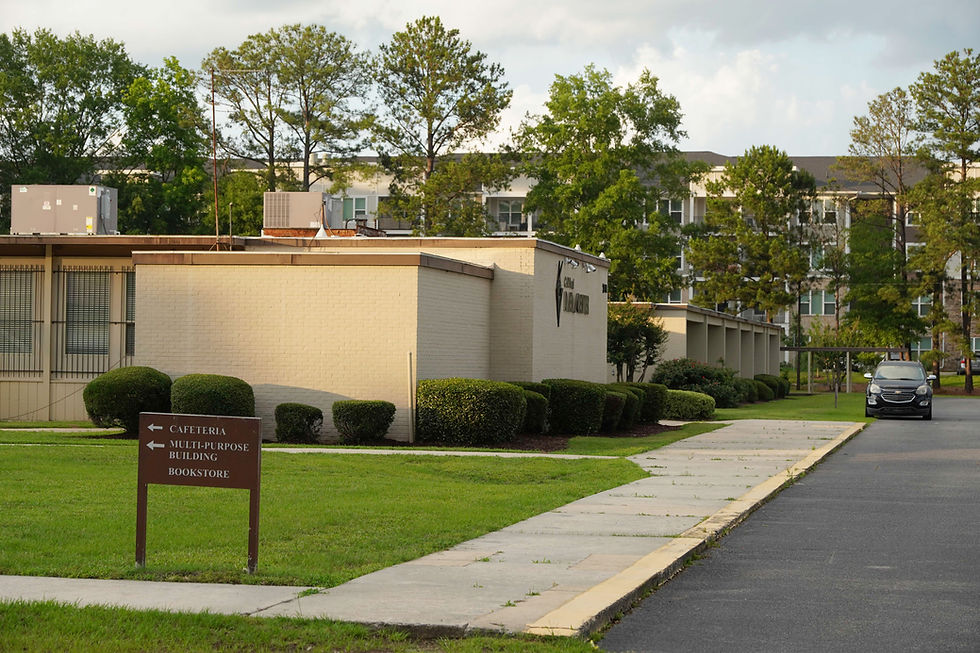
Jackson also placed the current development in a longer history.
During the Congaree Pointe meeting, he recalled community opposition years earlier to locating unwanted uses along Bluff Road.
He talked about the area once being dismissed as swamp or empty land and pointed to the coming marketplace, health center, sheriff’s substation and other investments as evidence of how much had changed.
He talked about sidewalks and a future in which residents could walk from their neighborhoods toward Bluff Road, healthcare, businesses and other amenities.
That vision is now backed by substantial public investment.
The question repeatedly raised by residents was not whether southeast Columbia deserves those things.
Their question was considerably more personal:
Will they still belong to the community when the vision is complete?
BUILDING A BETTER COMMUNITY WITHOUT BUILDING PEOPLE OUT
C.R. Neal Academy could give families another educational option.
The Station could bring healthcare, food access, public safety and opportunities for small businesses.
New housing could bring homeowners and investment.
New sidewalks could connect neighborhoods that have spent decades without basic pedestrian infrastructure.
None of those things, standing alone, establishes gentrification.
But concerns about displacement cannot be dismissed simply because development brings benefits.
Residents inside that meeting were saying something more complicated.
They want investment.
They want better schools.
They want stores.
They want sidewalks.
They want safer neighborhoods.
They want their children to earn enough money to buy a $250,000 house.
They also want the grandmother who bought her house decades ago to still be living next door when all of it arrives.
C.R. Neal Academy may make history when its doors open in 2027.
But the larger story unfolding around it is whether southeast Columbia can accomplish something communities across America have struggled to do:
Build a better neighborhood without building the existing neighborhood out of it.
CUBN will continue following the money, the land and the promises.

Javar Juarez is Publisher and Editor-in-Chief of the Columbia Urban Broadcast Network (CUBN), an independent investigative news outlet based in Columbia, South Carolina, and a member of the South Carolina Press Association. He is also President of the Capital City Chapter of the A. Philip Randolph Institute.


Comments