Sacred Ground, Contested Soil: The Robert Smalls Monument Breaks Ground at the South Carolina State House


A groundbreaking ceremony one hundred sixty-four years in the making. A bipartisan act of legislative will. And a political performance that cannot be mistaken for reconciliation.
By Javar Juarez | CUBNSC | South Carolina Statehouse
Before there was Harriet Tubman, there was Robert Smalls.
He rests today in the sacred soil of downtown Beaufort, next to Tabernacle Baptist Church — one of the oldest Black congregations in South Carolina — flanked on the other side by the Harriet Tubman Memorial. Hallowed ground. Earned ground.

He was nineteen years old when he commandeered a Confederate warship, sailed his family and a crew of enslaved people to freedom, and delivered military intelligence to the Union Army that helped shift the course of the Civil War. He returned to Beaufort to build public schools. He served five terms in the United States Congress. He co-founded the South Carolina Republican Party. And he wrote an epitaph so precise it still cuts.

The house where he was born into slavery still stands in downtown Beaufort — and in one of the most defiant acts of personal sovereignty this state has ever witnessed, Robert Smalls saved his money, returned to that same house as a free man, and bought it. He is buried steps away from it. His story does not merely pass through Beaufort. It is rooted there, in the earth, in the wood, in the stone — and as of today, it is coming to the State House grounds in bronze.

"My race needs no special defense, for the past history of them in this country proves them to be the equal of any people anywhere. All they need is an equal chance in the battle of life." - Robert Smalls
THE GROUNDBREAKING: ONE HUNDRED SIXTY-FOUR YEARS TO THE DAY

The ceremonial groundbreaking for the Robert Smalls Monument was convened Wednesday, May 13, 2026 — the 164th anniversary of the very day Robert Smalls piloted the CSS Planter out of Charleston Harbor and into Union lines.
Gerald Malloy, who chairs the monument's fundraising committee, did not let the date pass without note. "Today is the 164th anniversary of Robert Smalls' daring journey to freedom," Malloy told the assembled crowd on the State House lawn. "That lets us know that this is predestined. It is time."
The ceremony was organized by the South Carolina Department of Administration, whose director Mike Shealy chairs the monument commission. Shealy announced from the podium that all required legislative approvals have now been secured — a journey nearly as improbable, in its own way, as the one Smalls made in 1862.

Under Act 77 of 2007, the General Assembly placed a moratorium on all new memorials on the State House grounds.
To add a monument, a formal exception had to be carved through the State House Committee, requiring proof that the subject represented, in the language of the statute, "enduring, significant historical contributions, achievements or accomplishments." The commission satisfied that standard.
The legislature passed Act 183 in 2024 — 99 to 0 in the House, 44 to 0 in the Senate — authorizing the Smalls monument. Governor Henry McMaster signed it on May 20, 2024.

The legislation's primary House sponsor was Republican Representative Brandon Cox. The path from idea to enacted law was not quick. "This thing started January of 2023," Cox explained. "Last day of session in the Senate in 2023. Last day of session in the Senate in 2024. Last day in 2025 in the State House committee. And then we got the concurrent resolution out midstream this year."
All legal paperwork is now complete. The commission has entered the fundraising phase.
FROM BEAUFORT TO THE STATE HOUSE GROUNDS: SENATOR MARGIE BRIGHT MATTHEWS

If there is a figure in South Carolina public life whose personal geography makes her uniquely situated to speak on Robert Smalls, it is Senator Margie Bright Matthews of Senate District 45. She represents the district that contains Smalls' birthplace, his church, and his final resting place — all in downtown Beaufort.
"For far too long, the contributions of Black South Carolinians were overlooked, minimized, or left out entirely from the public spaces of power in this state. But not today." — Sen. Margie Bright Matthews
"Beaufort is immensely proud of our son, Robert Smalls," Matthews told this reporter in remarks following the program. "Can you imagine, at his age, the courage it took? It was not only his life he was risking, but it was also his immediate family and other family members. If he had been caught, of course, he would have been lynched and killed."
Matthews also spoke directly to the tension between the ceremony unfolding on the State House lawn and the redistricting vote that had taken place in the chamber just one day before. "It took courage," she said, "courage of five members of the Republican Party to do what was right — not for Washington, not for Donald Trump — but to do what they felt was right for the state of South Carolina."
Matthews was also clear about the practical stakes of the monument itself.
Public education in South Carolina, she reminded the crowd, would not exist in its present form without Robert Smalls. He was among its architects during Reconstruction.
To allow the State House grounds to stand for generations with Ben Tillman and Wade Hampton honored in bronze while the man who built the public school system was absent from the record was not merely an omission — it was a lie told in stone.
"Monuments matter," she said. "They tell us who we value. They tell us whose stories deserve to be remembered. And they tell future generations what kind of courage and leadership we choose to honor."
A GENERATION THAT CAN SEE ITSELF: JERMAINE JOHNSON

Democratic gubernatorial candidate Jermaine Johnson, whose own journey from the College of Charleston to a campaign for the governor's mansion traces a path not entirely unlike the arc of Smalls' own improbable rise, was present for the ceremony and spoke with CUBN alongside Representative Cox.
"For young people to be able to see themselves on the State House grounds — it will let them know that this is a place that they can call home," Johnson said. "That they have been invited here, that they are welcome here."
When asked whether he draws a connection between his own journey and Smalls' legacy, Johnson did not deflect.
It was this reporter who posed the frame — Robert Smalls was nineteen years old when he commandeered the CSS Planter, a Confederate military vessel, navigated it past Confederate checkpoints in Charleston Harbor using the captain's known signals, and delivered himself, his family, his crew, and a ship full of military intelligence directly to the Union Navy.
Johnson received it without hesitation. "Mine pales in comparison to what he had to overcome. But what I always tell myself — and what I tell other young people — is: if he can do it, we can do it.
If he was able to overcome all those obstacles, we can surely work hard to achieve the American dream."
THE PITCH MAN: SENATOR GERALD MALLOY AND THE CALL TO COMMUNITY INVESTMENT

If the Robert Smalls Monument is going to become a physical reality on the State House grounds, it will not be done with public funds. This is the hard truth beneath the ceremony, and former Senator Gerald Malloy — who served twenty-two years in the South Carolina Senate — is clear-eyed about it.
"It has to be done with private money," Malloy said plainly. "I had 22 years in this body. It pales in comparison. It is nothing compared to what Robert Smalls did." In that spirit, Malloy announced his personal commitment: a contribution of twenty-five thousand dollars — roughly a thousand dollars for every year he served in the Senate, and then some.
The total budget for the monument is estimated between one and two million dollars. Malloy put that figure in deliberate context, noting that South Carolina operates on a budget of approximately $15 billion. "We have an opportunity," he said, "to put a little bit of resources together to shape the history of the state of South Carolina."
Sculptor Basil Watson — whose prior work includes pieces at the University of South Carolina — has been selected to execute the monument. The South Carolina Department of Administration is processing the contractual paperwork. The commission has begun accepting public donations.

Malloy issued a direct challenge to every member of the General Assembly: match the moment with money. "I've already sent most of them letters as to what their contribution should end up being," he said. But his appeal reaches further than the legislature. He wants every South Carolinian — and particularly every Black South Carolinian — to understand what is at stake.
The grounds of the State House have honored Wade Hampton and Ben Tillman — architects of the Redeemer era, the post-Reconstruction terror that violently stripped Black South Carolinians of the rights Smalls had fought to secure — for generations.
Those monuments were not built with reluctance. They were built with conviction, with collective will, and with money. If Robert Smalls is to stand permanently among them — not as a footnote, but as a giant — it will require that same collective conviction from the community he represented.
"We want to end up having a showpiece here in South Carolina that will be long remembered. And what you will remember by this day: you were a part of it." — Sen. Gerald Malloy
To contribute, visit: admin.sc.gov/robertsmalls
THE UNCOMFORTABLE TRUTH: PERFORMANCE IS NOT RECONCILIATION

The State House yard was full. Press, members of the public, legislators, constitutional officers. Fox News was there. By the visible measure of attendance, this was a significant occasion. And it was. Robert Smalls deserves every bit of it, and more.
But what was also present cannot go unnamed: contradiction.
The same legislative session that produced this bipartisan ceremony of unity also produced, just the day before, a Republican-led effort in the House chamber to redraw congressional district maps in a manner that would dilute the political power of approximately 400,000 Black voters.
The districts at issue are politically gerrymandered — not unconstitutionally racially gerrymandered, a distinction that matters legally and constitutionally — but the intent of the House effort was unmistakable to anyone paying attention.
Standing behind the podium at this groundbreaking was Lieutenant Governor Pamela Evette.
Her presence is noted not to diminish the moment — Robert Smalls is bigger than any individual who showed up to be photographed near his name.
It is noted because the public record must reflect the full picture.
Lieutenant Governor Evette has aligned herself, politically and rhetorically, with an agenda antithetical to the principles Robert Smalls embodied: equal access to the ballot, public education, full citizenship, and freedom from political violence and suppression.
The courage that Senator Bright Matthews invoked — the courage of five Republican senators who voted their conscience against pressure from Washington and the White House — is courage that Lieutenant Governor Evette has not demonstrated.

A smile for the cameras and a shovel in the ground do not constitute a reckoning with the legacy of the man being honored. They do not constitute an apology for the policies being advanced in the same building on the same days. And they should not be received as such.
Robert Smalls understood this dynamic intimately.
He served in the South Carolina legislature alongside men who wanted him removed from public life. He went to Congress alongside men who voted to strip him of his citizenship. He did not mistake their presence in the same room for their conversion to his cause.
He kept building, kept fighting, kept serving — and he wrote his epitaph knowing exactly what his people would still face after he was gone.
This monument is not a reconciliation. It is a record.
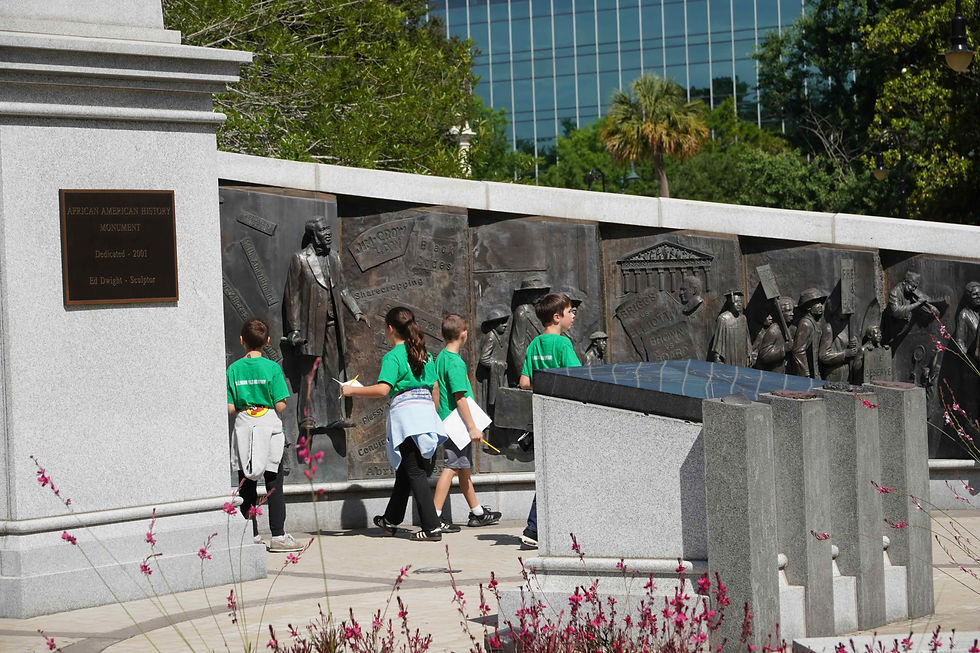
It is a statement that this man existed, that he mattered, that his story is part of South Carolina's story whether those in power prefer it or not.
The people who truly honor Robert Smalls are not the ones who stood at the podium today — they are the ones who will stand at the monument when it is built, who will tell their children what he did, who will vote, who will run for office, who will refuse to be reduced.
That story will be told whole.

Javar Juarez is an award winning investigative journalist and publisher at the Columbia Urban Broadcast Network (CUBNSC), an independent news outlet covering South Carolina politics, civic affairs, and community issues. He serves as President of Capital City A. Philip Randolph Institute (APRI) in South Carolina, where he leads grassroots civic engagement and organizational advocacy. His reporting is rooted in Black American history and the political landscape of the American South.
