Jim Crow Politics Cannot Survive a Boycott Economy
- Javar Juarez

- May 13
- 7 min read

A Call to Action for Black Leaders, Clergy, Civil Rights Organizations, and Concerned Citizens of South Carolina on the Imminent MAGA-Aligned Redistricting of the Sixth Congressional District
By Javar Juarez | Publisher & Editor-in-Chief, Columbia Urban Broadcast Network (CUBN) | President, Capital City Chapter, A. Philip Randolph Institute (APRI), South Carolina
They have made their intentions plain.
Governor Henry McMaster, empowered by a Freedom Caucus whose loyalty runs not to South Carolina but to Mar-a-Lago, is preparing to call the General Assembly back into special session — past May 14th — for a single purpose: to carve Black voters out of South Carolina's Sixth Congressional District using maps drawn by Adam Kincaid, the same architect behind the most aggressive Republican gerrymandering efforts in the nation.
Make no mistake about what this is. This is not legislative maneuvering. This is not procedural housekeeping. This is a coordinated, MAGA-aligned effort to make Richland County — one of the highest concentrations of African American political, economic, and intellectual power in the entire state — governable by those who have never governed in our interest and never intend to.
The Stakes

People in Richland County do not always recognize how much they have relative to the rural communities that MAGA truly governs — those districts where civil society has been hollowed out, where economic infrastructure has been stripped bare, where the machinery of democracy runs cold and rusted. The capital is land and milk and honey. It is creative energy and labor and intellectual weight. It is the seat of institutional power in this state.
And they want it.
They believe, as oppressors always have, that we can be moved. Redrawn. Diluted. Scattered into districts where our numbers do not reach the threshold of consequence.
They believe that if they draw the lines correctly, they can build a Trumpian, Jim Crow economic architecture in which our labor funds a system designed to exclude us from its governance.
They are wrong.
But they will not discover that error through litigation alone. Courts move slowly. Appeals accumulate. Maps take effect before remedies arrive. We have lived this.
The contradictions between the U.S. Supreme Court's own rulings — Alexander v. South Carolina State Conference of the NAACP and Louisiana v. Callais — tell us precisely how unstable legal protection has become under this court majority.
We cannot afford to place our votes, our voices, and our lives entirely in the hands of institutions that have already shown us what they value.
What Has Already Happened

H.5684 — the Republican redistricting bill — and its companion legislation H.5683, which targeted primary filing deadlines to disadvantage challengers to any new maps, failed to clear the General Assembly before the session deadline. That was a victory. But it was not the end.
Governor McMaster is now expected to call the legislature back into special session specifically to pass redistricting using Kincaid's maps, bypassing the normal legislative calendar.
Freedom Caucus-aligned members of the General Assembly have signaled they are prepared to deliver the votes.
Richland County — home to Columbia, Fort Jackson, the University of South Carolina, and one of the largest concentrations of Black voters in the state — is the central target.

The Sixth Congressional District, currently represented by leadership that reflects and serves Black South Carolina, would be fundamentally restructured to dilute that power and transfer it to a MAGA-aligned political machine that has earned none of it.
The official names of the co-sponsors are as follows:
Reps. Rankin, Pace, Huff, Martin, Bailey, Edgerton, Yow, Pedalino, Ligon, Long, B. Newton, Hiott, Oremus, Chapman, Kilmartin, Burns, Duncan, T. Moore, D. Mitchell, Frank, Morgan, Caskey, Magnuson, Cromer, Gilreath, Hartz, Lastinger, McCravy, Harris, Whitmire, Gibson, Chumley, Hewitt, Forrest, Hixon, Pope, Sanders, G.M. Smith, White and Wooten.
The Mandate
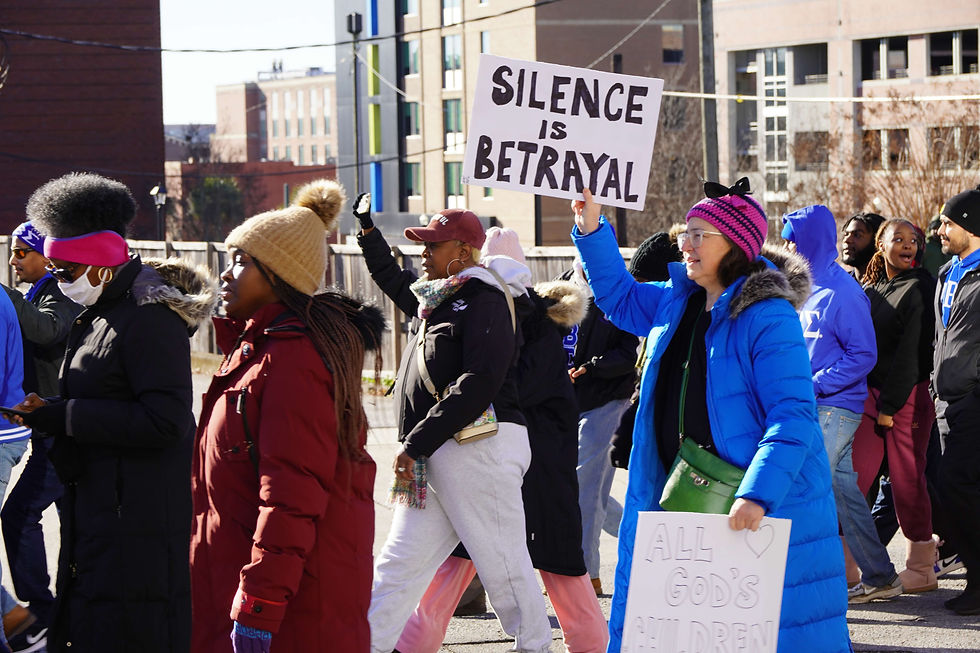
Because they have demonstrated they will not hear us through ordinary channels — because law enforcement has too often been deployed in service of their political interests rather than ours — we must speak in the only language that commands their full, undivided attention in the state of South Carolina.
We must speak in dollars.
An embargo — a coordinated, organized withdrawal of Black economic participation from businesses, institutions, and commercial interests aligned with those who seek to disenfranchise us — is not a radical act. It is a constitutionally protected, historically proven, and morally sound instrument of nonviolent resistance.
From the Montgomery Bus Boycott to the Birmingham Campaign, from the grape boycotts of César Chávez to the international sanctions that helped bring down apartheid South Africa, economic pressure has always been the lever that moved mountains when marches alone could not.
Nothing moves the South Carolina General Assembly like the Almighty Dollar. Let us remind them that the dollar they covet runs through us.
What an Embargo Looks Like in Practice
We want to be clear about what we are asking — and what we are not asking.
Grocery shopping at your nearest major retailer — including Walmart, Target, and large grocery chains — is not where this fight is won or lost.
The truth is that grocery is a near-zero-margin business for these corporations. They do not profit meaningfully from your food purchases. Do not let anyone tell you that you must go hungry or travel unreasonable distances to participate in this movement. Feed your family. Get your medicine. Take care of your household.
What we are asking you to withdraw is everything else.
The electronics. The clothing. The home goods. The seasonal items. The impulse purchases. The unnecessary extras that line the margins of these corporations and, by extension, fund the political ecosystem that makes MAGA redistricting possible.
College sports — including SEC games and state university athletics — are part of that ecosystem.
Do not buy the tickets. Do not fill the stadiums. Do not fund the machine that funds our erasure.
The one exception is clear: support your HBCUs. Support Claflin, Benedict, Allen, South Carolina State, and Voorhees without reservation.
Those institutions were built for us and have always stood with us.
Extend that same discipline to concerts, festivals, and large ticketed events tied to corporations or entertainers who have chosen silence or complicity in the face of what is happening to us. Your presence is currency. Spend it wisely.
Every dollar you do not spend on a non-essential item at a corporation aligned with or indifferent to our disenfranchisement is a dollar that stays in your community, in your household, in your control.
It will increase your savings.
It will reduce your debt.
It will have a measurable, positive impact on your credit.
It will reduce the stress that comes from living beyond your means in a society that has spent decades convincing you that consumption is identity.
It will return power to you — real, tangible, daily power — because there is something you can do, and it begins at home, right now, with every purchase you choose not to make.
For too long, we have lived in a society that places emphasis on material things over the content of one's character and the strength of one's community. The hyper-individualism that COVID accelerated — and that Trump 2.0 has actively cultivated as a substitute for collective civic life — has separated us from one another at precisely the moment we most need to be together.
It is time to return to the collective.
It is time to remember that we were always stronger together than apart, and that the communities which have endured the longest in this country did so not through individual consumption but through collective care.
We Call On All Black Leaders, Clergy, Organizations, and Concerned Citizens To:
I. Organize immediately. Convene emergency sessions in every Black church, NAACP chapter, civic organization, fraternity, sorority, and community hall in Richland County and across South Carolina. The struggle will not wait for a convenient calendar.
II. Issue a unified economic embargo. Identify and publicly name businesses, donors, and commercial interests that have funded or vocally supported MAGA redistricting efforts. Withdraw non-essential patronage. Redirect Black dollars toward Black-owned and community-aligned institutions wherever possible.
III. Descend on the State House. Mass presence at the South Carolina State House is non-negotiable. When the Governor calls this session, we must already be there — visible, organized, and unified across denominational, organizational, and political lines.
IV. Demand accountability from every elected Democrat. No Democrat — state or federal — receives our enthusiastic organizational support without a public, on-record commitment to fight this redistricting by every procedural and legal means available.
V. Unite across every difference. Put aside the divisions they have cultivated between us — denominational, generational, organizational, personal. The struggle is not static. The conditions they have created are dynamic. Our response must be equally dynamic.
A Final Word
They believe that because they have drawn lines before — because they have moved Black people before, literally and figuratively — they can do it again without consequence. They are counting on our disorganization. They are counting on our exhaustion. They are counting on our silence.
We will not give them our silence.
Individuals who believe they can bully nearly a million people across Richland County and South Carolina's Sixth Congressional District need to understand the hard way that there has never been, and will never be, a time when we succumb to Trumpism and the manufactured grievances of those who cannot imagine a democracy that includes us as equals.
James E. Clyburn held that seat because Black South Carolina built the coalitions that made it possible. What has been built can be defended. What has been defended can be extended. But only if we move — together, now, with everything we have.
There is no machine without us. There is no economy without us. There is no opportunity without us. There is no democracy without us.
Javar Juarez is the Publisher and Editor-in-Chief of the Columbia Urban Broadcast Network (CUBN), an independent investigative news outlet covering South Carolina politics, civic affairs, and community accountability. He is also President of the Capital City Chapter of the A. Philip Randolph Institute (APRI) in South Carolina.


Comments