Federal Judge Rejects Richland County’s Bid to Kill WOG CDC Lawsuit; Civil-Rights Conspiracy Claim Survives


A federal Judge says WOG alleged “concrete supporting facts” and rules that Richland County’s alleged system of council member “veto power” may provide a personal incentive for officials to join an unlawful conspiracy.
CUBNSC Reported the Warning Months Ago
By Javar Juarez | CUBNSC | August 13, 2026
Columbia, S.C. - For nearly a year, CUBNSC has followed the allegations surrounding WOG CDC’s attempt to purchase and redevelop Dutch Square Mall—and the closed-door process that plaintiffs say killed the project before it ever received a public hearing.
In October 2025, CUBNSC reported that the federal lawsuit described a sweeping redevelopment proposal intended to transform the aging mall into a center for film and animation production, technology training, education, entertainment, hospitality, retail and workforce development.
The lawsuit alleged that WOG entered into a contract to purchase Dutch Square Mall in August 2023. The original purchase price was $14 million before being reduced to approximately $12.99 million. The proposed redevelopment was projected to exceed $100 million in value.
According to the plaintiffs, the project could not be completed economically without the kinds of hospitality-tax funding and property-tax abatements that Richland County had made available to other developers.
But WOG alleges it was never given equal access to that process.
As CUBNSC previously reported, council member Allison Terracio allegedly refused to bring the proposal before the full County Council because of WOG’s religious affiliation and her interpretation of the separation of church and state.
The complaint says Terracio communicated that position during a recorded Zoom meeting.
WOG then contacted other council members and county officials, allegedly warning them that excluding a religiously affiliated organization from an otherwise available economic-development process would be unconstitutional.
The project still did not receive full consideration.
The lawsuit alleges that the Council subsequently entered a closed executive session and maintained the decision not to consider WOG’s proposal. According to the complaint, the project then “died on the vine.”
Richland County has denied wrongdoing.
The Closed-Door Meeting at the Center of the Case
In December 2025, CUBNSC reported on allegations that an internal poll may have occurred during a July 2, 2024 executive session.
The central question was straightforward: Did members of Richland County Council privately coordinate to block the Dutch Square proposal after being informed that the stated religious justification was allegedly unconstitutional?
CUBNSC reported then that the County appeared particularly determined to eliminate WOG’s §1985(3) conspiracy claim before factual development could expose what occurred in the closed meeting.
That is the precise claim Judge Lewis has now allowed to survive.
In its motion, Richland County characterized WOG’s conspiracy allegations as conclusory and legally insufficient.
Judge Lewis described that argument as having been made “rather cursorily.”
She found that the County failed to challenge three of the five required elements of a §1985 claim “in any particularized way.” Those elements, the judge wrote, were “easily satisfied by the Complaint.”
The court then addressed the two elements the County did meaningfully contest: the existence of a conspiracy and an overt act committed in furtherance of that conspiracy.
The alleged executive session and the resulting refusal to consider the Dutch Square proposal were sufficient at this stage, the judge ruled, to support both elements.
According to the order, WOG alleges that the remaining council members and county actors knew about Terracio’s alleged reasoning, were warned that it was unconstitutional and nevertheless accepted that reasoning when the project was denied.
“This allegation the rest of the council members and defendants were aware of and accepted Terracio’s motive and reasoning for denying the project is sufficient joint conduct to allege a conspiracy to deprive Plaintiffs of their constitutional rights,” Judge Lewis wrote.
The County’s Immunity Argument Runs Into Its Own Alleged Power Structure
Richland County also argued that its council members and employees could not conspire with one another because they were all agents of the same government.
That defense is based on the “intracorporate conspiracy doctrine,” which generally provides that an organization cannot legally conspire with itself through employees acting within their official roles.
Judge Lewis agreed that the doctrine can apply to a municipality and a §1985 claim.
But that was not the end of the analysis.
Federal law recognizes exceptions when an alleged conspirator has a personal stake independent of the organization or acts outside the authority granted by the organization.
WOG argued that Richland County’s 11 independently elected council members have separate constituencies, political interests and individual decision-making authority.
The court found that argument plausible enough to require further factual development.
The deciding issue may be an alleged Richland County “custom and practice” that CUBNSC has repeatedly examined: major proposals are purportedly prevented from reaching the full Council unless the council member representing the affected district agrees to bring them forward.
Dutch Square Mall is located in Terracio’s District 5 which runs along the Broad River Corridor.
Judge Lewis wrote that this alleged practice may have afforded “effective veto power to individual council members.”
That power structure, she reasoned, may have given each council member a personal incentive to protect the system. By respecting another member’s control over projects within that member’s district, each council member could preserve the same control within his or her own district.
In other words, the County’s alleged system of councilmanic deference may become part of the evidence supporting WOG’s conspiracy claim.
“Such a policy—affording effective veto power to individual council members—might contribute to each council member’s decision to respect the policy so as to preserve their own power,” Judge Lewis wrote.
The court determined that it is too early to decide whether the officials are protected by intracorporate immunity. Documents, testimony and other evidence will be needed to establish whether the council members possessed a sufficiently independent political or personal stake.
The County’s Attack on the Complaint Also Failed
Richland County asked the court to dismiss WOG’s complaint with prejudice on the grounds that it was excessively long, unclear and noncompliant with federal pleading rules.
Alternatively, the County wanted WOG ordered to rewrite the complaint and provide a more definite statement.
Judge Lewis rejected both requests.
The judge acknowledged that some of the allegations were “needlessly lengthy or wholly unnecessary” and could have been more specific. But she concluded that the complaint concerns legally and factually complex constitutional claims and remains sufficiently clear for the defendants to answer.
The complaint, she wrote, is “both tolerable to the Court and sufficiently precise as to allow Defendants to answer.”
That ruling directly undercuts the procedural argument highlighted in Richland County’s October 2025 motion.
The court has now determined that those allegations are sufficiently pleaded to continue.
What Richland County Did Win
The order was not a complete victory for WOG.
Judge Lewis dismissed the claims against the individual defendants in their official capacities because those claims duplicated the case against Richland County itself.
However, the claims against those same officials in their individual capacities remain.
The distinction is important.
Council members and county officials named personally have not been removed from the litigation.
The court also dismissed WOG’s demand for punitive damages against Richland County because municipalities generally cannot be held liable for punitive damages under the applicable law. The order did not dismiss the punitive-damages demand against the individual defendants.
Finally, the court directed the clerk to identify Richland County—not “Richland County Council”—as the proper governmental defendant.
WOG had substantially agreed to each of those changes before the ruling.
None of them eliminates an underlying constitutional cause of action.
What the Decision Does Not Mean
Wednesday’s order does not declare WOG the final winner of the lawsuit.
It does not establish that Terracio discriminated against the plaintiffs, that the full Council entered into a conspiracy or that the alleged district-veto practice ultimately defeats the County’s immunity defense.
No damages have been awarded, and no injunction has been entered.
Those questions will depend on evidence.
But that is exactly why this ruling matters.
Richland County attempted to end the case before the disputed facts could be fully examined. Instead, the court found that WOG alleged enough facts for the central civil-rights claims to remain alive.
The case can now move deeper into the part of federal litigation where internal communications, testimony, meeting records and the motives behind official decisions may become critical.
CUBNSC reported in April that the court’s existing schedule contemplated discovery, depositions, mediation and a potential jury trial. Under that schedule, discovery was set to continue through September 29, 2026, with mediation required by December 14 and the case potentially eligible for trial beginning in February 2027.
As CUBNSC wrote when that schedule was entered, the ultimate question is not simply whether the Dutch Square proposal was a good project.
The question is whether the process used to block it was lawful.
What Comes Next
For years, Dutch Square Mall has reflected the lack of investment along the Broad River corridor. WOG’s lawsuit now raises questions about how Richland County handled a proposal that promised to bring new development to the site.
The case could shed light on why the proposal never reached the full County Council, what council members discussed behind closed doors, and whether an informal system of district-level control allowed one elected official to halt the project without public consideration. It may also clarify what role, if any, the proposal’s religious affiliation played in the county’s decision.
Richland County sought to have the case dismissed. A federal judge’s ruling allows key claims to move forward, giving WOG an opportunity to pursue answers through the legal process.
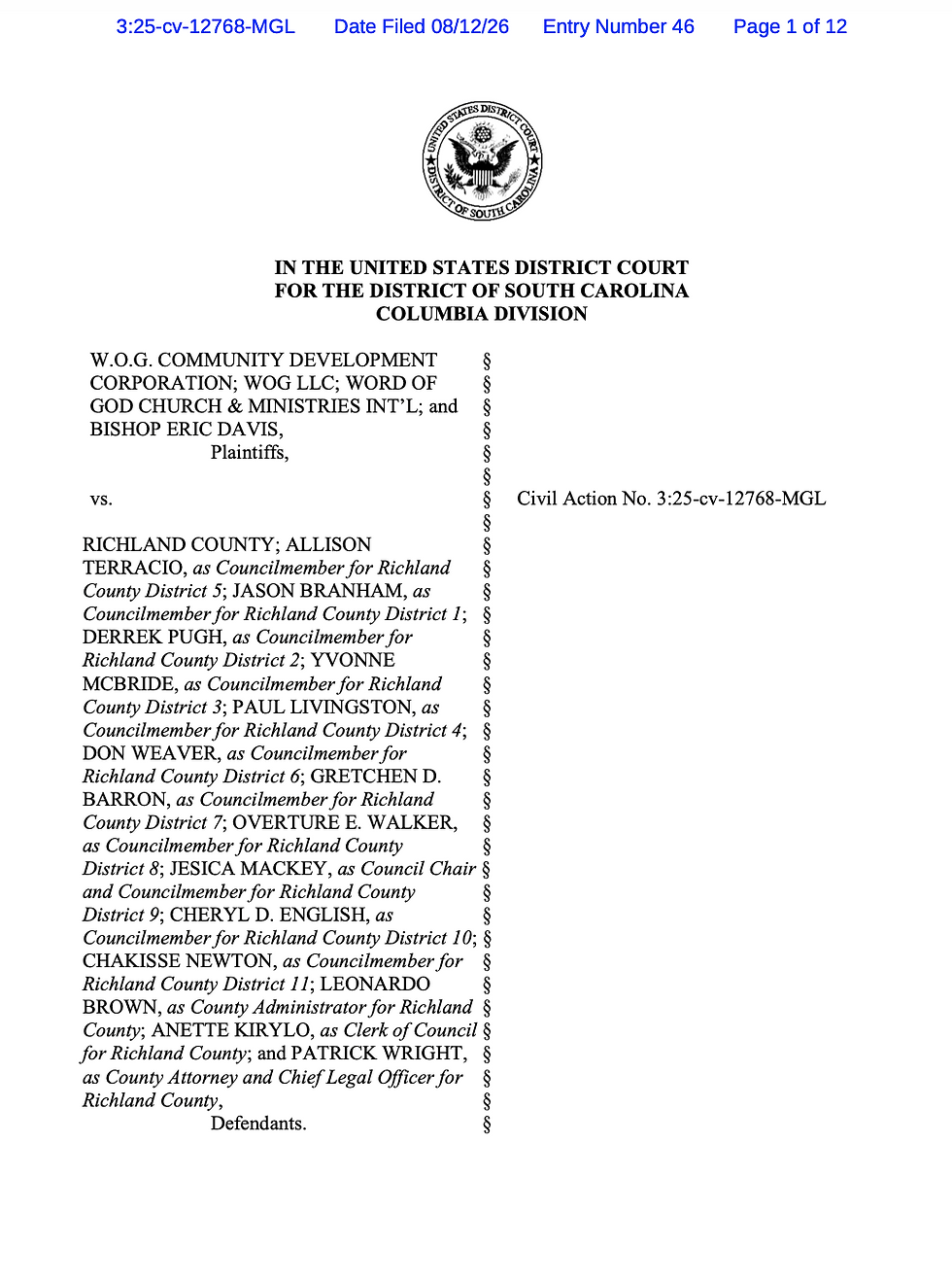
CUBNSC will continue reviewing the court filings and reporting on significant developments in the case. Link to Filing:

Javar Juarez is Publisher and Editor-in-Chief of the Columbia Urban Broadcast Network (CUBN), an independent investigative news outlet based in Columbia, South Carolina, and a member of the South Carolina Press Association. He is also President of the Capital City Chapter of the A. Philip Randolph Institute.


